FY--12-31false00018237945 Yearshttp://fasb.org/us-gaap/2025#RevenueFromContractWithCustomerIncludingAssessedTaxhttp://fasb.org/us-gaap/2025#RevenueFromContractWithCustomerIncludingAssessedTaxhttp://fasb.org/us-gaap/2025#RevenueFromContractWithCustomerIncludingAssessedTaxhttp://fasb.org/us-gaap/2025#Liabilitieshttp://fasb.org/us-gaap/2025#LiabilitiesDecember 31 2025December 31 2025December 31 2027http://fasb.org/srt/2025#BoardOfDirectorsChairmanMember http://fasb.org/srt/2025#ChiefExecutiveOfficerMember http://fasb.org/srt/2025#PresidentMember0001823794us-gaap:RetailMember2025-01-012025-12-310001823794us-gaap:RetainedEarningsMember2023-01-012023-12-310001823794stpr:TX2025-01-012025-12-310001823794us-gaap:OperatingSegmentsMemberarko:WholesaleMember2025-01-012025-12-310001823794arko:SeriesARedeemableTemporaryEquityMember2020-12-140001823794us-gaap:SeniorNotesMember2024-12-310001823794arko:TransitEnergyGroupMember2023-03-012023-03-010001823794srt:ParentCompanyMember2024-12-310001823794arko:OtherEquipmentMembersrt:MinimumMember2025-12-310001823794arko:OptionToAcquireOwnershipRightsMember2025-12-310001823794us-gaap:ForeignCountryMember2025-12-3100018237942024-12-310001823794us-gaap:OperatingSegmentsMember2023-01-012023-12-310001823794us-gaap:TradeNamesMember2025-12-310001823794us-gaap:RestrictedStockUnitsRSUMemberarko:NonEmployeeDirectorsMember2024-01-012024-12-310001823794arko:NewIsraeliShekelsMember2025-12-310001823794srt:MinimumMemberarko:HaymakerMember2025-12-310001823794us-gaap:AccumulatedOtherComprehensiveIncomeMember2023-12-3100018237942025-12-310001823794arko:FleetFuelingMemberus-gaap:SubsequentEventMember2026-01-012026-01-010001823794us-gaap:ProductAndServiceOtherMember2023-01-012023-12-310001823794us-gaap:RetailMember2024-12-310001823794us-gaap:RelatedPartyMember2025-12-310001823794us-gaap:PublicUtilitiesInventoryFuelMember2025-12-310001823794arko:TransitEnergyGroupMember2023-03-010001823794arko:ExpressStopMember2025-01-012025-12-310001823794arko:DealersMember2025-12-310001823794us-gaap:ProductAndServiceOtherMemberarko:WholesaleMember2024-01-012024-12-310001823794us-gaap:PublicUtilitiesInventoryFuelMember2024-12-310001823794us-gaap:AccumulatedOtherComprehensiveIncomeMember2024-01-012024-12-310001823794arko:OtherProductMember2023-01-012023-12-310001823794arko:CapitalOneLineOfCreditMember2025-01-012025-12-310001823794arko:GpmpMemberus-gaap:OperatingSegmentsMember2023-01-012023-12-310001823794arko:GpmpMember2025-12-310001823794arko:MerchandiseProductsMember2024-01-012024-12-310001823794arko:CapitalOneLineOfCreditMembersrt:MaximumMemberarko:AlternateBaseRateMember2025-01-012025-12-310001823794arko:GpmpMemberarko:MerchandiseRevenueMember2025-01-012025-12-310001823794srt:MaximumMember2025-01-012025-12-310001823794us-gaap:IntersegmentEliminationMember2023-01-012023-12-310001823794us-gaap:RetailMembersrt:FuelMember2023-01-012023-12-310001823794arko:MTTermLoansMemberarko:DueOnNovemberTenTwoThousandTwentyEightMember2025-01-012025-12-310001823794us-gaap:RetailMember2025-12-310001823794arko:DomesticStateNOLMember2025-12-310001823794arko:RestrictedStockUnitsAndPerformanceStockUnitsMember2023-01-012023-12-310001823794arko:FinancingCostsMember2025-12-310001823794arko:GpmpMembersrt:FuelMember2025-01-012025-12-310001823794us-gaap:OperatingSegmentsMemberarko:WholesaleMember2024-01-012024-12-310001823794arko:MerchandiseInventoryMember2025-12-310001823794stpr:TN2023-01-012023-12-310001823794us-gaap:AdditionalPaidInCapitalMember2025-01-012025-12-310001823794arko:MerchandiseRevenueMemberarko:WholesaleMember2024-01-012024-12-310001823794us-gaap:CommonStockMember2025-01-012025-12-310001823794arko:PNCLinesOfCreditMember2025-12-310001823794us-gaap:IntersegmentEliminationMemberus-gaap:AllOtherSegmentsMember2025-01-012025-12-3100018237942022-12-3100018237942025-10-012025-12-310001823794us-gaap:ProductAndServiceOtherMemberus-gaap:AllOtherSegmentsMember2023-01-012023-12-310001823794srt:FuelMember2023-01-012023-12-310001823794arko:EmpireAcquisitionMember2024-12-310001823794arko:EmpireAcquisitionMember2023-12-310001823794arko:PNCLinesOfCreditMembersrt:MaximumMemberarko:AlternateBaseRateMember2025-01-012025-12-310001823794arko:RestrictedStockUnitsAndPerformanceStockUnitsMember2025-01-012025-12-310001823794srt:MinimumMemberus-gaap:ForeignCountryMember2025-01-012025-12-310001823794arko:FinancingCostsMember2024-01-012024-12-310001823794arko:EmpireAcquisitionMember2020-10-060001823794arko:RestrictedStockUnitsRsusAndPerformanceSharesMember2024-01-012024-12-310001823794us-gaap:TreasuryStockCommonMember2023-01-012023-12-310001823794us-gaap:RedeemablePreferredStockMember2024-01-012024-12-310001823794arko:FleetFuelingMember2023-01-012023-12-310001823794arko:WholesaleMember2025-01-012025-12-310001823794us-gaap:MaterialReconcilingItemsMember2025-01-012025-12-310001823794arko:DeferredStockMember2025-01-012025-12-310001823794us-gaap:SeniorNotesMember2025-12-310001823794us-gaap:WarrantMemberarko:HaymakerMember2025-12-310001823794us-gaap:EmployeeStockOptionMember2024-01-012024-12-310001823794us-gaap:ParentMember2024-01-012024-12-310001823794arko:GpmpMember2024-01-012024-12-310001823794us-gaap:IntersegmentEliminationMemberus-gaap:AllOtherSegmentsMember2024-01-012024-12-310001823794arko:FuelProductsMemberarko:SupplierCMember2025-01-012025-12-310001823794arko:PrivateWarrantsMember2025-01-012025-12-310001823794us-gaap:DomesticCountryMember2025-12-310001823794arko:PrepaidIncentivesMember2023-12-310001823794arko:OtherIntangiblesMember2025-12-310001823794us-gaap:FairValueInputsLevel3Memberarko:AdditionalDeferredStockMemberus-gaap:MeasurementInputExpectedTermMember2025-12-310001823794arko:MTDebtMember2025-12-310001823794arko:ExpressStopMember2021-05-180001823794us-gaap:SeriesAPreferredStockMember2025-01-012025-12-310001823794arko:LigadInvestmentsAndConstructionLtdMember2025-01-012025-12-310001823794arko:MTEquipmentLineOfCreditMemberarko:UnusedFeeMember2025-12-310001823794arko:TransitEnergyGroupMember2023-01-012023-12-310001823794arko:FleetFuelingMember2025-12-310001823794srt:MinimumMemberarko:PncCreditAgreementMember2025-01-012025-12-310001823794arko:EquipmentInConvenienceStoresMembersrt:MaximumMember2025-12-310001823794us-gaap:RetailMemberus-gaap:OperatingSegmentsMember2024-01-012024-12-310001823794arko:PrivateWarrantsMember2024-01-012024-12-310001823794us-gaap:RetailMember2023-12-310001823794srt:MinimumMemberarko:OtherMTTermLoansMember2025-01-012025-12-310001823794us-gaap:NoncontrollingInterestMember2024-12-310001823794srt:ParentCompanyMember2024-01-012024-12-310001823794srt:FuelMemberus-gaap:AllOtherSegmentsMember2025-01-012025-12-310001823794us-gaap:IsraelTaxAuthorityMemberus-gaap:DomesticCountryMember2025-12-310001823794arko:EmpireAcquisitionMember2025-01-012025-12-310001823794srt:MaximumMemberus-gaap:FranchiseRightsMember2025-12-310001823794us-gaap:SeriesAPreferredStockMember2025-12-310001823794arko:MerchandiseRevenueMemberus-gaap:AllOtherSegmentsMember2024-01-012024-12-310001823794us-gaap:CommonStockMember2024-12-310001823794us-gaap:RetainedEarningsMember2023-12-310001823794us-gaap:DomesticCountryMember2025-01-012025-12-310001823794arko:PNCCreditLineAgreementMemberarko:GpmMemberus-gaap:SubsequentEventMembersrt:MaximumMember2026-02-120001823794arko:FuelProductsMemberarko:SupplierBMember2024-01-012024-12-310001823794us-gaap:ParentMember2025-01-012025-12-310001823794srt:MinimumMemberarko:CapitalOneLineOfCreditMember2025-01-012025-12-310001823794arko:FuelProductsMemberarko:SupplierBMember2023-01-012023-12-310001823794arko:OtherEquipmentMembersrt:MaximumMember2025-12-310001823794us-gaap:RedeemablePreferredStockMember2025-01-012025-12-310001823794us-gaap:IntersegmentEliminationMemberarko:WholesaleMember2025-01-012025-12-310001823794us-gaap:SecuredOvernightFinancingRateSofrOvernightIndexSwapRateMemberarko:CapitalOneLineOfCreditMembersrt:MaximumMember2025-01-012025-12-310001823794arko:CapitalOneLineOfCreditMemberarko:UnusedFeeMember2025-12-310001823794us-gaap:TradeNamesMember2025-12-310001823794srt:FuelMemberus-gaap:AllOtherSegmentsMember2024-01-012024-12-310001823794us-gaap:RetailMemberus-gaap:IntersegmentEliminationMember2024-01-012024-12-310001823794us-gaap:CommonClassAMemberarko:ARKOPetroleumCorpMemberus-gaap:SubsequentEventMember2026-02-132026-02-130001823794us-gaap:TradeNamesMemberarko:WtgFuelsHoldingsMember2025-01-012025-12-310001823794arko:SeriesARedeemableTemporaryEquityMember2024-12-310001823794arko:GpmpMemberarko:MerchandiseRevenueMember2023-01-012023-12-310001823794arko:BlueOwlMember2025-12-310001823794arko:RestrictedStockUnitsAndPerformanceStockUnitsMember2024-01-012024-12-310001823794arko:PerformanceBasedRestrictedStockUnitsMember2024-01-012024-12-310001823794arko:GpmpMember2023-12-3100018237942021-11-082021-11-090001823794arko:PublicAndPrivateWarrantsMember2025-01-012025-12-310001823794arko:GpmpMemberus-gaap:RevolvingCreditFacilityMember2024-03-260001823794arko:MerchandiseInventoryMember2024-12-310001823794us-gaap:SeniorNotesMember2024-12-310001823794arko:FuelProductsMemberarko:SupplierAMember2024-01-012024-12-310001823794arko:MTTermLoansMember2025-12-310001823794arko:OtherProductMember2025-01-012025-12-310001823794arko:FleetFuelingMember2025-01-012025-12-310001823794arko:PrivateWarrantsMember2025-12-310001823794us-gaap:RetainedEarningsMember2024-01-012024-12-310001823794arko:ForeignNOLMember2025-12-310001823794srt:MinimumMemberarko:EquipmentInConvenienceStoresMember2025-12-310001823794srt:MinimumMemberarko:CapitalOneLineOfCreditMemberarko:AlternateBaseRateMember2025-01-012025-12-310001823794us-gaap:RetainedEarningsMember2024-12-310001823794srt:ParentCompanyMember2022-12-310001823794arko:MTEquipmentLineOfCreditMemberus-gaap:SecuredOvernightFinancingRateSofrOvernightIndexSwapRateMember2025-01-012025-12-310001823794srt:ParentCompanyMember2025-01-012025-12-310001823794us-gaap:RetailMemberarko:MerchandiseRevenueMember2024-01-012024-12-310001823794arko:ExpressStopMember2025-12-310001823794us-gaap:SeriesAPreferredStockMember2021-12-310001823794us-gaap:RetailMember2024-01-012024-12-310001823794arko:GpmpMemberus-gaap:ProductAndServiceOtherMember2024-01-012024-12-310001823794arko:MTEquipmentLineOfCreditMemberarko:FixedRateMember2025-01-012025-12-310001823794arko:BuildingAndLeaseholdImprovementsMembersrt:MaximumMember2025-12-310001823794arko:WholesaleMember2023-01-012023-12-310001823794us-gaap:RetailMemberus-gaap:OperatingSegmentsMember2025-01-012025-12-310001823794us-gaap:RealEstateLoanMemberarko:GpmMember2025-04-012025-06-300001823794arko:PublicWarrantsMember2023-01-012023-12-310001823794arko:MTEquipmentLineOfCreditMemberus-gaap:SecuredOvernightFinancingRateSofrOvernightIndexSwapRateMemberarko:DueOnMayThirteenTwoThousandTwentyFiveMember2025-01-012025-12-310001823794arko:PerformanceBasedRestrictedStockUnitsMember2023-01-012023-12-310001823794arko:SeriesARedeemableTemporaryEquityMember2025-12-310001823794arko:FuelProductsMember2025-01-012025-12-310001823794arko:PNCCreditLineAgreementMemberarko:GpmMembersrt:MinimumMemberus-gaap:SubsequentEventMember2026-02-120001823794us-gaap:AdditionalPaidInCapitalMember2024-12-310001823794arko:EmpireAcquisitionMember2020-10-062020-10-060001823794us-gaap:ProductAndServiceOtherMember2024-01-012024-12-310001823794arko:FleetFuelingMember2024-01-012024-12-310001823794arko:GpmpMember2024-01-260001823794us-gaap:IntersegmentEliminationMemberarko:FleetFuelingMember2025-01-012025-12-310001823794arko:MTTermLoansMemberarko:DueOnJuneTenTwoThousandTwentySixMember2025-01-012025-12-310001823794us-gaap:FairValueInputsLevel3Memberus-gaap:MeasurementInputPriceVolatilityMemberarko:AdditionalDeferredStockMember2025-12-310001823794arko:OtherMTTermLoansMember2025-12-310001823794arko:GpmMemberarko:MTTermLoansMemberarko:AgreementWithMTBankMember2025-06-300001823794us-gaap:RetainedEarningsMember2025-01-012025-12-310001823794arko:WtgFuelsHoldingsMember2023-01-012023-12-310001823794arko:BlueOwlMember2025-01-012025-12-310001823794us-gaap:FairValueInputsLevel3Memberarko:AdditionalDeferredStockMemberus-gaap:MeasurementInputSharePriceMember2024-01-012024-12-310001823794us-gaap:AccumulatedOtherComprehensiveIncomeMember2023-01-012023-12-310001823794arko:OtherMTTermLoansMember2025-01-012025-12-310001823794arko:FuelCostMember2025-01-012025-12-3100018237942025-07-042025-07-040001823794arko:GpmMemberarko:AgreementWithMTBankMember2025-06-300001823794us-gaap:GeneralAndAdministrativeExpenseMemberarko:EmployeesAndBoardOfDirectorsMember2023-01-012023-12-310001823794arko:AdditionalDeferredSharesMember2024-12-310001823794arko:AmortizationExpenseMember2023-01-012023-12-310001823794arko:MTDebtMember2024-12-310001823794us-gaap:RetailMemberarko:MerchandiseRevenueMember2023-01-012023-12-310001823794arko:LotteryInventoryMember2024-12-310001823794arko:DomesticStateNOLMember2025-01-012025-12-310001823794arko:WtgFuelsHoldingsMember2025-01-012025-12-310001823794stpr:TX2024-01-012024-12-310001823794us-gaap:FranchiseRightsMember2025-12-3100018237942024-01-012024-12-310001823794arko:PublicWarrantsMember2024-01-012024-12-310001823794arko:RestrictedStockUnitsRSUAndPhantomShareUnitsPSUsMember2023-12-310001823794us-gaap:ForeignCountryMembersrt:MaximumMember2025-01-012025-12-310001823794arko:GpmMemberarko:AgreementWithMTBankMembersrt:MaximumMember2023-09-280001823794arko:PublicWarrantsMemberus-gaap:FairValueInputsLevel1Member2024-12-310001823794us-gaap:RetailMemberarko:MerchandiseRevenueMember2025-01-012025-12-310001823794arko:RestrictedStockUnitsRsusAndPerformanceSharesMember2023-01-012023-12-310001823794arko:RestrictedStockUnitsRSUAndPhantomShareUnitsPSUsMember2025-12-310001823794us-gaap:RestrictedStockUnitsRSUMemberarko:NonEmployeeDirectorsMember2024-12-310001823794srt:MaximumMemberarko:HaymakerMember2025-12-310001823794us-gaap:GeneralAndAdministrativeExpenseMemberarko:EmployeesAndBoardOfDirectorsMember2025-01-012025-12-310001823794arko:MTTermLoansMemberus-gaap:SecuredOvernightFinancingRateSofrOvernightIndexSwapRateMemberarko:DueOnNovemberTenTwoThousandTwentyEightMember2025-01-012025-12-310001823794arko:TransitEnergyGroupMember2025-12-310001823794arko:HaymakerMember2025-12-310001823794us-gaap:NoncontrollingInterestMember2024-01-012024-12-310001823794us-gaap:OperatingSegmentsMember2024-01-012024-12-310001823794arko:GpmpMemberus-gaap:RevolvingCreditFacilityMember2025-12-310001823794arko:MTEquipmentLineOfCreditMember2025-01-012025-12-310001823794arko:TransitEnergyGroupPurchaseAgreementAmendmentMemberarko:SecondInstallmentMember2024-03-262024-03-260001823794arko:PerformanceBasedRestrictedStockUnitsMember2025-01-012025-12-310001823794us-gaap:AdditionalPaidInCapitalMember2023-12-310001823794arko:FuelProductsMemberarko:SupplierAMember2025-01-012025-12-310001823794arko:OptionsToAcquireOwnershipRightsMember2025-12-310001823794us-gaap:EmployeeStockOptionMember2023-01-012023-12-310001823794us-gaap:AllOtherSegmentsMember2024-01-012024-12-310001823794us-gaap:SeniorNotesMember2025-01-012025-12-310001823794us-gaap:EmployeeStockOptionMember2025-01-012025-12-310001823794arko:ForeignCapitalLossMember2025-12-310001823794arko:TransitEnergyGroupPurchaseAgreementAmendmentMember2024-01-012024-12-310001823794arko:CommonClassAAndBMemberarko:ARKOPetroleumCorpMemberus-gaap:SubsequentEventMember2026-02-130001823794arko:PublicAndPrivateWarrantsMember2024-01-012024-12-310001823794srt:MaximumMemberarko:ComputersSoftwareAndLicensesMember2025-12-310001823794arko:SignsMembersrt:MaximumMember2025-12-310001823794srt:FuelMemberarko:FleetFuelingMember2023-01-012023-12-310001823794us-gaap:StateAndLocalTaxJurisdictionOtherMember2025-01-012025-12-310001823794arko:SeriesARedeemableTemporaryEquityMember2020-11-180001823794us-gaap:TreasuryStockCommonMember2024-01-012024-12-310001823794us-gaap:RetailMember2024-01-012024-12-310001823794arko:FuelEquipmentMembersrt:MinimumMember2025-12-310001823794arko:SeriesARedeemableTemporaryEquityMember2027-08-312027-08-310001823794arko:FinancingCostsMember2024-12-310001823794us-gaap:ProductAndServiceOtherMemberus-gaap:AllOtherSegmentsMember2024-01-012024-12-3100018237942023-05-310001823794us-gaap:WarrantMember2023-01-012023-12-310001823794srt:FuelMember2025-01-012025-12-310001823794arko:OtherProductMember2024-01-012024-12-310001823794arko:CapitalOneLineOfCreditMember2025-12-310001823794arko:EmpireAcquisitionMember2025-12-310001823794us-gaap:CustomerRelationshipsMember2024-12-310001823794us-gaap:SeriesAPreferredStockMember2020-11-180001823794arko:SeriesARedeemableTemporaryEquityMember2025-01-012025-12-310001823794arko:EmpireAcquisitionMember2023-01-012023-12-310001823794arko:MTEquipmentLineOfCreditMembersrt:MaximumMember2025-12-310001823794arko:GpmpMemberus-gaap:IntersegmentEliminationMember2025-01-012025-12-310001823794srt:MinimumMemberarko:ComputersSoftwareAndLicensesMember2025-12-310001823794arko:SpeedyAcquisitionMemberarko:ThirdPartyMember2023-08-152023-08-150001823794arko:AmortizationExpenseMember2025-01-012025-12-310001823794arko:DomesticFederalNOLMember2025-12-310001823794arko:GpmpMember2025-01-012025-12-310001823794arko:GpmMemberarko:MTTermLoansMemberarko:AgreementWithMTBankMember2025-05-130001823794arko:RestrictedStockUnitsAndPerformanceStockUnitsMember2025-12-310001823794us-gaap:TreasuryStockCommonMember2023-12-310001823794arko:SeriesARedeemableTemporaryEquityMember2020-11-182020-11-180001823794us-gaap:RetailMembersrt:FuelMember2025-01-012025-12-310001823794us-gaap:FairValueInputsLevel2Memberarko:PrivateWarrantsMember2024-12-310001823794arko:SpeedyqAcquisitionMember2024-04-092024-04-090001823794us-gaap:BaseRateMemberarko:CapitalOneLineOfCreditMember2025-12-310001823794us-gaap:NoncontrollingInterestMember2023-12-310001823794srt:FuelMember2024-01-012024-12-310001823794us-gaap:CommonClassAMemberarko:ARKOPetroleumCorpMemberus-gaap:SubsequentEventMember2026-02-130001823794arko:PrepaidIncentivesMember2025-12-3100018237942024-05-310001823794arko:WtgFuelsHoldingsMemberarko:CapitalOneCreditFacilityMember2023-06-062023-06-060001823794us-gaap:ProductAndServiceOtherMemberarko:FleetFuelingMember2025-01-012025-12-310001823794arko:GpmpMember2025-12-310001823794arko:GpmpMember2024-01-012024-12-310001823794arko:OptionsToAcquireOwnershipRightsMember2024-12-310001823794us-gaap:SecuredOvernightFinancingRateSofrOvernightIndexSwapRateMembersrt:MinimumMemberarko:CapitalOneLineOfCreditMember2025-01-012025-12-310001823794us-gaap:TreasuryStockCommonMember2025-01-012025-12-310001823794arko:WtgFuelsHoldingsMemberus-gaap:CustomerRelationshipsMember2025-01-012025-12-310001823794us-gaap:ProductAndServiceOtherMemberarko:WholesaleMember2023-01-012023-12-310001823794arko:ARKOPetroleumCorpMemberus-gaap:SubsequentEventMemberus-gaap:CommonClassBMember2026-02-132026-02-130001823794arko:PublicWarrantsMember2025-01-012025-12-310001823794srt:FuelMemberarko:WholesaleMember2023-01-012023-12-310001823794us-gaap:NoncontrollingInterestMember2025-01-012025-12-310001823794us-gaap:RetailMemberus-gaap:ProductAndServiceOtherMember2024-01-012024-12-310001823794us-gaap:IsraelTaxAuthorityMember2025-01-012025-12-310001823794arko:ARKOPetroleumCorpMemberus-gaap:IPOMemberus-gaap:SubsequentEventMemberus-gaap:CommonClassBMember2026-02-132026-02-130001823794us-gaap:SeniorNotesMember2025-12-310001823794srt:FuelMemberarko:WholesaleMember2024-01-012024-12-310001823794stpr:VA2023-01-012023-12-310001823794us-gaap:AccumulatedOtherComprehensiveIncomeMember2024-12-310001823794arko:ExpressStopMember2025-04-012025-06-300001823794us-gaap:RelatedPartyMember2024-12-310001823794arko:BlueOwlMember2023-08-152023-08-150001823794us-gaap:OperatingSegmentsMemberus-gaap:AllOtherSegmentsMember2023-01-012023-12-310001823794arko:WtgFuelsHoldingsMember2023-06-062023-06-060001823794us-gaap:IntersegmentEliminationMemberarko:FleetFuelingMember2024-01-012024-12-310001823794us-gaap:IntersegmentEliminationMemberarko:WholesaleMember2024-01-012024-12-310001823794us-gaap:RetailMemberus-gaap:IntersegmentEliminationMember2023-01-012023-12-310001823794us-gaap:AccumulatedOtherComprehensiveIncomeMember2025-12-310001823794us-gaap:WarrantMember2024-01-012024-12-310001823794us-gaap:CommonStockMember2023-01-012023-12-310001823794arko:GpmMemberarko:AgreementWithMTBankMember2025-12-310001823794arko:AdditionalDeferredSharesMember2025-12-310001823794us-gaap:TreasuryStockCommonMember2022-12-310001823794us-gaap:VehiclesMember2025-12-310001823794srt:ParentCompanyMember2023-12-310001823794arko:MerchandiseRevenueMemberus-gaap:AllOtherSegmentsMember2023-01-012023-12-310001823794us-gaap:SubsequentEventMember2026-01-012026-01-0100018237942025-01-012025-12-310001823794arko:ARKOPetroleumCorpMemberus-gaap:SubsequentEventMemberarko:CommonStockAAndBMember2026-02-130001823794srt:MinimumMemberarko:BuildingAndLeaseholdImprovementsMember2025-12-310001823794arko:PNCLinesOfCreditMember2025-01-012025-12-310001823794arko:WholesaleFuelSupplyAgreementsMember2025-12-310001823794arko:PNCLinesOfCreditMembersrt:MaximumMember2025-12-310001823794arko:CommonClassAAndBMemberarko:ARKOPetroleumCorpMemberus-gaap:OverAllotmentOptionMemberus-gaap:SubsequentEventMember2026-02-130001823794arko:GpmWarrantsMember2025-12-310001823794arko:MTTermLoansMemberus-gaap:SecuredOvernightFinancingRateSofrOvernightIndexSwapRateMembersrt:MaximumMember2025-01-012025-12-310001823794us-gaap:IntersegmentEliminationMemberarko:FleetFuelingMember2023-01-012023-12-310001823794arko:PNCLinesOfCreditMember2025-12-310001823794arko:GpmpMemberus-gaap:ProductAndServiceOtherMember2023-01-012023-12-310001823794srt:FuelMemberarko:FleetFuelingMember2025-01-012025-12-310001823794arko:GpmpMemberus-gaap:OperatingSegmentsMember2025-01-012025-12-310001823794us-gaap:AdditionalPaidInCapitalMember2022-12-310001823794arko:PrivateWarrantsMember2025-01-012025-12-310001823794us-gaap:CommonClassAMemberarko:ARKOPetroleumCorpMemberus-gaap:IPOMemberus-gaap:SubsequentEventMember2026-02-130001823794arko:MerchandiseRevenueMemberus-gaap:AllOtherSegmentsMember2025-01-012025-12-310001823794us-gaap:CommonClassAMemberus-gaap:OverAllotmentOptionMemberarko:ARKOPetroleumCorpMemberus-gaap:SubsequentEventMember2026-02-132026-02-130001823794arko:PNCLinesOfCreditMemberus-gaap:SecuredOvernightFinancingRateSofrOvernightIndexSwapRateMembersrt:MaximumMember2025-01-012025-12-310001823794us-gaap:StateAndLocalTaxJurisdictionOtherMember2024-01-012024-12-310001823794us-gaap:ParentMember2022-12-310001823794arko:LigadInvestmentsAndConstructionMemberarko:LigadInvestmentsAndConstructionLtdMember2014-01-310001823794arko:FleetFuelingMember2024-12-310001823794arko:RestrictedStockUnitsRSUAndPhantomShareUnitsPSUsMember2024-01-012024-12-310001823794arko:SpeedyAcquisitionMemberarko:ThirdPartyMember2023-08-150001823794srt:MinimumMember2025-01-012025-12-310001823794arko:WholesaleFuelSupplyContractsMemberarko:TransitEnergyGroupMember2025-01-012025-12-310001823794stpr:VA2025-01-012025-12-310001823794arko:FuelCostMember2024-01-012024-12-3100018237942020-11-182020-11-180001823794arko:ARKOPetroleumCorpMemberus-gaap:OverAllotmentOptionMemberus-gaap:SubsequentEventMemberarko:CommonStockAAndBMember2026-02-130001823794arko:LotteryInventoryMember2025-12-310001823794us-gaap:IntersegmentEliminationMemberus-gaap:AllOtherSegmentsMember2023-01-012023-12-310001823794us-gaap:RetailMembersrt:FuelMember2024-01-012024-12-310001823794us-gaap:CommonClassAMemberarko:ARKOPetroleumCorpMemberus-gaap:IPOMemberus-gaap:SubsequentEventMember2026-02-132026-02-130001823794arko:TransitEnergyGroupMember2025-01-012025-12-310001823794us-gaap:FairValueInputsLevel2Memberarko:PrivateWarrantsMember2024-01-012024-12-310001823794arko:WtgFuelsHoldingsMember2024-01-012024-12-310001823794arko:TransitEnergyGroupMember2024-03-012024-03-010001823794arko:ForeignCapitalLossMember2025-01-012025-12-310001823794us-gaap:ParentMember2025-12-310001823794arko:GpmpMember2023-01-012023-12-310001823794arko:BlueOwlMember2023-03-010001823794us-gaap:RetailMember2023-01-012023-12-310001823794arko:BlueOwlMember2023-06-060001823794arko:BlueOwlMember2024-04-090001823794arko:RestrictedStockUnitsRSUAndPhantomShareUnitsPSUsMember2024-12-310001823794us-gaap:NoncontrollingInterestMember2025-12-310001823794us-gaap:NoncontrollingInterestMember2022-12-310001823794srt:ScenarioForecastMember2026-03-210001823794arko:AdditionalDeferredSharesMember2025-01-012025-12-310001823794arko:FuelProductsMember2023-01-012023-12-310001823794us-gaap:TradeNamesMemberarko:TransitEnergyGroupMember2025-01-012025-12-310001823794arko:DomesticFederalNOLMember2025-01-012025-12-310001823794us-gaap:MeasurementInputRiskFreeInterestRateMemberus-gaap:FairValueInputsLevel2Memberarko:PrivateWarrantsMember2024-12-310001823794arko:FuelCostMember2023-01-012023-12-310001823794arko:WtgFuelsHoldingsMemberarko:WholesaleFuelSupplyContractsMember2025-01-012025-12-310001823794us-gaap:FairValueInputsLevel3Memberarko:AdditionalDeferredStockMemberus-gaap:MeasurementInputSharePriceMember2025-01-012025-12-310001823794us-gaap:OtherCurrentLiabilitiesMember2024-12-310001823794us-gaap:TreasuryStockCommonMember2025-12-310001823794us-gaap:AccumulatedOtherComprehensiveIncomeMember2022-12-310001823794arko:FuelProductsMemberarko:SupplierCMember2023-01-012023-12-310001823794arko:GPMPetroleumLPMemberarko:TransitEnergyGroupMember2025-12-310001823794us-gaap:CommonStockMember2022-12-310001823794arko:PNCLinesOfCreditMemberarko:UnusedFeeMember2025-01-012025-12-310001823794srt:ParentCompanyMember2025-12-310001823794arko:BlueOwlMember2023-08-150001823794us-gaap:OperatingSegmentsMemberarko:FleetFuelingMember2024-01-012024-12-310001823794arko:ApcMemberarko:PNCCreditLineAgreementMemberus-gaap:SubsequentEventMembersrt:MaximumMember2026-02-122026-02-120001823794us-gaap:OtherCurrentLiabilitiesMember2025-12-310001823794us-gaap:CommonStockMember2023-12-310001823794us-gaap:ProductAndServiceOtherMemberarko:FleetFuelingMember2024-01-012024-12-310001823794arko:GpmpMember2024-12-310001823794arko:CapitalOneCreditFacilityMember2025-12-310001823794arko:GpmpMembersrt:FuelMember2024-01-012024-12-310001823794arko:MerchandiseProductsMemberarko:SupplierDMember2023-01-012023-12-310001823794srt:FuelMemberarko:WholesaleMember2025-01-012025-12-310001823794stpr:TN2024-01-012024-12-310001823794srt:FuelMemberus-gaap:AllOtherSegmentsMember2023-01-012023-12-310001823794arko:GpmpMemberus-gaap:OperatingSegmentsMember2024-01-012024-12-310001823794us-gaap:CommonClassAMemberarko:ARKOPetroleumCorpMemberus-gaap:OverAllotmentOptionMemberus-gaap:SubsequentEventMember2026-02-130001823794arko:GpmpMemberus-gaap:IntersegmentEliminationMember2024-01-012024-12-310001823794us-gaap:FairValueInputsLevel3Member2024-12-310001823794us-gaap:RetailMemberus-gaap:IntersegmentEliminationMember2025-01-012025-12-310001823794arko:TransitEnergyGroupPurchaseAgreementAmendmentMember2024-03-260001823794arko:EmpireAcquisitionMember2024-01-012024-12-310001823794us-gaap:IntersegmentEliminationMember2024-01-012024-12-310001823794arko:MerchandiseRevenueMemberarko:WholesaleMember2025-01-012025-12-310001823794arko:MerchandiseRevenueMemberarko:FleetFuelingMember2024-01-012024-12-310001823794us-gaap:OperatingSegmentsMemberus-gaap:AllOtherSegmentsMember2025-01-012025-12-310001823794arko:FleetFuelingMemberarko:MerchandiseRevenueMember2023-01-012023-12-310001823794us-gaap:RetailMember2025-01-012025-12-310001823794arko:FuelProductsMemberarko:SupplierAMember2023-01-012023-12-310001823794arko:PublicAndPrivateWarrantsMember2023-01-012023-12-310001823794us-gaap:OperatingSegmentsMemberus-gaap:AllOtherSegmentsMember2024-01-012024-12-310001823794us-gaap:IntersegmentEliminationMemberarko:WholesaleMember2023-01-012023-12-310001823794us-gaap:PhantomShareUnitsPSUsMember2025-01-012025-12-310001823794us-gaap:GoodwillMember2025-01-012025-12-310001823794us-gaap:OperatingSegmentsMemberarko:WholesaleMember2023-01-012023-12-310001823794srt:FuelMemberarko:FleetFuelingMember2024-01-012024-12-310001823794srt:MaximumMemberarko:OtherMTTermLoansMember2025-01-012025-12-310001823794us-gaap:SeniorNotesMember2021-10-210001823794us-gaap:WarrantMember2025-01-012025-12-310001823794arko:TransitEnergyGroupMember2024-01-012024-12-310001823794us-gaap:TreasuryStockCommonMember2024-12-310001823794arko:ARKOPetroleumCorpMemberus-gaap:SubsequentEventMemberus-gaap:CommonClassBMember2026-02-130001823794arko:CapitalOneCreditFacilityMemberarko:SpeedyqAcquisitionMember2024-04-092024-04-090001823794us-gaap:OperatingSegmentsMemberarko:FleetFuelingMember2025-01-012025-12-310001823794arko:WtgFuelsHoldingsMember2023-06-060001823794arko:ForeignNOLMember2025-01-012025-12-310001823794us-gaap:ParentMember2024-12-310001823794arko:FuelEquipmentMembersrt:MaximumMember2025-12-310001823794us-gaap:RelatedPartyMember2024-12-310001823794arko:MerchandiseProductsMemberarko:SupplierDMember2025-01-012025-12-310001823794us-gaap:ProductAndServiceOtherMemberarko:WholesaleMember2025-01-012025-12-310001823794us-gaap:OperatingSegmentsMember2025-01-012025-12-310001823794arko:AgreementWithMTBankMember2025-01-012025-12-310001823794us-gaap:StateAndLocalTaxJurisdictionOtherMember2023-01-012023-12-310001823794arko:MerchandiseProductsMemberarko:SupplierDMember2024-01-012024-12-310001823794us-gaap:RetailMemberus-gaap:ProductAndServiceOtherMember2023-01-012023-12-310001823794arko:PublicWarrantsMember2025-12-310001823794arko:SpeedyqAcquisitionMember2024-04-090001823794us-gaap:MeasurementInputExpectedDividendRateMemberus-gaap:FairValueInputsLevel2Memberarko:PrivateWarrantsMember2024-12-310001823794arko:WholesaleFuelSupplyAgreementsMember2024-12-310001823794us-gaap:OperatingSegmentsMemberarko:FleetFuelingMember2023-01-012023-12-310001823794arko:WholesaleMember2024-01-012024-12-3100018237942023-12-310001823794arko:MerchandiseRevenueMemberarko:WholesaleMember2023-01-012023-12-310001823794arko:FinancingCostsMember2025-01-012025-12-310001823794arko:GpmpMemberus-gaap:ProductAndServiceOtherMember2025-01-012025-12-310001823794srt:MinimumMemberarko:CapitalOneLineOfCreditMemberarko:UnusedFeeMember2025-01-012025-12-310001823794us-gaap:FairValueInputsLevel3Memberus-gaap:MeasurementInputRiskFreeInterestRateMemberarko:AdditionalDeferredStockMember2025-12-310001823794arko:PNCLinesOfCreditMembersrt:MinimumMemberarko:AlternateBaseRateMember2025-01-012025-12-310001823794us-gaap:ProductAndServiceOtherMember2025-01-012025-12-310001823794arko:AmortizationExpenseMember2024-01-012024-12-310001823794arko:MerchandiseRevenueMemberarko:FleetFuelingMember2025-01-012025-12-310001823794us-gaap:RelatedPartyMember2025-12-310001823794us-gaap:AdditionalPaidInCapitalMember2024-01-012024-12-310001823794us-gaap:MaterialReconcilingItemsMember2024-01-012024-12-310001823794arko:MTTermLoansMemberarko:DueOnMayTenTwoThousandThirtyMember2025-01-012025-12-310001823794arko:ThirdPartyMemberarko:BlueOwlMember2023-08-152023-08-150001823794us-gaap:RetainedEarningsMember2025-12-310001823794us-gaap:RedeemablePreferredStockMember2023-01-012023-12-310001823794arko:GpmpMemberarko:MerchandiseRevenueMember2024-01-012024-12-310001823794us-gaap:RestrictedStockUnitsRSUMemberarko:NonEmployeeDirectorsMember2025-01-012025-12-310001823794arko:MerchandiseRevenueMember2023-01-012023-12-310001823794us-gaap:CommonStockMember2024-01-012024-12-310001823794us-gaap:LineOfCreditMemberus-gaap:SubsequentEventMember2026-02-132026-02-130001823794us-gaap:FairValueInputsLevel2Memberarko:PrivateWarrantsMemberus-gaap:MeasurementInputExpectedTermMember2024-12-310001823794arko:MerchandiseRevenueMember2024-01-012024-12-310001823794us-gaap:ParentMember2023-12-310001823794stpr:TN2025-01-012025-12-310001823794country:IL2024-01-012024-12-310001823794arko:CapitalOneLineOfCreditMemberarko:UnusedFeeMembersrt:MaximumMember2025-01-012025-12-310001823794us-gaap:DomesticCountryMember2024-12-310001823794us-gaap:SeriesAPreferredStockMemberarko:HaymakerMember2025-01-012025-12-310001823794us-gaap:RetailMemberus-gaap:OperatingSegmentsMember2023-01-012023-12-310001823794arko:PrepaidIncentivesMember2024-12-310001823794us-gaap:FairValueInputsLevel3Memberus-gaap:MeasurementInputRiskFreeInterestRateMemberarko:AdditionalDeferredStockMember2024-12-310001823794stpr:TX2023-01-012023-12-310001823794arko:BlueOwlMember2023-05-022025-09-300001823794us-gaap:AllOtherSegmentsMember2025-01-012025-12-310001823794us-gaap:MeasurementInputPriceVolatilityMemberus-gaap:FairValueInputsLevel2Memberarko:PrivateWarrantsMember2024-12-310001823794arko:LigadInvestmentsAndConstructionLtdMember2025-10-052025-10-050001823794arko:MerchandiseProductsMember2023-01-012023-12-310001823794arko:PNCLinesOfCreditMembersrt:MaximumMember2025-01-012025-12-310001823794arko:PrivateWarrantsMember2023-01-012023-12-310001823794arko:WholesaleFuelSupplyContractsMembersrt:MaximumMember2025-12-310001823794us-gaap:FairValueInputsLevel3Memberarko:AdditionalDeferredStockMemberus-gaap:MeasurementInputExpectedTermMember2024-12-310001823794us-gaap:NoncontrollingInterestMember2023-01-012023-12-310001823794arko:GpmMemberarko:AgreementWithMTBankMemberarko:MTTermLoansMember2016-12-210001823794arko:NonContractualCustomerRelationshipsMember2025-12-310001823794us-gaap:ProductAndServiceOtherMemberarko:FleetFuelingMember2023-01-012023-12-310001823794us-gaap:IntersegmentEliminationMember2025-01-012025-12-310001823794arko:TransitEnergyGroupPurchaseAgreementAmendmentMemberarko:CapitalOneCreditFacilityMember2024-03-260001823794us-gaap:AccumulatedOtherComprehensiveIncomeMember2025-01-012025-12-310001823794us-gaap:CustomerRelationshipsMember2025-12-310001823794us-gaap:BaseRateMemberarko:MTEquipmentLineOfCreditMember2025-12-310001823794us-gaap:RetailMemberus-gaap:ProductAndServiceOtherMember2025-01-012025-12-310001823794arko:FuelProductsMemberarko:SupplierCMember2024-01-012024-12-310001823794us-gaap:AllOtherSegmentsMember2023-01-012023-12-310001823794us-gaap:ProductAndServiceOtherMemberus-gaap:AllOtherSegmentsMember2025-01-012025-12-310001823794arko:WholesaleFuelSupplyContractsMember2025-12-310001823794arko:TransitEnergyGroupMember2024-03-010001823794srt:ParentCompanyMember2023-01-012023-12-310001823794arko:GpmpMembersrt:FuelMember2023-01-012023-12-310001823794us-gaap:MaterialReconcilingItemsMember2023-01-012023-12-310001823794arko:GpmpMember2024-12-310001823794us-gaap:ParentMember2023-01-012023-12-310001823794us-gaap:GeneralAndAdministrativeExpenseMemberarko:EmployeesAndBoardOfDirectorsMember2024-01-012024-12-310001823794arko:FuelProductsMemberarko:SupplierBMember2025-01-012025-12-310001823794country:IL2023-01-012023-12-3100018237942023-01-012023-12-310001823794us-gaap:RestrictedStockUnitsRSUMemberarko:NonEmployeeDirectorsMember2025-12-310001823794arko:FuelProductsMember2024-01-012024-12-310001823794arko:TransitEnergyGroupPurchaseAgreementAmendmentMember2024-03-262024-03-260001823794arko:DealersMember2024-12-310001823794arko:AdditionalDeferredSharesMember2023-01-012023-12-310001823794arko:CapitalOneCreditFacilityMemberarko:TransitEnergyGroupMember2023-03-012023-03-010001823794us-gaap:CommonStockMember2025-12-310001823794arko:FinancingCostsMember2023-01-012023-12-310001823794us-gaap:AdditionalPaidInCapitalMember2023-01-012023-12-310001823794arko:MerchandiseProductsMember2025-01-012025-12-310001823794us-gaap:FairValueInputsLevel3Memberus-gaap:MeasurementInputPriceVolatilityMemberarko:AdditionalDeferredStockMember2024-12-310001823794arko:SignsMembersrt:MinimumMember2025-12-310001823794arko:LeaseholdImprovementsBuildingsAndRealEstateMember2025-01-012025-12-310001823794arko:WtgFuelsHoldingsMemberarko:GPMPetroleumLPMember2025-12-310001823794country:IL2025-01-012025-12-310001823794arko:MTTermLoansMemberus-gaap:SecuredOvernightFinancingRateSofrOvernightIndexSwapRateMembersrt:MinimumMember2025-01-012025-12-310001823794us-gaap:TradeNamesMember2024-12-310001823794arko:GpmpMemberus-gaap:IntersegmentEliminationMember2023-01-012023-12-310001823794arko:MTEquipmentLineOfCreditMember2025-12-3100018237942026-02-240001823794arko:RestrictedStockUnitsRsusAndPerformanceSharesMember2025-01-012025-12-310001823794arko:NewIsraeliShekelsMember2024-12-310001823794us-gaap:EquipmentMember2025-01-012025-12-310001823794stpr:VA2024-01-012024-12-310001823794arko:MerchandiseRevenueMember2025-01-012025-12-310001823794arko:PNCLinesOfCreditMemberus-gaap:SecuredOvernightFinancingRateSofrOvernightIndexSwapRateMembersrt:MinimumMember2025-01-012025-12-310001823794us-gaap:AdditionalPaidInCapitalMember2025-12-310001823794arko:LiquorLicensesMember2025-01-012025-12-310001823794arko:AdditionalDeferredSharesMember2024-01-012024-12-310001823794srt:MinimumMemberus-gaap:FranchiseRightsMember2025-12-310001823794us-gaap:RetainedEarningsMember2022-12-3100018237942025-06-300001823794arko:WholesaleFuelSupplyContractsMembersrt:MinimumMember2025-12-310001823794arko:RestrictedStockUnitsRSUAndPhantomShareUnitsPSUsMember2025-01-012025-12-310001823794arko:OtherIntangiblesMember2024-12-31iso4217:USDxbrli:sharesarko:Expressstopxbrli:purearko:Cardlockarko:Lessorsarko:Storearko:Dealerarko:Gallonsutr:Yutr:galarko:NumberOfLeaseAgreementsxbrli:sharesiso4217:USDutr:galarko:Statesarko:Sitesiso4217:USD
UNITED STATES
SECURITIES AND EXCHANGE COMMISSION
WASHINGTON, DC 20549
FORM 10-K
(Mark One)
|
|
☒ |
ANNUAL REPORT PURSUANT TO SECTION 13 OR 15(d) OF THE SECURITIES EXCHANGE ACT OF 1934 |
For the fiscal year ended December 31, 2025
OR
|
|
☐ |
TRANSITION REPORT PURSUANT TO SECTION 13 OR 15(d) OF THE SECURITIES EXCHANGE ACT OF 1934 |
For the transition period from to .
Commission file number 001-39828
ARKO Corp.
(Exact Name of Registrant as Specified in Its Charter)
______________________________________________
|
|
|
Delaware |
|
85-2784337 |
(State or Other Jurisdiction of
Incorporation or Organization) |
|
(I.R.S. Employer
Identification No.) |
8565 Magellan Parkway
Suite 400
Richmond, Virginia 23227-1150
|
(Address of Principal Executive Offices) (Zip Code) |
(804) 730-1568 |
(Registrant’s Telephone Number, Including Area Code) |
|
|
|
|
|
Securities registered pursuant to Section 12(b) of the Act: |
|
|
|
|
|
Title of Each Class |
|
Trading Symbol |
|
Name of Each Exchange on Which Registered |
Common Stock, $0.0001 par value per share |
|
ARKO |
|
Nasdaq Capital Market |
Securities registered pursuant to Section 12(g) of the Act:
None
Indicate by check mark if the registrant is a well-known seasoned issuer, as defined in Rule 405 of the Securities Act. Yes No
Indicate by check mark if the registrant is not required to file reports pursuant to Section 13 or Section 15(d) of the Act. Yes No
Indicate by check mark whether the registrant (1) has filed all reports required to be filed by Section 13 or 15(d) of the Securities Exchange Act of 1934 during the preceding 12 months (or for such shorter period that the registrant was required to file such reports), and (2) has been subject to such filing requirements for the past 90 days. Yes No
Indicate by check mark whether the registrant has submitted electronically every Interactive Data File required to be submitted pursuant to Rule 405 of Regulation S-T (§ 232.405 of this chapter) during the preceding 12 months (or for such shorter period that the registrant was required to submit such files). Yes No
Indicate by check mark whether the registrant is a large accelerated filer, an accelerated filer, a non-accelerated filer, smaller reporting company or an emerging growth company. See the definitions of “large accelerated filer,” “accelerated filer,” “smaller reporting company,” and “emerging growth company” in Rule 12b-2 of the Exchange Act.
|
|
|
|
|
Large accelerated filer |
|
|
Accelerated filer |
|
Non-accelerated filer |
|
|
Smaller reporting company |
☐ |
|
|
|
Emerging growth company |
☐ |
If an emerging growth company, indicate by check mark if the registrant has elected not to use the extended transition period for complying with any new or revised financial accounting standards provided pursuant to Section 13(a) of the Exchange Act.
Indicate by check mark whether the registrant has filed a report on and attestation to its management’s assessment of the effectiveness of its internal control over financial reporting under Section 404(b) of the Sarbanes-Oxley Act (15 U.S.C. 7262(b)) by the registered public accounting firm that prepared or issued its audit report. ý
If securities are registered pursuant to Section 12(b) of the Act, indicate by check mark whether the financial statements of the registrant included in the filing reflect the correction of an error to previously issued financial statements. ☐
Indicate by check mark whether any of those error corrections are restatements that required a recovery analysis of incentive-based compensation received by any of the registrant’s executive officers during the relevant recovery period pursuant to §240.10D-1(b). ☐
Indicate by check mark whether the registrant is a shell company (as defined in Rule 12b-2 of the Act). Yes ☐ No
As of June 30, 2025, the last business day of the registrant's most recently completed second quarter, the aggregate market value of the registrant's common stock held by non-affiliates of the registrant was $382.6 million based on the closing price as reported on the Nasdaq Capital Market on that date. For purposes of determining this number, all named executive officers and directors of the registrant as of June 30, 2025 were considered affiliates of the registrant. This number is provided only for the purposes of this Annual Report on Form 10-K, and does not represent an admission by either the registrant or any such person as to the affiliate status of such person.
As of February 24, 2026, the registrant had 110,891,325 shares of its common stock, par value $0.0001 per share (“common stock”) outstanding.
Documents Incorporated by Reference
Portions of the registrant’s definitive proxy statement for its 2026 Annual Meeting of Stockholders are incorporated by reference in Part III of this Annual Report on Form 10-K. Such proxy statement will be filed with the Securities and Exchange Commission within 120 days of the registrant’s fiscal year ended December 31, 2025.
CAUTIONARY STATEMENT REGARDING FORWARD-LOOKING STATEMENTS
This Annual Report on Form 10-K contains “forward-looking statements,” as that term is defined under the Private Securities Litigation Reform Act of 1995 (“PSLRA”), Section 27A of the Securities Act of 1933, as amended (the “Securities Act”), and Section 21E of the Securities Exchange Act of 1934, as amended (the “Exchange Act”). Forward-looking statements include statements about our expectations, beliefs or intentions regarding our business, financial condition, results of operations, strategies or prospects. You can identify forward-looking statements by the fact that these statements do not relate strictly to historical or current matters. Rather, forward-looking statements relate to anticipated or expected events, activities, trends or results as of the date they are made. Because forward-looking statements relate to matters that have not yet occurred, these statements are inherently subject to risks and uncertainties that could cause our actual results to differ materially from any future results expressed or implied by the forward-looking statements. Many factors could cause our actual activities or results to differ materially from the activities and results anticipated in forward-looking statements. These factors include those described in “Item 1A-Risk Factors” of this Annual Report on Form 10-K. We do not undertake any obligation to update forward-looking statements, except to the extent required by applicable law. We intend that all forward-looking statements be subject to the safe-harbor provisions of the PSLRA. These forward-looking statements are only predictions and reflect our views as of the date they are made with respect to future events and financial performance.
Risks and uncertainties, the occurrence of which could adversely affect our business, include the following:
•changes in economic conditions, trade policies, and consumer confidence in the United States;
•the success of the Company’s multi-year transformation plan;
•our ability to successfully achieve the anticipated benefits of the planned conversion of certain retail stores within our retail segment to dealer locations within our wholesale segment (dealerization);
•our ability to successfully implement our growth strategies;
•our ability to promptly and effectively realize the strategic and financial benefits expected as a result of the initial public offering of a minority interest in our subsidiary, ARKO Petroleum Corp., the primary operating entity for our wholesale, fleet fueling and GPMP segments;
•significant changes in the current consumption of, and related regulations and litigation related to, cigarettes and other tobacco products;
•changes in the wholesale prices of motor fuel;
•significant changes in demand for fuel-based modes of transportation and for trucking services;
•the highly competitive fragmented industry in which we operate, characterized by many similar competing products and services;
•our ability to make acquisitions and divestitures on economically acceptable terms;
•our ability to successfully integrate acquired operations or otherwise realize the expected benefits from our acquisitions;
•negative events or developments associated with branded motor fuel suppliers;
•we depend on several principal suppliers for our fuel purchases, third-party transportation providers for the transportation of most of our motor fuel and one principal supplier for merchandise;
•a significant portion of our revenue is generated under fuel supply agreements with dealers that must be renegotiated or replaced periodically;
•the retail sale, distribution, transportation and storage of motor fuels is subject to environmental protection and operational safety laws and regulations that may expose us or our customers to significant costs and liabilities;
•failure to comply with applicable laws and regulations;
•the loss of key senior management personnel or the failure to recruit or retain qualified personnel;
•unfavorable weather conditions;
•our ability to effectively manage our workforce;
•payment-related risks that may result in higher operating costs or the inability to process payments;
•significant disruptions of information technology systems, breaches of data security or compromised data;
•evolving laws, regulations, standards, and contractual obligations related to data privacy and security regulations, and our actual or perceived failure to comply with such obligations;
•our failure to adequately secure, maintain, and enforce our intellectual property rights and third-party claims of infringement upon their intellectual property rights;
•our operations present risks which may not be fully covered by insurance;
•the agreements governing our indebtedness contain various restrictions and financial covenants;
•our corporate structure includes Israeli entities that may expose us to additional tax liabilities;
•the market price and trading volume of our common stock may be volatile and could decline significantly; and
•sales of a substantial number of shares of our common stock in the public market could cause the prices of our common stock to decline.
PART I
Unless the context otherwise requires, all references in this Annual Report on Form 10-K to the “Company,” “ARKO,” “we,” “our,” “ours,” and “us” refer to ARKO Corp., a Delaware corporation, including our consolidated subsidiaries.
ITEM 1. BUSINESS
Overview
Based in Richmond, Virginia, ARKO Corp. is one of the largest operators of convenience stores and wholesalers of fuel in the United States (“U.S.”), ranked by store count and gallons sold, respectively.
As of December 31, 2025, we operated 1,118 retail convenience stores under more than 25 regional store brands. Our brands have been in existence for an average of more than 50 years, and we consider them “a Family of Community Brands.” While maintaining multiple established brand names, our stores derive significant value from the scale, corporate infrastructure and centralized marketing programs associated with our large network, including a common operating platform and a loyalty program that we use as a platform for promotions and marketing initiatives across our convenience stores.
As of December 31, 2025, we supplied fuel to 2,099 dealer locations. Additionally, we operate a fleet fueling business that included the operation of 295 proprietary and third-party cardlock locations (unstaffed fueling locations), as of December 31, 2025, and the issuance of proprietary fuel cards that provide customers access to a nationwide network of fueling sites.
We are diversified geographically and, as of December 31, 2025, operated in the District of Columbia and in more than 30 states in the Mid-Atlantic, Midwestern, Northeastern, Southeastern and Southwestern U.S.
We have achieved strong site count growth over the last decade, primarily through our implementation of a highly successful acquisition strategy. From 2013 through 2025, we completed 26 acquisitions, and our site count has grown from 320 sites in 2011 to 3,512 sites as of December 31, 2025. Since the second half of 2024, we have been implementing a multi-year transformation plan (the “Transformation Plan”) that includes the conversion of a significant number of retail stores to dealer locations, leveraging our position as a leading wholesale distributor of motor fuel.
Corporate Information
ARKO Corp. was incorporated under the laws of Delaware on August 26, 2020 for the purpose of facilitating the business combination of Haymaker Acquisition Corp. II, a Delaware corporation, and ARKO Holdings Ltd., a company organized under the laws of the State of Israel. Our shares of common stock, $0.0001 par value per share (“common stock”), are listed on the Nasdaq Stock Market under the symbol “ARKO.”
We own 100% of GPM Investments, LLC, a Delaware limited liability company (“GPM”), which was our primary operating entity for all of our reportable segments through the closing of the initial public offering of the Class A common stock of our subsidiary, ARKO Petroleum Corp., a Delaware corporation (“APC”), on February 13, 2026 (the “APC IPO”), after which GPM became our primary operating entity for our retail segment and APC became the primary operating entity for our wholesale, fleet fueling and GPMP segments (the “APC Business”). APC’s Class A common stock began trading on the Nasdaq under the symbol “APC” on February 12, 2026. We currently own 75.9% of the economic interests and 94.0% of the combined voting power of APC. We continue to consolidate and present the APC Business as our segments subsequent to the APC IPO.
Our Business Segments
We operate in four segments: retail, wholesale, fleet fueling and GPMP. As of December 31, 2025, all of our business segments were operated by GPM. Commencing February 13, 2026, our wholesale, fleet fueling and GPMP segments became part of the APC Business.
Retail Segment
Our retail segment includes the operation of a chain of retail stores, which includes convenience stores selling fuel products and merchandise to retail customers, from which we generate a significant portion of our revenue and a large proportion of our profitability. We operate our stores under more than 25 regional store brands (which we consider “a Family of Community Brands”), including 1-Stop, Admiral, Apple Market®, BreadBox, Corner Mart, Dixie Mart, ExpressStop®, E-Z Mart®, fas mart®, fastmarket®, Flash Market, Handy Mart, Jetz, Jiffi Stop®, Jiffy Stop, Li’l Cricket, Market Express, Next Door Store®, Pride, Roadrunner Markets, Rose Mart, Rstore, Scotchman®, shore stop®, Speedy’s, SpeedyQ, Town Star, Uncle’s, Village Pantry® and Young’s. Our brands have been in existence for an average of more than 50 years, and their names are highly recognizable to local customers.
We operate our retail stores centrally with consistent marketing, merchandising and assortment strategies across our brands, but we occasionally offer regional items based on consumer demand in select markets or brands. We believe this approach increases operational efficiencies while preserving flexibility. Our marketing initiatives and merchandising and assortment strategies are centered around offering our customers an assortment of products with an attractive value proposition. Our retail offering includes a wide array of grab-n-go hot and cold prepared foods and dispensed beverages, take home packaged beverages and beer, candy, salty snacks, bakery and packaged sweet snacks, general and seasonal merchandise, cigarettes, and other tobacco products, such as moist tobacco, vape, nicotine pouches, and cigars. We have various foodservice offerings at approximately 965 stores, with options including hot and cold grab-n-go foods, such as bakery, Nathan’s® hot dogs and Tornado® roller grill items. We have 140 stores with delis offering a more robust foodservice menu that includes fried chicken, pizza, breakfast sandwiches, chicken tenders, potato wedges and more. We supplement our foodservice offering with approximately 90 quick service major national brand restaurants, such as Dunkin’ and Subway. Additionally, we offer a number of traditional convenience store services, including lottery, prepaid products, gift cards, money orders, ATMs, skill gaming, Bitcoin® ATMs and other ancillary product and service offerings. We sell fuel at 1,095 of our retail sites, and we had 211 electric vehicle (“EV”) chargers at 72 of our locations across 16 states as of December 31, 2025. We also generate revenue from car washes at approximately 65 of our locations.
In June of 2025, as part of our Transformation Plan discussed below, we launched our new format fas craves flagship location showcasing our key strategic priority to offer food that is relevant, delicious, and affordable and do so within stores that are completely remodeled with modernized interior and exterior designs, with layouts intended to provide a strong focus on our food offerings. fas craves food elevates our assortment of hot and cold grab-and-go food and dispensed beverages. The new fas craves format stores are designed to elevate the customer experience and better reflect our commitment to foodservice, convenience, efficiency and value. We have since completed several additional remodels. Our Transformation Plan is built around strategically targeted retail stores with a goal of increasing traffic, sales and improving profitability through a higher margin mix of sales, and we believe our new fas craves format stores will help us reach that goal.
We have traditionally acquired our stores in smaller towns that have lower concentrations of national-chain convenience stores. Approximately 46% of our retail stores are in cities with populations of fewer than 20,000 people, and approximately 23% of our retail stores are in cities with populations between 20,000 and 50,000 people. We believe that our focus on secondary and tertiary markets allows us to preserve “local” brand name recognition.
By maintaining the regional store branding of our stores, we believe we retain the goodwill associated with the respective brands’ long-term community presence. Concurrently, our Family of Community Brands benefits significantly from being part of a leading convenience store operator given their access to:
•Centralized merchandising, marketing and procurement programs;
•Fuel price optimization and purchasing functions;
•Common loyalty program under the name fas REWARDS®;
•A comprehensive portfolio of fuel brands with strong consumer recognition through national advertising;
•Common IT and point-of-sale platforms; and
•Centralized environmental management and environmental practices.
For the year ended December 31, 2025, the retail segment generated total revenues of approximately $4.4 billion, including approximately $1.5 billion of in-store sales and other revenues. Gross profit dollars from in-store merchandise accounted for 52.4% of our gross profit dollars from our retail segment for the year ended December 31, 2025. In addition, the retail segment sold approximately 922.7 million gallons of branded and unbranded fuel to our retail customers.
Wholesale Segment
The wholesale segment supplies fuel to dealers, sub-wholesalers and bulk and spot purchasers, on either a consignment or cost plus basis.
•Fuel supply contracts — 1,801 sites as of December 31, 2025 plus bulk and spot purchasers. In arrangements of this type, the dealer purchases the fuel from us. We make final sales to dealers (referred to as a “lessee-dealer” if the dealer leases the station from us or an “open-dealer” if the dealer controls the site), sub-wholesalers and bulk and spot purchasers on a fixed-fee basis. The sales price is determined according to the terms of the relevant agreement, which typically reflects our total fuel costs plus the cost of transportation, taxes and a fixed margin, with us generally retaining any prompt pay discounts and rebates, largely eliminating our exposure to commodity price movements.
•Consignment contracts — 298 sites as of December 31, 2025. In arrangements of this type, we own the fuel until the date of sale to the end consumer, and the gross profit created from the sale of the fuel is allocated between us and the dealer based on the terms of the relevant agreement. In certain cases, gross profit is split based on a percentage and in other cases we pay a fixed fee per gallon to the dealer.
In 2024, as part of our Transformation Plan, we utilized our wholesale platform to convert retail stores that we believe will provide more economic benefit as dealer locations leased from us and supplied through our fuel agreements, and in certain cases, providing benefits under our vendor agreements.
For the year ended December 31, 2025, the wholesale segment sold 989.1 million gallons of fuel (approximately 47.9% of our total gallons sold in 2025), generating revenues of approximately $2.8 billion.
Fleet Fueling Segment
The fleet fueling segment includes the operation of proprietary and third-party cardlock locations (unstaffed fueling locations) with sales to commercial and municipal entities, and commissions from the sales of fuel using proprietary fuel cards that provide customers access to a nationwide network of more than 320,000 retail and private fueling sites, truck stops, maintenance providers and service locations. Diesel fuel currently accounts for approximately 80% of our fleet fueling sales.
For the year ended December 31, 2025, the fleet fueling segment sold 142.8 million gallons of fuel, generating revenues of approximately $483.8 million.
GPMP Segment
The GPMP segment engages in the wholesale distribution of fuel to substantially all of our sites that sell fuel in the retail and wholesale segments. GPM Petroleum LP (“GPMP”) sells fuel at GPMP’s cost of fuel (including taxes and transportation) plus a fixed margin (through December 31, 2025, 5.0 cents per gallon; 6.0 cents per gallon thereafter) and charges an inter-segment fixed fee primarily to sites in the fleet fueling segment that are not supplied by GPMP.
Growth Strategy
We believe that the ongoing implementation of our Transformation Plan, together with the new organizational operating structure following the APC IPO creates a significant opportunity to increase our sales and profitability by executing on our organic and inorganic strategies described below.
Site Conversion Strategy (Dealerization)
As part of our Transformation Plan, we are leveraging our unique, multi-segment operating model through active conversion of retail stores within our retail segment to dealer locations within our wholesale segment. Conversions of certain retail stores benefit both our retail and wholesale segments. In such cases, we realize higher profit from ongoing fuel supply agreements and rental income than from continued operation of these stores in our retail segment. These conversions also allow us to focus on, and better prioritize, future investments in our remaining retail stores. During the year ended December 31, 2025, we converted 256 retail stores to dealer locations, and we have converted a total of 409 stores since the beginning of this initiative in the middle of 2024. We expect to convert a meaningful number of additional stores throughout 2026. These conversions have resulted in approximately $11.8 million in incremental operating income before general and administrative expenses for the year ended December 31, 2025.
Retail Organic Growth Opportunities
Our retail organic growth strategies are focused on improving the performance of our retail stores through enhanced marketing and merchandising initiatives across our brands, such as our loyalty program, which deepens our relationship with our customers, enhancing our existing retail store base and expanding our foodservice offering to meet our customers’ needs, through the implementation of our Transformation Plan.
Enhanced Marketing and Merchandising Initiatives
(i)Increased focused on both our pricing and procurement strategies across our retail stores to support ongoing merchandise margin rate growth, including using customer centric data-driven decisions to expand our six core destination merchandise categories, which are packaged beverages, candy, salty snacks, packaged sweet snacks, alternative snacks and beer. These categories represented approximately 54% of our same store merchandise contribution for the year ended December 31, 2025. Because our core destination merchandise categories represent a high concentration of our merchandise
contribution, we focus on marketing and merchandising initiatives within these categories because we believe that they will have the greatest impact on our performance.
(ii)Development and strengthening of customer relationships through our fas REWARDS loyalty program, which is available in all of our retail stores and offers enrolled loyalty members the most value in our stores, in-app member only deals not available without the app, and the ability to earn points that can be redeemed for either fuel or merchandise savings. Other in-app features include the ability to convert earned points to fas BUCKS, which can be spent like cash on most merchandise categories in our stores, or stackable fuel cents off up to $2.00 off per gallon, up to 20 gallons at the pump as part of our Fueling America’s Future promotion. To celebrate America’s 250th anniversary in 2026, members can now save up to $2.50 per gallon in fuel savings. Currently, approximately 2.4 million customers are enrolled in our fas REWARDS loyalty program. In the first quarter of 2026, we plan to relaunch our fas REWARDS loyalty program app, which will include personalized features such as easy enrollment, an employee hub, store locators with individual member fuel pricing, Fueling America’s Future deals, value meals, age verified offers for tobacco and alcohol, and gaming.
Remodels and New-to-Industry (“NTI”)
As part of our Transformation Plan, we have allocated additional targeted capital toward strategic sub-segments of our retail stores, with a goal of increasing traffic and improving profitability. Complementing our remodeling initiative in 2025, we opened a Dunkin’ store and two NTI (new to industry) retail stores. Two additional NTI retail stores opened thus far in 2026, and we plan to open one more NTI retail store and three Dunkin’ stores in 2026. We intend to continue leveraging our experienced management team to identify attractive geographic markets for NTI site development. Additionally, we are planning approximately 25 remodels, all which will feature the fas craves food and beverage elements. We also plan to expand components of fas craves food and beverage to certain non-remodel stores where space permits while awaiting their remodel. In the past two years, we continued to upgrade existing stores through functional remodels, such as adding bean-to-cup coffee offerings, roller grills, enhanced dispensed beverage offerings and our successful grab-n-go and freezer strategy.
Wholesale Organic Growth
Starting in the middle of 2024, as part of our Transformation Plan, we expanded our wholesale fuel distribution network by converting a meaningful number of retail stores throughout our chain to dealer locations, and we are in the process of converting a meaningful number of additional retail stores to dealer locations throughout 2026.
Fleet Fueling Organic Growth
We plan to grow our fleet fueling business by increasing fuel volumes with existing commercial accounts and municipalities and growing our network of accounts. We plan to invest in targeted equipment upgrades and branding enhancements to drive volume growth at existing sites. Additionally, our in-house sales team will be focused on organically growing existing and new accounts at our existing cardlocks.
We intend to leverage our experienced management team to identify attractive geographic markets for NTI site development in both existing and new markets. We are targeting 20 NTI fleet fueling locations with target openings during 2026, 10 of which we are currently advancing, which we anticipate will have a positive impact on our results of operations given the attractive, durable cash flow profile of our fleet fueling business. New fleet fueling locations can offer high return, capital-efficient organic growth. We also expect that there is room to grow the number of third-party fleet fueling locations we supply through territorial expansion and moderate pricing power.
Inorganic Growth Opportunities
Given the ownership fragmentation across the fuel distribution and retail convenience store industries, we believe that there is considerable opportunity for us to capitalize on industry consolidation. We have a dedicated in-house M&A team that focuses on identifying, closing and integrating acquisitions. Our experienced M&A team is continually evaluating opportunities, leveraging a breadth of industry relationships, our strong reputation and a long track record of success in M&A. Our scale and the experience of our management team gives us the flexibility to pursue a wide range of acquisition opportunities from small bolt-on acquisitions to large-scale transactions. We have a strong track record of successfully acquiring and integrating businesses that have expanded our market presence, operational scale and increased fuel volumes with fuel suppliers, demonstrating our ability to generate strong returns on capital and meaningfully improve target performance post-integration through operating expertise and economies of scale, with minimal additional back-office costs. We believe that our business model provides us with strategic flexibility to acquire chains with retail, dealer and cardlock locations. We believe our significant size and scale aids our efforts to successfully deploy our organic growth strategies in our acquired assets, which we anticipate will result in value accretion.
As a “super-jobber” wholesaler, we believe we are better positioned to gain and renew supply contracts from dealers in addition to convenience store and wholesale fuel portfolios, and we incentivize our wholesale sales staff based on renewals.
Additionally, we believe we can grow and expand the Company’s fleet fueling platform through further acquisitions, including in conjunction with our retail and wholesale acquisitions.
Suppliers
In 2025, we purchased merchandise inventory from one primary wholesale distributor, Core-Mark, as well as approximately 810 direct store delivery supplier distributors. We leverage our relationships to generate economies of scale across our store base.
We purchase motor fuel primarily from large, integrated oil companies and independent refiners under supply agreements. As of December 31, 2025, approximately 81% of our retail fuel locations sold branded fuel. We sell branded fuel under brand names including, among others, Valero®, Marathon®, BP®, Exxon® and Shell® brand names. In addition to driving customer traffic, we believe that our branded fuel strategy enables us to maintain a secure fuel supply. In addition, we purchase unbranded fuel from branded and unbranded fuel suppliers to supply 207 unbranded retail fueling locations, 193 dealer locations and 295 cardlock locations.
Competition
The retail convenience market, the wholesale motor fuel distribution industry and the fleet fueling business are all characterized by intense competition and fragmentation. The retail convenience market includes operations and services that are similar to those that we provide, primarily the sale of convenience items and motor fuels. We face significant competition from other large chain operators, such as 7-Eleven/Speedway; Circle K; Casey’s; Murphy USA; Quik Trip; Royal Farms; Sheetz; and Wawa, many of which are building NTI sites in our markets. We believe that convenience stores managed by individual operators who offer branded or non-branded fuel are also significant competitors in the local markets in which we operate. Often, operators of both chains and individual stores compete by selling unbranded fuel at lower retail prices relative to the market. We believe that the primary competitive factors influencing the retail segment are: site location; the number of sites in an area; competitive prices; convenient access routes; the quality and configuration of the store and the fueling facility; the range of high-quality products and services offered; a convenient store-front; cleanliness; branded fuel; and the degree of capital investment in the store. In implementing our Transformation Plan, our goal is to better position ARKO to face growing competition.
The convenience store industry experiences competition from other retail sectors, including grocery stores, large warehouse retail stores, dollar stores and pharmacies. In particular, dollar stores (such as Family Dollar and Dollar General) and pharmacies (such as CVS and Walgreens) now sell snacks, beer and wine and other products that have traditionally been sold by convenience stores, while grocery and large warehouse stores (such as Costco and Wal-Mart) sell fuel adjacent to their stores. In smaller towns and more rural areas, we primarily compete with other local convenience stores, local or regional grocery stores, and to some extent, restaurants, and in more heavily populated areas, we often compete with local retailers as well as major national grocery chains, national drug store and warehouse retail stores brands like those mentioned above, traditional convenience stores, expanded fuel stations, and discount food retailers.
In the wholesale segment, we supply fuel to third-parties both at sites owned or leased by dealers, sites that we own or for which we have a long-term lease, and bulk and spot purchasers. For sites that we do not own or lease, in the renewal of contracts, we compete with refiners that distribute their own products, as well as other independent third-party motor fuel distributors.
In order to mitigate this competition, we typically offer our dealers competitive pricing within the framework of our existing fuel supply agreements, such as those we have with Valero, BP, Shell, Motiva, Marathon and ExxonMobil, with the advantage that we distribute fuel sourced from a number of major oil company suppliers which allows us to approach a wide variety of branded and unbranded dealers in order to offer a variety of alternative supply arrangements. Wholesale fuel distributors typically compete by offering lesser collateral requirements and larger incentives and/or rebates to enter into contracts. We believe we have competitive arrangements with respect to fuel equipment, which provides an advantage when negotiating contracts with equipment suppliers by allowing us to be more competitive on upfront investments at sites.
Cardlocks compete against retail gas stations, especially those with a significant number of high-flow diesel pumps, however, we believe that our cardlock footprint allows for easier access and more efficient fueling for commercial vehicles than traditional retail fueling locations. Site growth in the fleet fueling segment is driven by commercial customers outsourcing the provision of on-site fleet fueling. The primary competitors for third-party sites are companies that provide delivered fuels, with national, regional and local
companies offering this service. We believe that we are well positioned in the industry because we combine the ability to utilize our proprietary cardlock sites with our fleet card product sales.
We believe that the primary barriers to entering our industry are the significant financial strength required to enter into agreements with suppliers of fuel products and competition from other fuel companies and retail chains.
Environmental and Other Government Regulations
Our operations are subject to numerous legal and regulatory restrictions and requirements at the federal, state and local levels. With regard to fuel, these restrictions and requirements relate primarily to the transportation, storage, and sale of petroleum products, including stringent environmental protection requirements. In our wholesale and GPMP segments, we are also subject to the Petroleum Marketing Practices Act, which is a federal law that applies to the relationships between fuel suppliers and wholesale distributors, as well as between wholesale distributors and dealers, regarding the marketing of branded fuel.
With regard to non-fuel products, there are legal restrictions at the federal, state and local levels in connection with the sale of food, alcohol, cigarettes and other tobacco products, lottery, ephedrine, menu labeling, video retention, money orders, money transfer services, gaming, pricing, rebates and incentives. Also, regulatory supervision is exercised by health departments at the federal, state and local levels over the food products that are sold in our stores.
With respect to data collected by us or on our behalf, including credit card information and data related to loyalty customers, we are subject to federal, state and local requirements related to the possession, use and disclosure of personally identifiable information, including mandated procedures to be followed in the event a data breach were to occur.
We hold various federal, state, and local licenses and permits, some of which are perpetual, but most of which must be renewed annually. These include general business licenses, lottery licenses, licenses and permits in connection with the sale of cigarettes, licenses in connection with the operation of gaming machines, licenses in connection with the sale of alcoholic drinks, licenses and permits that are required in connection with the sale of fuel, licenses that are required for the operation of convenience stores and licenses to sell food products.
Our operations are subject to federal and state laws governing such matters as minimum wage, overtime, rest breaks, working conditions and employment eligibility requirements. New and proposed regulations at local, state and federal levels have affected minimum wage rates, paid time-off and paid sick leave.
With respect to environmental, health and safety regulations, we are subject to a comprehensive framework of local, state and federal environmental laws and regulations governing our properties and operations, including, but not limited to, the transportation, storage and sale of fuel. These regulations significantly impact on our operations and necessitate strict adherence to the requirements set forth by the U.S. Environmental Protection Agency (“EPA”) and other federal and state agencies. Key applicable federal statutes include the Comprehensive Environmental Response, Compensation, and Liability Act; the Resource Conservation and Recovery Act; the Clean Air Act; the Occupational Safety and Health Act; the Hazardous Materials Transportation Act; the Energy Policy and Conservation Act; and analogous local and state laws and regulations. Compliance with these laws is essential to our commitment to environmental stewardship and operational integrity.
The EPA and several states also regulate the ownership and operation of underground fuel storage tanks (“USTs”), the release of hazardous substances into the air, water and land, the storage, handling disposal and transportation of hazardous materials, restrictions on exposure to hazardous substances and maintaining safety and health of employees who handle or are exposed to such substances. These regulations require UST owners to demonstrate that they have the financial capacity to pay for environmental cleanup associating with USTs. Several states in which we conduct business have state-sponsored trust fund programs that allow for the sharing and reimbursement of the costs of corrective measures incurred by UST owners. In addition, we are subject to regulations regarding fuel quality and air emissions.
We are committed to compliance with all applicable environmental laws and regulations. Nevertheless, we have ongoing remediation obligations at certain of our facilities to address contamination and spills, both historical and more recent, and we expect that we could be required to remediate additional sites in the future due to the risks inherent to our business. We allocate a portion of our capital expenditure program to compliance with environmental laws and regulations and environmental remediation and such capital expenditures were approximately $3.3 million for the year ended December 31, 2025. We do not expect such capital expenditures to be material for the year ending December 31, 2026. Our environmental department maintains direct interaction with federal, state and local environmental agencies across all jurisdictions in which we operate so that we remain informed of regulatory developments and to promote compliance with evolving environmental standards. As part of our environmental risk management
process, we engage qualified environmental consultants and service providers. These experts assist in analyzing our exposure to environmental risks, developing remediation plans, and implementing corrective actions as necessary. We believe this collaborative approach effectively manages potential environmental liabilities while upholding our commitment to sustainability.
Human Capital
As of December 31, 2025, we employed 9,748 employees, with 8,438 employed in our stores and 1,310 in corporate and field management positions. Following the APC IPO, we provide management services and certain related services to APC, including by our executive management team.
To build, and continually improve upon, our corporate culture, we emphasize core values such as integrity, teamwork, and customer focus communicated through various channels such as training programs, internal communications, and employee feedback.
We value our employees and believe that communication, training, and employee development are key elements of our performance. Investing in our people is essential to creating a strong and capable team and supporting long-term resilience, growth, and success. Employees benefit from various training programs which are designed to develop their knowledge and skill sets, including on-the-job and structured training, delivered in an office, classroom, or virtual setting. Training delivery is supported by our Learning Management System (LMS), which offers short, job-specific online modules completed upon hire and repeated annually to promote compliance and consistency. Full completion of all training requirements is a necessary condition for promotion. Over the past few years, we have been developing role-specific training programs (“targeted training programs”) to provide structured employee development opportunities, strengthen role clarity, enhance compliance and accelerate readiness across key operational roles. Our targeted training programs are tailored to address specific position requirements, equipping employees with necessary hard and soft skills to perform their duties and improve their performance. Some of the training topics include effective customer service, food preparation, responsible marketing, payment methods, and conflict resolution. By aligning training with role-specific expectations, we seek to ensure operational consistency and long-term workforce development. We have built these targeted training programs into our enhanced new hire checklist and training tools, which we believe drives faster onboarding, reinforces compliance, improves leadership accountability, and supports succession planning.
We have communication vehicles allowing us to send company information and reminders to targeted levels of employees, to keep them informed and improve efficiency, particularly during key times throughout the year such as the 100 days of summer selling season. Employees may also communicate anonymous feedback to the Company, which assists our efforts to improve processes and programs for future and existing employees.
We seek to recruit and retain qualified personnel to work in our stores. Wage rates in the markets in which we operate, including voluntary increases in wages because of current labor market conditions, have increased our costs associated with recruiting and retaining qualified personnel, and expect to continue to do so in the future. We look to promote employee retention by providing employee benefits such as medical, dental, 401(k) retirement plan and insurance. We believe our benefits offerings are competitive in the markets in which we operate.
We evaluate wages and other opportunities available to employees within our markets, and, as applicable, grant sign-on, retention, referral and other bonus opportunities to our employees based on their respective roles. By researching and understanding hiring trends, we have adopted mobile technology to simplify the application process and we have invested in additional recruiting resources and implemented virtual recruiting and interviewing methods. We have also deployed enhanced recruiting techniques to optimize the selection of our talent pool. As of December 31, 2025, none of our employees were represented by a labor union or have terms of employment that are subject to a collective bargaining agreement. We consider our relationships with our employees to be good and have not experienced any work stoppages.
Intellectual Property
We rely on trademarks that we own and trademarks we license from third-parties to protect our brands and identify the source of our goods and services. We have registered or applied to register many of our trademarks with the United States Patent and Trademark Office. We license various marks in relation to the branded fuels that we supply, including “ExxonMobil,” “Marathon,” “BP,” “Shell,” and “Valero.” In our quick service food offerings, we license trademarks such as “Subway” and “Dunkin’” to use at our applicable franchised or licensed outlets. We also license the “Jetz” trademark for use at certain of our convenience stores in Wisconsin.
We rely on other forms of intellectual property to help establish and maintain our competitive advantage, including proprietary software, trade secrets and other proprietary and confidential information. We receive confidential information from our franchise and fuel supply partners, and use it in the operation of our stores under agreements that we have with our partners. We also rely on our own proprietary and confidential information, including trade secrets and a limited amount of proprietary software, to conduct our business and preserve our position in the market. As a key part of our broader risk management strategy, we use access
controls and contractual restrictions in an effort to prevent unauthorized use or disclosure of our proprietary or confidential information.
Environmental, Social and Governance
As a leading operator of convenience stores and gas stations, we are focused on integrating Environmental, Social and Governance principles that are aligned with our long-term business strategy. Annually, we issue a Sustainability Report which includes a description of our governance framework, environmental initiatives and social responsibility initiatives. Our 2025 Sustainability Report issued in July 2025 is available on our website at www.arkocorp.com. The information related to Environmental, Social and Governance on our website, including our Sustainability Report, is not, and shall not be deemed to be, a part hereof or incorporated by reference into this or any of our other filings with the U.S. Securities and Exchange Commission (“SEC”).
Our Relationship with APC
We believe that the relationship between APC and our retail business fosters a mutually beneficial commercial relationship that allows both entities to benefit from our combined economies of scale and purchasing power. We and APC have entered into the following agreements that govern our ongoing business relationships and operational arrangements.
•Management Services Agreement. Under the management services agreement (the “Management Services Agreement”) we entered into with APC, we continue to perform or arrange for a broad range of services for the benefit of APC, including support in the areas of operations, human resources, payroll and benefits administration, finance and accounting, financial and public company reporting, information technology, legal, real estate management, executive services and general administrative services. The scope of the services may be modified by mutual agreement of the parties and the related fees are generally based on cost allocations, usage or other metrics, plus reimbursement of direct expenses.
•Omnibus Agreement. Our amended and restated omnibus agreement (the “Omnibus Agreement”) with APC provides for a long-term, exclusive fuel supply relationship between the companies, and also governs acquisition and other accretive opportunities and how they will be allocated among the parties. If opportunities arise for either GPM or APC to acquire convenience stores, wholesale motor fuel distribution contracts, dealer locations, fleet fueling locations, or related fuel distribution assets, GPM will be offered the opportunity to acquire the convenience store businesses, while APC will be offered the opportunity to acquire wholesale, fleet fueling and supply-related businesses, at a purchase price that the parties negotiate in good faith.
•Employee and Intercompany Matters Agreement. Our employee and intercompany matters agreement with APC (the “Employee and Intercompany Matters Agreement”) governs the allocation of employee benefit and compensation plans, and certain shared obligations between us and our affiliates, including that all of our subsidiaries shall continue to be covered by joint insurance policies, except with respect to directors and officers insurance. In addition, the Employee and Intercompany Matters Agreement grants our subsidiaries a non-transferable, non-exclusive, royalty-free license to use the “GPM” name and related marks.
•Fuel Distribution Agreement. GPM entered into a third amended, restated and consolidated fuel distribution agreement with certain subsidiaries of APC (the “Fuel Distribution Agreement”), which regulates the exclusive distribution of branded and unbranded gasoline, diesel fuel, ethanol, biodiesel and kerosene for convenience stores and gasoline facilities operated by our subsidiaries. The Fuel Distribution Agreement establishes pricing based on the applicable rack price plus a fixed adder, together with applicable taxes, fees and surcharges.
•Tax Matters Agreement. We have entered into a tax matters agreement with APC that governs our and APC’s respective rights, responsibilities and obligations with respect to certain tax matters.
Additionally, there are various real estate agreements amongst us and our subsidiaries pursuant to which we lease, sublease or are co-tenants with respect to various properties used in our business operations. These related party agreements are material to our business operations and financial performance.
Available Information
We are required to file annual, quarterly and current reports, proxy statements and other information with the SEC. Information that we file with the SEC is available at the SEC’s website at www.sec.gov. We also make available free of charge on or through our website, at www.arkocorp.com, our Annual Reports on Form 10-K, Quarterly Reports on Form 10-Q, Current Reports on Form 8-K and all amendments to those reports as soon as reasonably practicable after such material is electronically filed with the SEC. The information on our website is not, and shall not be deemed to be, a part hereof or incorporated into this or any of our other filings with the SEC.
Use of our Website and Social Media to Distribute Material Company Information
We use our website as a channel of distribution for important Company information. We post on our website important information, including press releases, investor presentations and financial information, which may be accessed by clicking on the News & Events, Company Info, and Governance sections of www.arkocorp.com. We also use our website to expedite public access to time-critical information regarding our Company in advance of, or in lieu of, distributing a press release or a filing with the SEC disclosing the same information. Therefore, investors should look to the News & Events, Company Info, and Governance sections of our website for important and time-critical information. Visitors to our website can also register to receive automatic e-mail and other notifications alerting them when certain new information is made available on our website. Information contained on, or accessible through, our website is not a part of and is not incorporated by reference into this Annual Report on Form 10-K.
We encourage investors, the media and other interested parties to review the information we post on our website, together with the information we file with the SEC and announce via press releases, conference calls and webcasts.
ITEM 1A. RISK FACTORS.
You should carefully consider the risks described below, as well as other information contained in this Annual Report on Form 10-K, including the audited consolidated financial statements contained in Part II, Item 8 of this Annual Report on Form 10-K (the “Consolidated Financial Statements”) and the notes thereto and “Management’s Discussion and Analysis of Financial Condition and Results of Operations.” If any of the following risks occur, our business, results of operations, financial condition, and cash flows could be materially and adversely affected. Some statements in this Annual Report on Form 10-K, including statements in the following risk factors, constitute forward-looking statements.
Risks Related to Our Business and Industry
Changes in economic conditions, tax or trade policy, and consumer confidence in the U.S. could materially adversely affect our business.
Our operations and the scope of services we provide are affected by changes in the macro-economic situation in the U.S., which has a direct impact on consumer confidence and spending patterns. A number of key macro-economic factors, such as interest rates and unemployment, could have a negative effect on consumer habits and spending, and lead to lower demand for fuel and other products sold at our convenience stores. The U.S. economy has continued to experience inflationary pressures, which reduce consumer purchasing power. Significant negative developments in the macro-economic environment in the U.S. could have a material adverse effect on our business, financial condition and results of operations. Any major changes in tax or trade policy between the U.S. and countries from which we or our suppliers source merchandise and other products for our sites, such as the imposition of additional tariffs or duties on imported products, could require us to take certain actions, including raising prices on products we sell and seeking alternative sources of supply. Any of these actions could adversely affect our reputation and results of operations.
The U.S. government imposes tariffs on certain foreign goods from time to time. Recently, the U.S. has implemented a range of new tariffs and increases to existing tariffs. While certain of the announced tariffs have been delayed, the U.S. government may in the future pause, reimpose or increase tariffs, and countries subject to such tariffs have and in the future may impose reciprocal tariffs or other restrictive trade measures in response. This, in turn, could require us to increase prices to our customers, which may reduce demand, or, if we are unable to increase prices, result in lowering our margin on products sold. There is currently significant uncertainty about the future relationship between the U.S. and other countries with respect to trade policies, taxes, government regulations and tariffs. and we cannot predict whether, and to what extent, current tariffs will continue or trade policies will change in the future. We cannot predict the extent to which the U.S. or other countries will impose quotas, duties, tariffs, taxes or other similar restrictions upon the import or export of our products in the future, nor can we predict future trade policy or the terms of any renegotiated trade agreements and their impact on our business. The adoption and expansion of trade restrictions, the occurrence of a trade war, or other governmental action related to tariffs or trade agreements or policies has the potential to adversely impact demand for our products, our costs, our customers, our suppliers, and the U.S. economy, which in turn could have a material adverse effect on our business, operating results and financial condition.
The Russia-Ukraine War, Israel-Hamas War, events occurring in response thereto and any expansion of hostilities, as well as the political, economic and social instability in Venezuela and Iran, may have an adverse impact on our business, our future results of operations, and our overall financial performance.
The effects on our business, financial condition, and results of operations of the conflicts between Russia and Ukraine beginning in February 2022 and between Israel and Hamas beginning in October 2023, as well as the political, economic and social instability in Venezuela and Iran, are impossible to predict. Any increase in sanctions, escalation of the conflicts, including the regional or global expansion of hostilities, and other future developments could significantly affect the global economy, lead to market volatility and supply chain disruptions, have an adverse impact on energy prices, including prices for crude oil, other feedstocks, and
refined petroleum products, have an adverse impact on the margins from our wholesale distribution and fleet fueling operations, and have a material adverse effect on our business, financial condition, and results of operations.
If our acquisitions or divestitures are not on economically acceptable terms, or if our acquisitions do not perform as we expect, our future growth may be negatively impacted.
Our growth strategy includes the acquisition of other companies or assets that either complement or expand our existing businesses. The execution of our growth strategy also includes opportunistic divestitures. Any such acquisitions or divestitures will be subject to the negotiation of definitive agreements, applicable governmental approvals and consents, including under applicable antitrust laws, and, in certain instances, satisfactory financing arrangements. We cannot assure you that we will be able to identify suitable transactions and, even if we are able to identify such transactions, that we will be able to consummate any such transactions on economically acceptable terms. Any acquisitions or divestitures that we pursue may involve a number of risks, including some or all of the following:
•the diversion of management’s attention from our core business;
•the disruption of our ongoing business;
•inaccurate assessment of liabilities or assets and lack of adequate protections or potential related indemnities;
•the inability to successfully integrate our acquisitions;
•the inability to achieve the anticipated synergies and financial improvements;
•the loss of key customers or employees;
•increasing demands on our operational systems;
•the integration of information systems and internal control over financial reporting; and
•possible adverse effects on our reported results of operations or financial position.
There is intense competition for acquisition opportunities in our industry, and we may not be able to identify attractive acquisition opportunities. Competition for acquisitions may also increase the cost of, or cause us to refrain from, completing acquisitions. We may complete acquisitions, which, contrary to our expectations, ultimately do not prove to be accretive. If any of these events were to occur, our future growth may be negatively impacted. We also may not recognize the anticipated benefits, including operating advantages and cost savings, of divestitures that we pursue. If we do not realize the expected strategic, economic or other benefits of any divestiture or if we are unable to offset impacts from the loss of revenue associated with such divestiture, it could materially and adversely affect our business, cash flows, financial condition and results of operations.
We may be unable to successfully integrate acquired operations or otherwise realize the expected benefits from our acquisitions, which could adversely affect the expected benefits from our acquisitions and our results of operations and financial condition.
Any acquisition involves the integration of the business of two companies that have previously operated independently. The difficulties of combining the operations of the two businesses include: integrating personnel with diverse business backgrounds; familiarizing employees with new systems; converting customers to new loyalty platforms; and combining different corporate cultures.
The process of integrating operations could cause an interruption of, or loss of momentum in, the activities of the business, and the loss of key personnel or customers. The diversion of management’s attention and any delay or difficulty encountered in connection with the integration of the two companies’ operations could have an adverse effect on our business and results of operations.
The success of our acquisitions depends, in part, on our ability to realize the anticipated benefits from combining the acquired business with ours. If we are unable to successfully integrate an acquired business, the anticipated benefits of such acquisition may not be realized fully or may take longer to realize than expected which could have a material adverse effect on our business, financial condition and results of operations. For example, we may fail to realize the anticipated increase in earnings anticipated to be derived from an acquisition or the synergies expected, or there could be higher expenses related to the acquired business than expected. In addition, as with any acquisition, a significant decline in asset valuations or cash flows may also cause us not to realize expected benefits.
If our conversion of certain retail stores within our retail segment to dealer locations within our wholesale segment does not result in the anticipated benefits of such conversion, then our growth may be negatively impacted and could adversely affect our results of operations and financial condition.
A part of our Transformation Plan includes the conversion of a meaningful number of retail stores within our retail segment to dealer locations within our wholesale segment. The success of these conversions depends, in part, on our ability to realize the
anticipated benefits from the related new dealer fuel supply contracts. If the terms of the new fuel supply contracts are not as favorable as we had anticipated, the anticipated benefits of such conversions may not be realized fully, if at all, or may take longer to realize than expected which could have a material adverse effect on our business, financial condition and results of operations. Additionally, we may lose certain economies of scale with respect to our purchasing power that are provided by the current scope of our retail operations.
Our future growth depends on our ability to successfully implement our growth strategies, a part of which consists of upgrading and remodeling our convenience stores and constructing NTI stores.
A part of our growth strategy consists of functional and full remodeling of our convenience stores, as well as building new convenience stores. Such upgrades, remodeling and building projects, regardless of scale, entail significant risks, including development, conceptual and timing risks. Specifically, with the execution of remodeling and building strategies, risks include shortages of materials and skilled labor, environmental or geological problems, work stoppages, weather interference, unanticipated cost increases and non-availability of construction equipment. Such risks, in addition to potential difficulties in obtaining any required licenses and permits, could lead to significant cost increases and substantial delays in opening remodeled or new convenience stores. In certain instances, these factors have led to delays and increased costs for our projects, and there can be no assurance that we will be able to achieve our growth targets by successfully implementing this strategy.
Significant changes in current consumption of cigarettes and other tobacco products and related regulations and litigation could materially adversely affect our business.
Cigarettes and other tobacco products accounted for approximately 38% of our total merchandise revenues for the year ended December 31, 2025. Significant increases in wholesale cigarette and other tobacco product prices, current and future tobacco legislation, including restrictions or bans on flavored and menthol tobacco products and related advertising, national, state and local campaigns to discourage smoking, a decrease in the consumption of cigarettes, increases in retail cigarette prices, lawsuits against manufacturers and retailers of cigarettes and other tobacco products, reductions in manufacturer rebates for the purchase of tobacco products and increases in, and new, taxes on cigarettes and other tobacco products could have a material adverse effect on the demand for tobacco products, and on our customer transactions and, in turn, on our financial condition and results of operations.
Our financial condition and results of operations are influenced by changes in the wholesale prices of motor fuel, which may materially adversely impact our sales, operations, customers’ financial condition and the availability of trade credit.
During the year ended December 31, 2025, fuel sales were approximately 79% of our total revenues and approximately 47% of our combined fuel, merchandise and other income margin. Generally, our retail fuel inventory on hand turns quickly in the ordinary course of our business. Our operating results are influenced by prices for motor fuel, variable retail, consignment and cardlock margins and the market for such products. Crude oil and domestic wholesale motor fuel markets are volatile. The margins we earn on our wholesale and fleet fueling segments’ sales, and the gallons of fuel we sell, are dependent on a number of factors outside our control, including the overall supply of refined products, overall market conditions, the demand for these products, competition from third parties, and the price of crude oil and domestic wholesale motor fuel. General political conditions, tariffs, trade wars, acts of war or terrorism and instability in oil producing regions, particularly in the Middle East, Russia, Africa and South America, could significantly affect crude oil supplies and wholesale fuel prices. Significant increases and volatility in wholesale fuel prices could result in substantial increases in the retail price of motor fuel products, lower fuel gross margin per gallon, lower demand for such products and lower sales to customers and dealers. As motor fuel prices decrease, so do our prompt payment incentives, which are generally calculated as a percentage of the total purchase price of the motor fuel we distribute.
Conversely, as motor fuel prices increase, the margins we realize at our retail, consignment and certain of our fleet fueling locations generally decrease as a result of the delay with which retail prices respond to wholesale price changes. This volatility makes it extremely difficult to predict the impact future wholesale cost fluctuations will have on our financial condition and results of operations. Additionally, because the interchange fees we pay when credit cards are used to make purchases are based on transaction amounts, higher fuel prices at the pump result in higher credit card expenses. These additional fees increase operating expenses. We occasionally lock in fuel prices by committing to purchase fuel in the future at a certain price. If the spot price for fuel at the time we actually take delivery of such product is less than what we paid for it, our margins could be negatively impacted. Fuel futures contracts to hedge price volatility may not perform as intended, which may negatively impact our margins. Extended periods of market conditions that result in us earning margins lower than anticipated or in us selling fewer gallons of product to wholesale and fleet fueling customers, for any of the reasons set forth above or otherwise, could adversely affect our financial condition, results of operations and cash flows.
Additionally, when diesel fuel prices rise, this results in higher truck shipping costs which causes shippers to consider alternative means for transporting freight, which may reduce trucking business and, in turn, may reduce our fuel sales volume. High diesel fuel prices may also cause our trucking customers to seek cost savings throughout their businesses, including measures which reduce total fuel consumption and may in turn reduce our fuel sales volume. Finally, higher prices for motor fuel may reduce our access to trade credit or worsen the terms under which such credit is available to us, or may affect dealers, who may have insufficient
credit to purchase motor fuel from us at their historical volumes, which could have a material adverse effect on our financial condition and results of operations.
Significant changes in demand for fuel-based modes of transportation and for trucking services could materially adversely affect our business.
The road transportation fuel and convenience business is generally driven by consumer preferences, growth of road traffic, demand for trucking services, and trends in travel and tourism. Automotive, industrial and power generation manufacturers are developing more fuel-efficient engines, hybrid engines, electric vehicles and alternative clean power systems. Developments aimed at reducing greenhouse gas (“GHG”) emissions’ contribution to climate change may decrease the demand or increase the cost for our major product, petroleum-based motor fuel. Attitudes toward this product and its relationship to the environment may significantly affect our effectiveness in marketing our product and sales. Efforts to steer the public toward non-petroleum-based fuel dependent modes of transportation such as electric, hybrid, battery powered, hydrogen or other alternative fuel-powered motor vehicles may foster a negative perception toward motor fuel or increase costs for our product, thus affecting the public’s attitude toward our primary product. In 2025, electric vehicles accounted for approximately 7.8% of all light vehicle sales in the United States. In addition, truck and other vehicle manufacturers and our customers continue to focus on ways to improve motor vehicle fuel efficiency and conserve fuel, including use of truck platooning, or the electronic linking of trucks with a lead vehicle, heat and kinetic energy recovery technologies, substantially lighter “super trucks” and higher efficiency motor fuels. In addition, there are government regulations at various levels of government aimed at reducing emissions and increasing fuel efficiency (e.g., EV mandates, fuel efficiency standards and low emission zones) and other factors to accelerate the transition to electric vehicles, which could reduce demand for our products and services. Demand for trucking services in the U.S. generally reflects the amount of commercial activity in the U.S. economy. When the U.S. economy declines, demand for goods moved by trucks usually declines, and in turn demand for diesel fuel supplied by our fleet fueling segment typically declines, which could significantly harm our results of operations and financial condition. Significant developments in any of the above-listed factors could lead to substantial changes in the demand for petroleum-based fuel and have a material adverse effect on our business, financial condition and results of operations.
We operate in a highly competitive, fragmented industry characterized by many similar competing products and services, and our inability to successfully compete could have a material adverse effect on our business.
We compete with other convenience stores, gas stations, large and small food retailers, quick service restaurants and dollar stores, as well as companies that provide delivered fuels. Because all such competitors offer products and services that are very similar to those offered by us, a number of key factors determine our ability to successfully compete in the marketplace. These include the location of stores and our competitors’ locations, competitive pricing, brand name recognition, convenient access routes, the quality, configuration and efficiency of stores and fueling facilities, and a high level of service. In particular, many large convenience store chains have expanded their number of locations and remodeled their existing locations in recent years, enhancing their competitive position. In addition, some of our competitors have greater financial resources and scale than us, which may provide them with competitive advantages in negotiating fuel and other supply arrangements.
Our inability to successfully compete in the marketplace by continuously meeting customer requirements concerning price, quality and service level could have a material adverse effect on our business, financial condition and results of operations.
Negative events or developments associated with branded motor fuel suppliers could have a material adverse impact on our revenues.
The success of our operations is dependent, in part, on the continuing favorable reputation, market value and name recognition associated with the motor fuel brands sold at our gas stations and to dealers. An event which adversely affects the value of those brands could have a negative impact on the volumes of motor fuel we distribute, which in turn could have a material adverse effect on our business, financial condition and results of operations.
We depend on several principal suppliers for our fuel purchases, third-party transportation providers for the transportation of most of our motor fuel and one principal supplier for merchandise. A failure by a principal supplier to renew its supply agreement, a disruption in supply, a significant change in supplier relationships or a significant incident related to a supplier could have a material adverse effect on our business and results of operations.
We depend on several principal suppliers for our fuel purchases, and we depend on one major vendor to supply a majority of our in-store merchandise. A significant disruption or operational failure affecting the operations of any of our suppliers, including its ability to have adequate supply at its fuel terminals, could materially impact the availability, quality and price of products and fuel we sell, cause us to incur substantial unanticipated costs and expenses, and adversely affect our business, financial condition and results of operations.
Our fuel supply agreements expire on various dates through June 2032. If any of our principal suppliers elects not to renew their contracts with us, we may be unable to replace the volume of motor fuel we currently purchase from such supplier on similar terms or at all. We rely upon our suppliers to timely provide the volumes and types of motor fuels for which they contract. In times of extreme market demand, supply disruption or as a result of futures market and geopolitical conditions, we may be unable to acquire
enough fuel, including diesel fuel in particular, to satisfy the demand of our customers. Most of the motor fuel we distribute is transported from terminals to gas stations and cardlock locations by third-party transportation providers. Such providers may suspend, reduce or terminate their obligations to us if certain events (such as force majeure) occur, or may be subject to a shortage of drivers that results in a disruption in service. A change of key transportation providers, a disruption or cessation in services or supply provided by our providers, a significant change in our relationship with our suppliers or a significant accident or other incident involving a transportation provider could have a material adverse effect on our business, financial condition and results of operations.
A significant portion of our revenue is generated under fuel supply agreements with dealers that must be renegotiated or replaced periodically. If we are unable to successfully renegotiate or replace these agreements, then our results of operations and financial condition could be adversely affected.
A significant portion of our revenue is generated under fuel supply agreements with dealers. As these supply agreements expire, they must be renegotiated or replaced. Our fuel supply agreements generally have an initial term of 10 years. As of December 31, 2025, the volume-weighted average remaining term for our dealers was approximately 5.4 years. Our dealers have no obligation to renew their fuel supply agreements with us on similar terms or at all. We may be unable to renegotiate or replace our fuel supply agreements when they expire, and the terms of any renegotiated fuel supply agreements may not be as favorable as the terms of the agreements they replace. Whether these fuel supply agreements are successfully renegotiated or replaced is frequently subject to factors beyond our control. Such factors include fluctuations in motor fuel prices, a dealer’s ability to pay for or accept the contracted volumes and a competitive marketplace for the services offered by us. If we cannot successfully renegotiate or replace our fuel supply agreements, or must renegotiate or replace them on less favorable terms, revenues from these agreements could decline and our results of operations and financial condition could be adversely affected.
The retail sale, distribution, transportation and storage of motor fuels is subject to environmental protection and operational safety laws and regulations, business interruptions and inherent hazards and risks that may expose us, our customers or suppliers to significant costs and liabilities, which could have a material adverse effect on our business.
Our operations—including the sale, distribution, transportation, and storage of fuel products—and those of our suppliers and customers are subject to various environmental, health, safety, and operational risks that could materially and adversely affect our business, financial condition, and results of operations.
We and our facilities, particularly the operation of gas stations, and the storage, transportation and sale of fuel products, as well as the operations of our suppliers and customers, are subject to extensive federal, state and local environmental, health and safety laws, and regulations, in particular, those related to the quality of fuel products, the handling and disposal of hazardous wastes and the prevention and remediation of environmental contaminations. These continue to evolve and have generally become more stringent over time. We invest financial and managerial resources to comply with environmental laws and regulations and believe such investment will be necessary for the foreseeable future. Failure to comply with these laws and regulations may result in the assessment of administrative, civil, and criminal penalties, the imposition of remedial obligations, the issuance of orders enjoining our operations, or other claims and complaints. Additionally, our insurance and compliance costs may increase as a result of changes in environmental laws and regulations or changes in enforcement. These laws and regulations, as well as any new laws and regulations affecting fuel quality standards or the sale, distribution transportation and storage of motor fuels, have tended to become increasingly restrictive over time and could adversely affect our business and operating results by increasing our costs, limiting the demand for our products and services, or restricting our operations in the future. Most compliance costs are embedded in normal business operations. However, it is uncertain how much additional investment in technology, facilities, or increased operating costs will be necessary to address hazardous materials, environmental restoration, or new regulatory requirements.
Accidental leaks, spills, or other releases have occurred at our facilities and may continue to occur during our operations, potentially resulting in corrective actions, which can be costly, or environmental investigations at our facilities, leased locations, or third-party sites we manage. We may also face liability at non-company sites where our products have been handled or disposed of, particularly if prior practices—even if acceptable at the time—require remediation to meet current standards.
Most of our fuel is transported by third-party carriers to our retail, dealer and fleet fueling sites. A portion of fuel is transported in our own trucks, therefore, our operations are also subject to hazards and risks inherent in transporting motor fuel. These hazards and risks include, but are not limited to, fires, explosions, traffic accidents, spills, discharges and other releases, and cross-drops, any of which could result in distribution difficulties and disruptions, environmental pollution, governmentally-imposed fines or clean-up obligations, personal injury or wrongful death claims and other damage to our properties and the properties of others.
The transportation of motor fuels, as well as the associated storage of such fuels at locations including convenience stores, are subject to various federal, state and local environmental laws and regulations, covering storage tanks, material releases, hazardous waste management, and employee safety. These regulations require permits, compliance with pollution standards, and impose liability for pollution or non-compliance. Federal and state authorities, including the DOT and EPA, monitor compliance and may impose fines, penalties, or orders to halt operations.
Where releases of motor fuels, other pollutants, substances or wastes have occurred, federal and state laws and regulations, and our lease agreements, require that contamination caused by such releases be assessed and remediated to meet applicable clean-up standards. Certain environmental laws impose strict, joint and several liability without regard to negligence or fault on current and former site owners and operators for costs required to clean-up and restore sites where motor fuels or other waste products have been disposed of or otherwise released. We may also be exposed to potential liability for personal injury or property damage caused by any release, spill, exposure or other accident involving such pollutants, substances or wastes. Private parties may also have the right to pursue legal actions to enforce compliance, as well as to seek damages for non-compliance, with environmental and safety laws and regulations or for personal injury or property damage. The costs associated with the investigation and remediation of contamination, as well as any associated third-party claims for damages or to impose corrective action obligations, could be substantial and could have a material adverse effect on us or our dealers.
Our business, and the businesses of our suppliers and customers, may also be affected by the adoption of environmental laws and regulations intended to address global climate change by limiting carbon emissions and introducing more stringent requirements for the exploration, drilling, transportation and use of crude oil and petroleum products. A number of state and regional efforts have emerged to address climate change and GHG, including efforts that are aimed at tracking or reducing GHG emissions by means of cap-and-trade or carbon tax programs. Although it is not possible at this time to predict how new legislation or regulations that may be adopted to address GHG emissions would impact us, any future laws and regulations imposing reporting obligations on, or limiting emissions of GHGs from our or our suppliers’ or customers’ equipment and operations, could require us to incur costs to reduce or measure emissions of GHGs associated with operations. Restrictions on emissions of methane or carbon dioxide that may be imposed in various states or international jurisdictions, as well as international, state and local climate change initiatives, such as increased energy or fuel efficiency standards or mandates for renewable energy sources, could adversely affect our business or the business of our suppliers or customers. Widespread implementation of such laws and regulations may lead to a significant increase in the cost of petroleum-based fuels, or otherwise lower demand for road transportation fuel, which may have a material adverse effect on our results of operations and our financial condition as a whole.
Upon entering office, the current federal U.S. administration issued a series of executive orders that signaled a significant shift in the United States energy, environmental and climate change policy from the prior U.S. presidential administration. Among other directives, such executive orders: (i) direct federal agencies to identify and exercise emergency authorities to facilitate conventional energy production, transportation and refining and call for the use of emergency regulations to expedite energy infrastructure projects; (ii) rescission of pre-existing executive actions meant to address climate change, including initiation of the withdrawal of the U.S. from the Paris Agreement and other climate change- focused international initiatives; (iii) promote energy exploration and production on federal lands and waters; (iv) mandate a review of existing regulations that may burden domestic energy development; and (v) pause disbursement of funds appropriated through the Inflation Reduction Act of 2022 and Infrastructure Investment and Jobs Act, including funds intended to support renewable energy and electric vehicle technologies. The administration has since proposed or promulgated a variety of regulatory initiatives, other executive actions and legislative proposals intended to further these and other policy priorities. These efforts include executive actions, regulatory actions, and legislative initiatives rescinding or limiting funding and tax provisions of the Inflation Reduction Act of 2022 in support of renewable energy technologies and electric vehicle adoption discussed above, including the One Big Beautiful Bill Act enacted on July 4, 2025 and the retraction of the 2009 “endangerment finding” that greenhouse gases are dangerous to human health. The outcome or effects of such policy changes cannot be predicted at this time. The long-term impact of such actions, and any future actions taken during the current administration, on our and our suppliers’ and customers’ operations or the demand for our products and services, if any, is difficult to predict at this time; however, they may result in increased activity from other policymakers, including at the state and local level, or from the private sector, which may adversely impact our operations or those of our value chain.
For more information on potential risks arising from environmental and occupational safety and health laws and regulations, please see “Business—Environmental and Other Government Regulations.”
Failure to comply with applicable laws and regulations could result in liabilities, penalties, costs, or license suspension or revocation that could have a material adverse effect on our business. In addition, future regulations, or more stringent enforcement of existing regulations, could increase those costs and liabilities, which could adversely affect our financial position and results of operations.
Our operations are subject to numerous federal, state and local laws and regulations, including regulations related to the sale of alcohol, cigarettes and other tobacco products, lottery products, other age-restricted products, operation of gaming machines, various food safety and product quality requirements, environmental laws and regulations, and various employment laws, including requirements for various licenses and registrations. To the extent we are not able to provide information that is required under such regulations because owners of our stock or our officers and directors do not provide the necessary documentation to comply or fail to comply with such regulations, we may have those licenses suspended or revoked, or new licenses may not be issued.
Our violation of, or inability to comply with, such regulations could expose us to regulatory sanctions ranging from criminal liability or monetary fines to the revocation or suspension of our permits and licenses for the sale of such products. We may also be
subject to litigation including class action litigation which may result in substantial costs, expenses and damages related to legal proceedings. Such regulatory action or litigation could adversely affect our business, financial condition and results of operations.
Our failure to comply with applicable labor and employment laws pertaining to, among others, minimum wage, overtime, rest breaks, mandated healthcare benefits or paid time-off benefits could result in increased regulatory scrutiny, monetary fines and substantial costs and expenses related to legal proceedings.
Additionally, we may not be able to comply with new or amended laws and regulations that are adopted, and any new or amended laws and regulations could require us to modify our operations or equipment, shut down our facilities or obtain additional permits or approvals. Additionally, our customers and suppliers may not be able to comply with any new or amended laws and regulations, which could cause our customers or suppliers to curtail or cease operations.
We are subject to extensive tax liabilities imposed by multiple jurisdictions that potentially have a material adverse effect on our financial condition and results of operations.
We are subject to extensive tax liabilities imposed by multiple jurisdictions, including income taxes, fuel excise taxes, sales and use taxes, payroll taxes, franchise taxes, property taxes and tobacco taxes. Many of these tax liabilities are subject to periodic audits by the respective taxing authorities. Changes in the tax laws could arise as a result of the base erosion and profit shifting project undertaken by the Organization for Economic Co-operation and Development (“OECD”). In December 2022, the European Union (“EU”) member states reached an agreement to implement the minimum tax component (“Pillar Two”) of the OECD’s tax reform initiative. The directive was enacted into the national law of the EU member states in 2023. If similar directives under Pillar Two are adopted by other taxing authorities, such changes could increase the amount of taxes we pay and therefore decrease our results of operations and cash flow. Additionally, substantial changes or reforms in the current tax regime could result in increased tax expenses and potentially have a material adverse effect on our financial condition and results of operations.
We lease certain of our sites from third parties; and our dealers control other sites, all of which could result in increased costs and disruptions to our operations.
We lease a portion of our sites from third parties under long-term arrangements with various expiration dates. We are also a party to master leases. We also lease or sublease properties to certain of our dealers, and a default by the dealer under its lease or sublease could result in us losing a supply relationship. Such defaults by a significant number of our dealers could materially adversely affect our business. Additionally, we are subject to the possibility that we are unable to renew such leases or are only able to do so with increased costs or more onerous terms. The occurrence of any of the foregoing could have a material adverse effect on our business, financial condition, and results of operations.
We may not be able to lease sites we own or sublease sites we lease on favorable terms and any such failure could adversely affect our results of operations and financial condition.
We may lease or sublease certain sites to dealers. If we are unable to obtain tenants or subtenants on favorable terms for sites we own or lease, the resulting rental payments may be insufficient to cover our costs for the site. We cannot provide any assurance that the margins on our distribution of motor fuel to these sites will be sufficient to offset our operating costs or unfavorable lease terms. The occurrence of these events could adversely affect our results of operations and financial condition.
We rely on a large number of store employees. If we do not effectively manage our workforce, our labor costs and results of operations could be adversely affected.
With approximately 8,450 store employees, our labor costs represent one of our largest site operating expenses and our business is dependent on our ability to attract, train, and retain the appropriate mix of qualified employees. Most of our store employees are in entry-level or part-time positions, which historically have high turnover rates. Current employment trends and the prevailing wage rates in the markets in which we operate, including voluntary increases in wages because of current labor market conditions, have increased our costs associated with recruiting and retaining qualified personnel, and may continue to do so in the future. Our ability to meet our changing labor needs while controlling our costs is subject to external factors outside of our control such as labor laws and mandatory requirements at the local, state and federal levels (such as minimum wages, overtime, rest breaks, paid leave time, and other social benefits), unemployment levels, prevailing wage rates, benefit costs, changing demographics, and our reputation and relevance within the labor market. If we are unable to attract and retain qualified personnel to work in our stores, do not provide proper training, or provide clear succession planning, our operations, customer service levels, reputation, and competitiveness could suffer and our results of operations could be adversely affected.
The loss of key senior management personnel or the failure to recruit or retain qualified senior management personnel could materially adversely affect our business.
We are dependent on the ability to recruit, train and retain qualified individuals to manage our business. Economic factors, the state of the current labor market and availability of other employment options for our management personnel could impact our ability to recruit and retain qualified personnel that could have a material impact on our results of operations and impact our ability to
execute upon our strategic goals. If we do not provide proper training and clear succession planning or are unable to entice the necessary talent to join our company and retain our employees over time, we may not have appropriate staff to be promoted to management roles as they become available. Additionally, we are dependent on certain key employees to operate our business and the loss of any of our executive officers or other key employees could harm our business.
Unfavorable seasonal weather or other climatic conditions could adversely affect our business.
Weather conditions have a significant effect on our sales, as retail customer transactions in higher profit margin products generally increase when weather conditions are favorable. Consequently, our results are seasonal, and we typically earn more during the warmer second and third quarters of the year. Severe weather phenomena, such as hurricanes, floods, and blizzards, may adversely affect our results of operations due to increased costs associated with such weather conditions, possible significant damage to our retail, dealer and fleet fueling locations, and possible interruption of distributions to our retail, dealer and fleet fueling locations. Temporary or long-term disruptions to our supply chain in connection with unfavorable weather conditions could impact our network of suppliers and distributors, significantly impacting the quality, variety and pricing of merchandise and fuel sold at our sites. Climate change is expected to increase the frequency and intensity of these and other weather phenomena, as well as contribute to various chronic changes (including in meteorological and hydrological patterns) which may result in similar risks or otherwise adversely impact our operations. While we may, from time to time, take actions to mitigate associated risks, we cannot guarantee that such efforts will be successful. For example, an increase in frequency and intensity of natural disasters may adversely impact the availability or cost of insurance
We are subject to risks regarding sustainability matters.
There is ongoing scrutiny from investors, customers, policymakers and other stakeholders regarding companies’ management of climate change, human capital, and various other sustainability matters. We engage in various initiatives (including disclosures) to help manage such matters and address stakeholder expectations; however, such initiatives can be costly and may not have the desired effect. For example, many sustainability initiatives leverage methodologies, standards, and data that are complex and continue to evolve. As with other companies, we expect our approach to evolve as well, and we cannot guarantee that the approach will align with the expectations or preferences of any particular stakeholder. Stakeholders have different, and at times conflicting, expectations. Both advocates and opponents of such matters are increasingly resorting to activism, including litigation, to advance their perspectives. Similarly, policymakers (including certain states) have taken various actions to advance or constrain consideration of certain sustainability matters, and this divergence may increase the cost and complexity of compliance and any associated risks. Addressing stakeholder expectations and regulatory requirements may be costly and any failure to successfully navigate such expectations or requirements may result in reputational harm, loss of customers or contracts, changes in the availability or cost of capital, regulatory or investor engagement, or other adverse impacts to our business.
We are subject to payment-related risks that may result in higher operating costs or the inability to process payments, either of which could harm our brand, reputation, business, financial condition and results of operations.
We and our dealers accept a variety of credit cards and debit cards and, accordingly, we and our dealers are, and will continue to be, subject to significant and evolving regulations and compliance requirements, including obligations to implement enhanced authentication processes that could result in increased costs and liability and reduce the ease of use of certain payment methods. Additionally, we pay, and in some cases pass-through, interchange and other fees, which may increase over time.
Europay, MasterCard and Visa, or EMV, is a global standard for credit cards that uses computer chips to authenticate and secure chip-card transactions. We may be liable for fraudulent credit card transactions at the fuel dispensers. As of December 31, 2025, the majority of our owned fuel dispensers were EMV-compliant.
We rely on fuel brands and independent service providers for payment processing, including credit and debit cards. If these fuel brands and independent service providers become unwilling or unable to provide these services to us, if the cost of using these providers increases, or if such providers have a data breach or mishandle our data, our business could be harmed. Additionally, there is a trend toward cardless payment methods, which may require additional investment to implement at our locations. As these trends develop, we will need to align our fleet card offering to the new technologies.
We are also subject to payment card association operating rules and agreements, including data security rules and agreements and certification requirements which could change or be reinterpreted to make it difficult or impossible for us to comply. In particular, we must comply with the Payment Card Industry Data Security Standard, or PCI DSS, a set of requirements designed to ensure that all companies that process, store or transmit payment card information maintain a secure environment to protect cardholder data. If we, or our third-party service providers, fail to comply with any of these rules or requirements, or if our, or our third-party service providers, data security systems are breached or compromised, we may be liable for losses incurred by card issuing banks or customers, subject to fines and higher transaction fees, lose our ability to accept credit or debit card payments from our customers, or process electronic fund transfers or facilitate other types of payments. Any failure to comply with such rules or requirements could significantly harm our brand, reputation, business, financial condition and results of operations.
Significant disruptions of information technology systems, breaches of data security or other cybersecurity incidents, or compromised data could materially adversely affect our business.
We rely on multiple information technology systems and a number of third-party vendor platforms (collectively, “IT Systems”) in order to run and manage our daily operations, including for fuel pricing, loyalty programs, payroll, accounting, budgeting, reporting, and site operations. Such IT Systems allow us to manage various aspects of our business, communicate with customers, and to provide reliable analytical information to our management. The future operation, success and growth of our business depends on streamlined processes made available through our uninhibited access to information systems, global communications, internet activity and other network processes. Like most other companies, despite our current cybersecurity risk management framework (see “Cybersecurity” for additional detail) and process controls, our IT Systems, those of our third-party service providers and our customers, may be vulnerable to information security breaches, ransomware or extortion, mishandled data, acts of vandalism, computer viruses and interruption or loss of valuable business data. Stored data might be improperly accessed due to a variety of events beyond our control, including, but not limited to, damage and interruption from power loss or natural disasters, computer system and network failures, loss of telecommunications services, physical and electronic loss of access to data and information, terrorist attacks, hackers, security breaches or other security incidents, and computer viruses or attacks. We rely on third-parties to provide maintenance and support of our IT Systems, and to store our data (including customer data) and a failure of any of these third-parties to provide adequate and timely support, or compromise of these third-parties’ systems, could adversely affect the operation of our IT Systems. We have technology security initiatives and disaster recovery plans in place to mitigate our risk to these vulnerabilities, but these measures may not be adequately designed or implemented to ensure that our operations are not disrupted or the data security breaches do not occur.
Hackers and data thieves are increasingly sophisticated and operate large-scale and complex attacks which may remain undetected until after they occur. Such attacks also may be further enhanced in frequency or effectiveness through threat actors’ use of artificial intelligence. Any breach of our network or those of our vendors may result in damage to our reputation, the loss of valuable business data, the misappropriation of our valuable intellectual property or trade secret information, misappropriation of our customers’ or employees’ personal information, key personnel being unable to perform duties or communicate throughout the organization, loss of sales, significant costs for data restoration and other adverse impacts on our business. Despite our existing security procedures and controls, if our network or the network of one of our service providers was compromised, it could give rise to unwanted media attention, materially damage our customer relationships, harm our business, reputation, results of operations, cash flows and financial condition, result in fines or litigation, and may increase the costs we incur to protect against such information security breaches, such as increased investment in technology, the costs of compliance with consumer protection laws and costs resulting from consumer fraud. In addition, successful cyberattacks, data breaches, or data security incidents, at one of our vendors, other convenience store operators, large retailers or other market participants, whether or not we are directly impacted, could lead to a general loss of customer confidence or affect our supply chain which could negatively affect us, including harming the market perception of the effectiveness of our security measures or harming the reputation of the industry in general, which could result in reduced use of our products and services.
The costs of mitigating cybersecurity risks are significant and are likely to increase in the future. These costs include, but are not limited to, retaining the services of cybersecurity providers; compliance costs arising out of existing and future cybersecurity, data protection and privacy laws and regulations; costs related to maintaining redundant networks, data backups and other damage-mitigation measures; and extra administrative costs to mitigate risk and deal with any system breaches. While we maintain cyber liability insurance, our insurance may not be sufficient to protect against all losses we may incur due to policy exclusions or if we suffer significant or multiple attacks.
We are subject to evolving laws, regulations, standards, and contractual obligations related to data privacy and security regulations, and our actual or perceived failure to comply with such obligations could harm our reputation, subject us to significant fines and liability, or otherwise adversely affect our business.
As a retailer of merchandise and retailer and wholesaler of fuel, we collect and store large amounts of data on our network, including personal data from customers and other sensitive information concerning our employees, customers and vendors. As such, we are subject to, or affected by, a number of federal, state, and local laws and regulations, as well as contractual obligations and industry standards, that impose certain obligations and restrictions with respect to data privacy and security, and govern our collection, storage, retention, protection, use, processing, transmission, sharing and disclosure of personal and other information including that of our employees, customers, and others. If we are found to have breached any such laws or regulations, we may be subject to enforcement actions that require us to change our business practices in a manner which may negatively impact our revenue, as well as expose us to litigation, fines, civil and/or criminal penalties and adverse publicity that could cause our customers to lose trust in us, negatively impacting our reputation and business in a manner that harms our financial position.
The U.S. Federal Trade Commission (the “FTC”) and state governments require companies to implement data security and privacy measures appropriate to the sensitivity of customer information, business size, and available tools. Failure to meet these expectations may result in claims of unfair or deceptive practices under the FTC Act or similar state laws, leading to potential legal actions for privacy and data security violations.
Further, we make public statements about our use and disclosure of personal information through our privacy policies that are posted on our websites and in our loyalty applications. The publication of our privacy policies and other statements that provide promises and assurances about data privacy and security can subject us to potential government or legal action if they are found to be deceptive, unfair or misrepresentative of our actual practices.
As described above, we are also subject to PCI DSS, which is a standard designed to protect credit card account data as mandated by payment card industry entities. We rely on vendors to handle PCI DSS matters and to ensure PCI DSS compliance. Despite our compliance efforts, we may become subject to claims that we have violated the PCI DSS based on past, present, and future business practices. Our actual or perceived failure to comply with the PCI DSS can subject us to fines, termination of banking relationships, and increased transaction fees.
In addition, numerous states already have, and are looking to expand, data protection and privacy legislation requiring companies like ours to consider solutions to meet differing needs and expectations of customers. Similar laws have been proposed at the federal level, reflecting a trend toward more stringent privacy legislation in the United States. The enactment of such laws could have potentially conflicting requirements that would make compliance challenging and we may not be able to monitor and react to all developments in a timely manner.
Our failure, and/or the failure by the various third-party service providers and partners with which we do business, to comply with applicable privacy policies or federal or state laws and regulations or any other obligations relating to privacy, data protection or information security, or any compromise of security that results in the unauthorized release of personal data or other user data, or the perception that any such failure or compromise has occurred, could negatively harm our brand and reputation, result in a loss sales and/or result in fines and/or proceedings by governmental agencies and/or customers, any of which could have a material adverse effect on our business, results of operations and financial condition.
Our business could suffer if we fail to adequately secure, maintain, and enforce our intellectual property rights.
We rely on our trademarks and trade names to distinguish some of our products and services from those of our competitors, and have registered or applied to register many of these trademarks. We cannot assure you that our trademark applications will be approved. Third-parties may also oppose our trademark applications, or otherwise challenge our use of the trademarks. In the event that our trademarks are successfully challenged, we could be forced to rebrand our products or services, which could result in loss of brand recognition, and could require us to devote resources to advertising and marketing new brands. Further, we cannot assure that competitors will not infringe our trademarks, or that we will have adequate resources to enforce our trademarks. Any claims of intellectual property infringement, even those without merit, could be expensive and time consuming to defend and divert management’s attention, cause us to cease making, licensing or using the products or services that incorporate the challenged intellectual property, require us to rebrand our products or services, if feasible, or require us to enter into royalty or licensing agreements in order to obtain the right to use a third-party’s intellectual property.
We also rely on trademarks that we license from third-parties to identify the branded fuels that we supply and trademarks in our quick service food offerings. If we violate the terms of these licenses, we could be liable for damages, and the licenses could be terminated. The termination or non-renewal of any of these licenses could require us to rebrand or to replace the licensed goods and services, and accordingly could have a material adverse effect on our business, reputation, financial condition and results of operations.
We are subject to business interruption from unplanned events and asset age, and our operations present risks which may not be fully covered by insurance.
Our operations are also subject to business interruptions from unplanned maintenance, fires, explosions, severe weather, power outages, labor disputes, acts of terrorism or other natural or man-made disasters. These events can result in serious injury or loss of life, property damage, environmental harm and significant financial losses. Furthermore, our storage tanks are generally long-lived assets, and some have been in service for many years. The age and condition of our assets could result in increased maintenance or repair expenditures in the future. If any of our facilities, or those of our customers or suppliers, suffer significant damage or are forced to shut down for a significant period of time, it may have a material adverse effect on our results of operations and our financial condition as a whole.
While we maintain comprehensive insurance coverage against the hazards and risks underlying our operations, not all events may be fully insured or insurable or, if covered, the financial amount of such liabilities may exceed our policy limits or fall within applicable deductible or retention limits. We believe our insurance policies are customary in the industry; however, some losses and liabilities associated with our operations may not be covered by our insurance policies. In addition, there can be no assurance that we will be able to obtain similar insurance coverage on favorable terms (or at all) in the future. Significant uninsured losses and liabilities could have a material adverse effect on our financial condition and results of operations. Furthermore, our insurance is subject to high deductibles. As a result, certain large claims, even if covered by insurance, may require a substantial cash outlay by us, which could have a material adverse effect on our financial condition and results of operations.
Our variable rate debt could adversely affect our financial condition and results of operations.
Certain of our outstanding term loans and revolving credit facilities bear interest at variable rates, subjecting us to fluctuations in the short-term interest rate. Beginning in early 2022, in response to significant and prolonged increases in inflation, the U.S. Federal Reserve Board raised interest rates eleven times during 2022 and 2023, which increased the borrowing costs on our variable rate debt. The Federal Reserve Board then paused rate increases in the fourth quarter of 2023 following the deceleration of inflationary growth. More recently, the Federal Reserve began an easing cycle in September 2024 and has continued its policy rate, including additional cuts in December 2024 and September, October and December 2025, and it may seek to further reduce interest rates, increase interest rates or maintain current interest rates. The timing, number and amount of any future interest rate changes are uncertain, and there can be no assurance that rates will continue to decrease at a rate currently predicted or at all, which would in turn negatively impact our borrowing costs. Any future federal fund rate increases could in turn make our financing activities, including those related to our acquisition activity, more costly and limit our ability to refinance existing debt when it matures or pay higher interest rates upon refinancing and increase interest expense on refinanced indebtedness. As of December 31, 2025, approximately 50% of our debt bore interest at variable rates, which is based on CME Group’s forward-looking Secured Overnight Financing Rate (“SOFR”). Consequently, significant increases in market interest rates would create substantially higher debt service requirements, which could have a material adverse effect on our overall financial condition, including our ability to service our indebtedness.
The agreements governing our indebtedness contain various restrictions and financial covenants that may restrict our business and financing activities.
We depend on the earnings and cash flow generated by our operations in order to meet our debt service obligations. The operating and financial restrictions and covenants in our credit facilities and our 5.125% Senior Notes due 2029 (the “Senior Notes”), and any future financing agreements, may restrict our ability to finance future operations or expand our business activities. For example, certain of our credit facilities and our Senior Notes restrict our ability to, among other things: incur additional debt or issue guarantees; incur or permit liens to exist on certain property; pay dividends, redeem stock or make other distributions; make certain investments, acquisitions or other restricted payments; enter into certain types of transactions with affiliates; agree to certain restrictions on the ability of restricted subsidiaries to make payments to us; engage in certain asset sales; modify or terminate certain material contracts; and merge or dispose of all or substantially all of certain entities’ assets.
In addition, certain of the credit agreements governing our credit facilities contain covenants requiring us to maintain certain financial ratios. See “Management’s Discussion and Analysis of Financial Condition and Results of Operations—Contractual Obligations and Indebtedness” for additional information about our credit facilities and our Senior Notes.
Our ability to comply with these restrictions and covenants is uncertain and will be affected by the levels of cash flow from operations and other events or circumstances beyond our control. If market or other economic conditions deteriorate, our ability to comply with these covenants may be impaired. If we violate any provisions of our credit facilities or Senior Notes that are not cured or waived within the appropriate time periods provided in the agreements governing such indebtedness, a significant portion of our indebtedness may become immediately due and payable, and our lenders’ commitment to make further loans to us under certain of our credit facilities may terminate. We might not have, or be able to obtain, sufficient funds to make these accelerated payments.
If we were unable to repay the accelerated amounts, the lenders under our secured credit facilities could proceed against the collateral granted to them to secure such debt. If the payment of our debt is accelerated, our assets may be insufficient to repay such debt in full, which could result in our insolvency.
Risks Related to Our Organizational Structure and Securities
We are the controlling shareholder of APC, a public company, and face potential liability and conflicts arising from that relationship.
As the controlling shareholder of APC, a public company, we may face claims from APC’s minority stockholders alleging that we have breached our fiduciary duties, particularly if we enter into transactions with APC that they view as unfavorable to APC or if we pursue opportunities that they believe should have been presented to APC.
We have entered into, and may continue to enter into, agreements and transactions with related parties, including APC. The agreements we have entered into with APC in connection with its IPO, including the Management Services Agreement, the Employee and Intercompany Matters Agreement, the Omnibus Agreement, the Fuel Distribution Agreement and the Tax Matters Agreement, were prepared when APC was our wholly owned subsidiary and, therefore, such agreements were not approved by a separate or disinterested board of directors. As a result, the terms of those agreements may not reflect terms that would have resulted from arm’s-length negotiations between unaffiliated third parties.
These arrangements may create actual or perceived conflicts of interest. Conflicts of interest may arise in determining the allocation of resources, the pricing of services or products, the timing and terms of payments, and the resolution of disputes under these agreements. In addition, individuals serving as directors, officers, or managers of both us and APC may face competing fiduciary duties. Certain of our executive officers are also executive officers of APC, including our Chairman, President and Chief
Executive Officer, who also serves as the Chairman, President and Chief Executive Officer of APC. This could create, or appear to create, potential conflicts of interest when we and APC encounter opportunities or face decisions that could have implications for both companies or in connection with the allocation of such officers’ time between APC and us. Although APC has established a conflicts committee to review certain related party transactions, there can be no assurance that these measures will be effective in identifying or mitigating all conflicts of interest.
Conflicts of interest may arise in determining the allocation of resources, the pricing of services or products, the timing and terms of payments, and the resolution of disputes under these agreements. In addition, individuals serving as directors, officers, or managers of both us and our related parties may face competing fiduciary duties. These conflicts could result in decisions that favor the interests of related parties over our interests or the interests of our stockholders.
Disputes under related party agreements may be more difficult to resolve due to the ongoing relationships among the parties and the potential for reputational, operational, or financial impacts. If any related party were to terminate, amend, or fail to perform under these agreements, we could experience disruptions to our operations, increased costs, loss of key services or assets, or adverse financial consequences.
Although we have adopted policies and procedures designed to review and approve related party transactions, including, in certain cases, review by our board of directors or an appropriate committee thereof, there can be no assurance that these measures will be effective in identifying or mitigating all conflicts of interest. Any of the foregoing could materially and adversely affect our business, financial condition, results of operations, and cash flows.
The IPO of a minority interest in the APC Business is subject to various risks and uncertainties, any of which could negatively impact our business, financial condition, results of operations and cash flows.
On February 13, 2026, the IPO of a minority interest in APC, which consists of our wholesale, fleet fueling and GPMP segments, was completed. As a result of the IPO and the formation transactions, we own 75.9% of the economic interests and 94.0% of the combined voting power of APC. We may not be able to achieve the anticipated strategic and financial benefits expected as a result of the APC IPO. In addition, as a result of the APC IPO and the formation transactions, we will only benefit from a portion of any profits and growth of the APC Business in the future, and our historical financial information may not be indicative of future results. Further, the APC Business will be subject to additional costs as a result of being a standalone public company.
Our corporate structure includes Israeli entities that may expose us to additional tax liabilities.
Our corporate structure includes Israeli entities that file tax returns in Israel. Israeli tax authorities may challenge positions taken by such entities with respect to their tax returns. To the extent such a challenge is sustained, this could increase our worldwide effective tax rate and adversely impact our financial position and results of operations. In addition, tax law or regulations in Israel may be amended, and Israeli tax authorities may change their interpretations of existing tax law and regulations such that we may be subject to increased tax liabilities, including upon transfer, termination or liquidation of our entities. We may face additional tax liabilities in transferring cash through our Israeli entities by means of dividends or otherwise to support us, primarily due to withholding tax requirements imposed pursuant to the provisions of the Israeli tax law (which may be reduced under the provisions of the convention between the Government of the United States of America and the Government of Israel with respect to Taxes on Income), which could have a material adverse effect on our business, financial condition and results of operations.
Our charter designates specific courts as the exclusive forum for certain litigation that may be initiated by our stockholders, which could limit our stockholders’ abilities to obtain a favorable judicial forum for disputes with us or our directors, officers or employees.
Our amended and restated certificate of incorporation, as amended (our “charter”), provides that unless we consent in writing to the selection of an alternative forum the sole and exclusive forum to the fullest extent permitted by law for (1) any derivative action or proceeding brought on our behalf, (2) any action asserting a claim of breach of a fiduciary duty owed by any of our directors, officers or other employees to us or our stockholders, (3) any action asserting a claim against us or any of our directors or officers or other employees arising pursuant to any provision of the Delaware General Corporation Law (“DGCL”) or, our charter or amended and restated bylaws, (4) any action asserting a claim that is governed by the internal affairs doctrine shall be the Court of Chancery of the State of Delaware (or, if that court lacks subject matter jurisdiction, another federal or state court situated in the State of Delaware) (the “Delaware Forum Provision”). Our charter further provides that unless we consent in writing to the selection of an alternative forum, the federal district court for the District of Delaware shall, to the fullest extent permitted by law, be the sole and exclusive forum for resolving any complaint asserting a cause of action arising under the Securities Act and the Exchange Act (the “Federal Forum Provision”). Any person or entity purchasing or otherwise acquiring any interest in shares of our capital stock shall be deemed to have notice of and consented to this provision.
The Delaware Forum Provision and the Federal Forum Provision may limit a stockholder’s ability to bring a claim in a judicial forum that finds favorable for disputes with us or our directors, officers or other employees, which may discourage lawsuits against us and our directors, officers and other employees. Alternatively, if a court were to find the Delaware Forum Provision or the Federal Forum Provision to be inapplicable or unenforceable in an action, we may incur additional costs associated with resolving
such action in other jurisdictions, which could harm our business, financial condition or results of operations. Notwithstanding the foregoing, stockholders will not be deemed to have waived our compliance with the federal securities laws and the rules and regulations thereunder.
The majority of our common stock is held by a limited number of stockholders and their interests may conflict with yours in the future.
A limited number of stockholders beneficially owned approximately 59% of our outstanding voting stock as of December 31, 2025. Each share of common stock entitles its holders to one vote on all matters presented to stockholders. Accordingly, this limited number of stockholders can have a material impact in the election and removal of our directors and thereby determine corporate and management policies, including potential mergers or acquisitions, payment of dividends, asset sales, amendment of the certificate of incorporation and bylaws and other significant corporate transactions for so long as they retain significant ownership. This concentration of ownership may delay or deter possible changes in control, and reduces the liquidity of our shares, which may reduce the value of an investment in the common stock. So long as they continue to own a significant amount of the combined voting power, even if such amount is less than 50%, they will continue to be able to strongly influence or effectively control our decisions.
The market price and trading volume of our common stock has been and may be volatile and could decline significantly.
The market price of our common stock has been and may continue to be volatile and could decline significantly. Between January 1, 2024 and February 20, 2026, our common stock has ranged from a high of $8.36 per share to a low of $3.65 per share. In addition, the trading volume in our common stock may fluctuate and cause significant price variations to occur. If the market price of our common stock declines significantly, you may be unable to resell your shares at a price above your purchase price We cannot assure you that the market price of our common stock will not fluctuate widely or decline significantly in the future in response to a number of factors, including, among others: the realization of any of the risk factors presented in this Annual Report on Form 10-K; actual or anticipated differences in our estimates, or in the estimates of securities analysts, or the expectations of stockholders, or changes by securities analysts in their estimates of our future earnings; failure of our operating results to meet our published guidance; the performance and market valuations of other similar companies; and broad disruptions in the financial markets, including sudden disruptions in the credit markets.
We own a significant majority of the equity interests in APC. As a result, our valuation and the market price of our common stock may be significantly influenced by the market price of APC’s Class A common stock. The market price of APC’s Class A common stock may be volatile and could fluctuate significantly in response to various factors, many of which are beyond our control, including APC’s operating results, changes in earnings estimates by analysts, and general market conditions. If the market price of APC’s Class A common stock declines, the value of our investment in APC would decline, which could have a material adverse effect on the market price of our common stock.
In the past, securities class action litigation has often been instituted against companies following periods of volatility in the market price of their shares. This type of litigation could result in substantial costs and divert our management’s attention and resources, which could have a material adverse effect on us.
Sales of a substantial number of shares of our common stock in the public market could cause the price of our common stock to decline.
As of December 31, 2025, we had 110,860,618 shares of common stock outstanding. We have registered shares of common stock that we may issue under our equity compensation plan. These shares may be sold freely in the public market upon issuance, subject to relevant vesting schedules, and applicable securities laws. Additionally, in the past we have issued, and may issue in the future, equity as part of the purchase price for an acquisition.
Sales of a substantial number of shares of our common stock in the public market or the perception that these sales might occur could depress the market price of our common stock and could impair our ability to raise capital through the sale of additional equity securities. We are unable to predict the effect that sales may have on the prevailing market price of our common stock.
We may not continue to declare cash dividends or may reduce the amount of cash dividends in the future.
In February 2022, we announced that our board of directors (the “Board”) authorized a regular dividend program under which we commenced payment of quarterly dividends on our common stock, subject to quarterly declarations in the sole discretion of our Board. Any future declarations of dividends, as well as the amount and timing of such dividends, are subject to capital availability and the discretion of our Board, which must evaluate, among other things, whether cash dividends are in the best interest of our stockholders and are in compliance with all applicable laws and any agreements containing provisions that limit our ability to declare and pay cash dividends.
Our ability to pay dividends in the future and their amount will depend upon, among other factors, our cash balances and potential future capital requirements, debt service requirements, earnings, financial condition, the general economic and regulatory
climate, and other factors beyond our control that our Board may deem relevant. Our dividend payments may change from time to time, and we may not continue to declare dividends in the future. A reduction in or elimination of our dividend payments could have a negative effect on our stock price.
None.
ITEM 1C. CYBERSECURITY.
Cybersecurity risk management is a component of our overall risk management systems and processes and we recognize the importance of evaluating, detecting, and mitigating significant risks related to cybersecurity threats, including operational risks, theft of intellectual property, fraud, injury to employees or customers, and breach of applicable laws.
Our information security program aims to manage these cybersecurity risks and threats that we can reasonably anticipate using different methods, such as third-party assessments, internal IT audits, governance oversight, and risk and compliance reviews. We use various security tools designed to help protect our information systems from cyberattacks and to address any vulnerabilities or incidents in a timely manner, and we rely in part on third-party services to identify, prioritize, assess, reduce, and remediate cybersecurity threats and incidents.
Our information security program also evaluates potential risks associated with certain third-parties with whom we do business, especially our service providers that deal with sensitive employee, business, or customer data. This includes risk evaluation before choosing such vendors, periodic assessment thereafter and if a third-party has a reported cybersecurity incident, we perform an assessment to find and reduce risks related to such third-party incident that may affect us.
Our systems regularly face attacks that aim to interrupt and delay our operations or obtain information from our systems. Any major disruption or nefarious access, to our systems or a third-party’s systems, could lead to disclosure or destruction of data, including employee, customer and corporate information, which may expose us to business, regulatory, litigation and reputation risk and could negatively affect our business and results of operations. As of the date of this Annual Report on Form 10-K, we have not encountered incidents from cybersecurity threats that have materially affected, or are reasonably likely to materially affect, our business strategy, results of operations or financial position. Refer to “Item 1A. Risk factors” in this Annual Report on Form 10-K, including “Significant disruptions of information technology systems, breaches of data security, or compromised data could materially adversely affect our business” for additional discussion about cybersecurity-related risks.
We perform various tasks designed to protect the Company from cybersecurity incidents, such as: conducting proactive cybersecurity reviews of systems and applications; performing penetration testing using external third-party tools and techniques; conducting employee training; and monitoring emerging laws and regulations related to data protection and information security. We evaluate risks from cyberattacks and technology threats and check our information systems for possible weaknesses. We use a risk quantification model created by the National Institute of Standards and Technology to find, assess and rank cybersecurity and technology risks and create related security controls and protections. Using third-party organizations and ongoing internal assessments, we regularly review and test our information security program to enhance our security measures and planning. We also engage an external auditor to perform an annual payment card industry data security standard review of our security controls protecting payment information, as well as quarterly third-party penetration testing of our cardholder environment and related systems.
We follow incident response and breach management processes that principally consist of four interrelated steps to identify and assess material risks from cybersecurity threats: (1) preparing for a cybersecurity incident; (2) detecting and analyzing a cybersecurity incident; (3) containing, eliminating and recovering from the cybersecurity incident; and (4) analyzing the cybersecurity incident after it is resolved. We assess, rank and prioritize cybersecurity incidents based on their severity and impact on our operations and business. Our information security team, with assistance from our legal team, oversees cybersecurity incident response and breach management processes.
GPM’s Chief Information Officer (“CIO”), who has more than 30 years of technology experience, leads our information security team. We also use additional employees with relevant educational and industry experience to support our information security program.
The Cybersecurity Special Committee, a subcommittee of the Audit Committee (the “Cybersecurity Subcommittee”), consists of four independent directors. The Board’s oversight, including through the Cybersecurity Subcommittee, includes receiving periodic reports from the CIO and other information technology team members on various cybersecurity matters, including risk assessments, mitigation strategies, areas of emerging risks, incidents and industry trends, and other areas of importance. In addition, the Cybersecurity Subcommittee is tasked with oversight of our annual cybersecurity assessment of key cybersecurity risks.
The Board has adopted cybersecurity processes to formalize company-wide procedures related to identifying, managing and assessing cybersecurity threats. In the event of a cybersecurity incident which is potentially material, the CIO must report such incident to the Company’s CEO, CFO, General Counsel and the chair of the Cybersecurity Subcommittee, and these executives and Board member determine whether, based on materiality or potential materiality, to report the cybersecurity incident to the Cybersecurity Subcommittee, which committee makes a determination if such cybersecurity incident requires a public filing.
ITEM 2. PROPERTIES.
As of December 31, 2025, we owned 409 properties, including 212 retail stores, 52 consignment agent locations, 113 lessee-dealer locations and 32 fleet fueling locations. Additionally, we have long-term control over a leased property portfolio composed of 1,585 locations as of December 31, 2025. Of the leased properties, 906 were retail stores, 136 were consignment agent locations, 387 were lessee-dealer locations and 156 were fleet fueling locations.
ITEM 3. LEGAL PROCEEDINGS.
Information with respect to this item may be found in Note 14 to the Consolidated Financial Statements, which information is incorporated herein by reference.
ITEM 4. MINE SAFETY DISCLOSURES.
Not applicable.
PART II
ITEM 5. MARKET FOR REGISTRANT’S COMMON EQUITY, RELATED STOCKHOLDER MATTERS AND ISSUER PURCHASES OF EQUITY SECURITIES.
Our common stock is listed on the Nasdaq Capital Market under the symbol “ARKO.”
As of February 24, 2026, there were 18 holders of record of our common stock.
Information concerning the dividends called for by this item is incorporated herein by reference to Note 18, “Equity,” in the Consolidated Financial Statements.
Purchases of Equity Securities by the Issuer and Affiliated Purchasers
The following table presents our share repurchase activity for the quarter ended December 31, 2025 (dollars in thousands, except per share amounts):
|
|
|
|
|
|
|
|
|
|
|
|
|
|
|
|
|
Period |
|
Total Number of Shares Purchased |
|
|
Average Price Paid per Share |
|
|
Total Number of Shares Purchased as Part of Publicly Announced Plans or Programs (1) |
|
|
Maximum Dollar Value that May Yet Be Purchased Under the Plans or Programs (1) |
|
|
|
|
|
|
|
|
|
|
|
October 1, 2025 to October 31, 2025 |
|
|
912,886 |
|
|
$ |
4.15 |
|
|
|
912,886 |
|
|
$ |
3,372 |
|
November 1, 2025 to November 30, 2025 |
|
|
606,807 |
|
|
|
4.34 |
|
|
|
606,807 |
|
|
|
738 |
|
December 1, 2025 to December 31, 2025 |
|
|
153,633 |
|
|
|
4.80 |
|
|
|
153,633 |
|
|
|
— |
|
Total |
|
|
1,673,326 |
|
|
$ |
4.28 |
|
|
|
1,673,326 |
|
|
$ |
— |
|
(1)All of the above repurchases were made on the open market at prevailing market prices plus related expenses under our share repurchase program, which authorized the repurchase up to $125 million of our common stock and was exhausted during the quarter ended December 31, 2025. We publicly announced this program first in February 2022 and announced the increased amount authorized to be repurchased in May 2023 and May 2024. There is no availability remaining under the share repurchase program.
Performance Graph
The following graph compares the performance of our common stock during the period beginning December 31, 2020 through December 31, 2025, assuming an investment of $100 on December 31, 2020, to that of the total return index for the S&P 500, the Russell 2000 and the S&P Retail Select Industry Index. In calculating total annual stockholder return, reinvestment of dividends, if any, is assumed. The indices are included for comparative purposes only. They do not necessarily reflect management’s opinion that such indices are an appropriate measure of the relative performance of our common stock.
The performance graph shall not be deemed incorporated by reference by any general statement incorporating by reference this Annual Report on Form 10-K into any filing under the Securities Act of 1933 or the Securities Exchange Act of 1934, except to the extent we specifically incorporate this information by reference, and shall not otherwise be deemed filed under such acts.
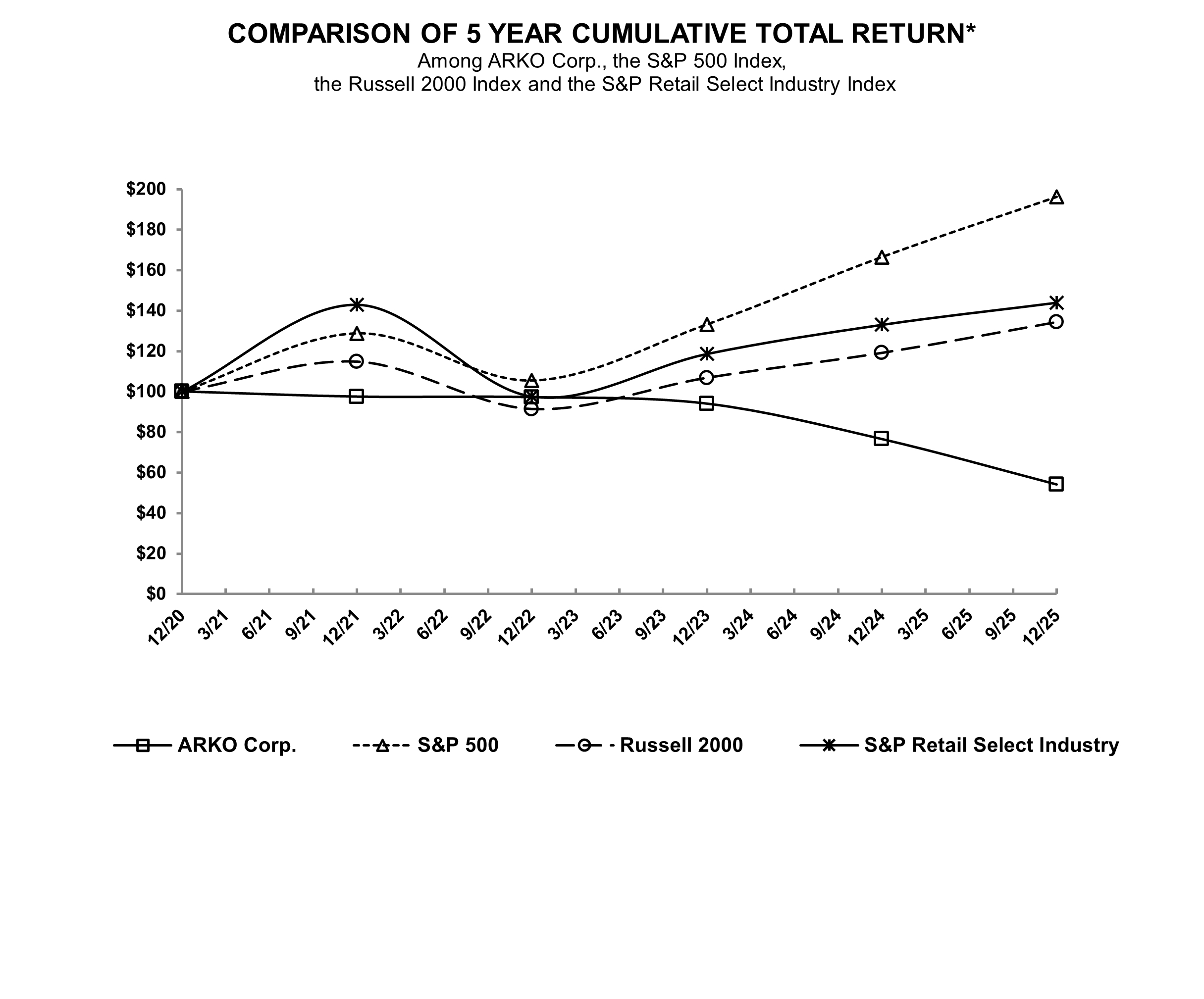
|
|
|
|
|
|
|
|
|
|
|
|
|
|
|
|
|
|
|
|
12/31/2020 |
|
12/31/2021 |
|
12/31/2022 |
|
12/31/2023 |
|
12/31/2024 |
|
12/31/2025 |
|
|
|
|
|
|
|
|
|
|
|
|
|
|
ARKO Corp. |
$ |
100 |
|
$ |
97.44 |
|
$ |
97.19 |
|
$ |
94.01 |
|
$ |
76.55 |
|
$ |
54.16 |
|
S&P 500 |
|
100 |
|
|
128.71 |
|
|
105.40 |
|
|
133.10 |
|
|
166.40 |
|
|
196.16 |
|
Russell 2000 |
|
100 |
|
|
114.82 |
|
|
91.35 |
|
|
106.82 |
|
|
119.14 |
|
|
134.40 |
|
S&P Retail Select Industry Index |
|
100 |
|
|
142.97 |
|
|
97.63 |
|
|
118.65 |
|
|
133.04 |
|
|
143.95 |
|
ITEM 7. MANAGEMENT’S DISCUSSION AND ANALYSIS OF FINANCIAL CONDITION AND RESULTS OF OPERATIONS
This Annual Report on Form 10-K contains forward-looking statements within the meaning of the Private Securities Litigation Reform Act of 1995 (“PSLRA”), Section 27A of the Securities Act of 1933, as amended (the “Securities Act”), and Section 21E of the Securities Exchange Act of 1934, as amended, (the “Exchange Act”), about our expectations, beliefs, plans and intentions regarding our product development efforts, business, financial condition, results of operations, strategies and prospects. You can identify forward-looking statements by the fact that these statements do not relate to historical or current matters. Rather, forward-looking statements relate to anticipated or expected events, activities, trends or results. Because forward-looking statements relate to matters that have not yet occurred, these statements are inherently subject to risks and uncertainties that could cause our actual results to differ materially from any future results expressed or implied by the forward-looking statements. Many factors could cause our actual activities or results to differ materially from the activities and results anticipated in forward-looking statements. These factors include those contained in “Item 1A — Risk Factors” of this Annual Report on Form 10-K. Forward-looking statements reflect our views only as of the date they are made. We do not undertake any obligation to update forward-looking statements except as required by applicable law. We intend that all forward-looking statements be subject to the safe harbor provisions of PSLRA.
Overview
Based in Richmond, Virginia, ARKO Corp. is one of the largest operators of convenience stores in the United States (“U.S.”), ranked by store count, operating 1,118 retail convenience stores as of December 31, 2025. We are also one of the largest wholesalers of fuel by gallons in the U.S. As of December 31, 2025, we supplied fuel to 2,099 dealer locations and operated 295 proprietary and third-party cardlock locations (unstaffed fueling locations). We are well diversified geographically and as of December 31, 2025, operated in the District of Columbia and more than 30 states in the Mid-Atlantic, Midwestern, Northeastern, Southeastern and Southwestern U.S. We own 100% of GPM Investments, LLC, a Delaware limited liability company (“GPM”), which was our primary operating entity through the closing of the initial public offering of the Class A common stock of our subsidiary ARKO Petroleum Corp., a Delaware corporation (“APC”), on February 13, 2026 (the “APC IPO”), after which GPM became our primary operating entity for our retail segment and APC became the primary operating entity for our wholesale, fleet fueling and GPMP segments. We own 75.9% of the economic interests and 94.0% of the combined voting power of APC. APC’s Class A common stock began trading on the Nasdaq under the symbol “APC” on February 12, 2026.
Description of Segments
Our reportable segments are described below.
Retail Segment
Our retail segment includes the operation of a chain of retail stores, which includes convenience stores selling fuel products and merchandise to retail customers, from which we generate a significant portion of our revenue and a large proportion of our profitability. At our convenience stores, we own the merchandise and fuel inventory and employ personnel to manage the store.
As of December 31, 2025, we operated the stores under more than 25 regional store brands including 1-Stop, Admiral, Apple Market®, BreadBox, Corner Mart, Dixie Mart, ExpressStop, E-Z Mart®, fas mart®, fastmarket®, Flash Market, Handy Mart, Jetz, Jiffi Stop®, Jiffy Stop, Li’l Cricket, Market Express, Next Door Store®, Pride, Roadrunner Markets, Rose Mart, Rstore, Scotchman®, shore stop®, Speedy’s, SpeedyQ, Town Star, Uncle’s, Village Pantry® and Young’s.
We operate our retail stores centrally with consistent marketing, merchandising and assortment strategies across our brands, but we occasionally offer regional items based on consumer demand in select brands. We believe this approach increases operational efficiencies while preserving flexibility. Our marketing initiatives and merchandising and assortment strategies are centered around offering our customers an assortment of products with an attractive value proposition. Our retail offering includes a wide array of grab-n-go hot and cold prepared foods and dispensed beverages, take home packaged beverages and beer, candy, salty snacks, bakery and packaged sweet snacks, general and seasonal merchandise, cigarettes, and other tobacco products such as moist tobacco, vape, nicotine pouches, and cigars. We have various foodservice offerings at approximately 965 stores, with options including hot and cold grab-n-go foods, such as bakery, Nathan’s® hot dogs and Tornado® roller grill items. We have 140 stores with delis offering a more robust foodservice menu that includes fried chicken, pizza, breakfast sandwiches, chicken tenders, potato wedges and more. We supplement our foodservice offering with approximately 90 quick service major national brand restaurants such as Dunkin’ and Subway. Additionally, we offer a number of traditional convenience store services, including lottery, prepaid products, gift cards, money orders, ATMs, skill gaming, Bitcoin® ATMs and other ancillary product and service offerings. We sell fuel at 1,095 of our retail sites, and we had 211 electric vehicle (“EV”) chargers at 72 of our locations across 16 states as of December 31, 2025. We also generate revenue from car washes at approximately 65 of our locations.
Wholesale Segment
Our wholesale segment supplies fuel to gas stations operated by third-party dealers, sub-wholesalers, and bulk and spot purchasers, on either a cost plus or consignment basis. For cost plus arrangements, the dealers, sub-wholesalers and bulk and spot purchasers, purchase fuel from us, and we earn a fixed mark-up above our cost. The sales price to the dealer is determined according to the terms of the relevant agreement, which typically reflects our total fuel costs plus the cost of transportation, taxes and our fixed margin. Furthermore, we generally retain any prompt pay discounts and rebates from our fuel suppliers. For consignment arrangements, we retain ownership of the fuel inventory at the site until the time of sale to the ultimate customer by the dealer, we are responsible for the pricing of the fuel to the end consumer and we share the gross profit generated from the sale of fuel by the dealer based on the terms of the relevant contract. In certain cases, gross profit is split based on a percentage and in others, we pay a fixed fee per gallon to the dealer and retain the remainder of the profit.
Fleet Fueling Segment
Our fleet fueling segment includes the operation of proprietary and third-party cardlock locations (unstaffed fueling locations), and commissions from the sales of fuel using proprietary fuel cards that provide customers access to a nationwide network of fueling sites.
GPMP Segment
Our GPMP segment primarily engages in inter-segment transactions of wholesale distribution of fuel to substantially all of our sites that sell fuel in the retail and wholesale segments. Our GPMP segment sells and supplies fuel at its cost of fuel (including taxes and transportation) plus a fixed margin to such supplied sites and charges an inter-segment fixed fee primarily to sites in the fleet fueling segment which are not supplied by the GPMP segment. The effect of these inter-segment transactions was eliminated in the Consolidated Financial Statements.
2025 Transformation Plan Updates and Initiatives
Remodels and New-to-Industry (“NTI”) Stores
A part of our multi-year Transformation Plan includes additional targeted capital allocation toward strategic sub-segments of our retail stores, with the goal of increasing traffic and improving profitability. In June of 2025, we launched our new format fas craves flagship location showcasing our key strategic priority to offer food that is relevant, delicious, and affordable and do so within stores that are completely remodeled with modernized interior and exterior designs, with layouts intended to provide a strong focus on our food offerings. fas craves food elevates our assortment of hot and cold grab-and-go food and dispensed beverages. The new fas craves format stores are designed to elevate the customer experience and better reflect our commitment to foodservice, convenience, efficiency, and value. Since the launch of our flagship location, we have completed several additional remodels and are planning approximately 25 remodels, all which will feature the fas craves food and beverage elements. We also plan to expand components of fas craves food and beverage to certain non-remodel stores where space permits while awaiting their remodel.
Complementing our remodeling initiative, in 2025, we opened a Dunkin’ store and two NTI (new to industry) retail stores. Two additional NTI retail stores opened thus far in 2026, and we plan to open one more NTI retail store and three Dunkin’ stores in 2026.
We are targeting 20 NTI fleet fueling locations with target openings during 2026, 10 of which we are currently advancing, which we anticipate will have a positive impact on our results of operations given the attractive, durable cash flow profile of our fleet fueling business.
fas REWARDS Loyalty Program
At the end of 2025, we had approximately 2.4 million enrolled members in our fas REWARDS loyalty program, representing a year over year increase of approximately 6% from 2024. Our fas REWARDS loyalty program is available in all of our retail stores and offers enrolled loyalty members the most value in our stores, in-app member only deals not available without the app, and the ability to earn points that can be redeemed for either fuel or merchandise savings. Other in-app features include the ability to convert earned points to fas BUCKS, which can be spent like cash on most merchandise categories in our stores, or stackable fuel cents off up to $2.00 off per gallon, up to 20 gallons at the pump as part of our Fueling America’s Future promotion. To celebrate America’s 250th anniversary in 2026, members can now save up to $2.50 per gallon in fuel savings.
In the first quarter of 2026, we plan to relaunch our fas REWARDS loyalty program app, which will include personalized features such as easy enrollment, an employee hub, store locators with individual member fuel pricing, Fueling America’s Future deals, value meals, age verified offers for tobacco and alcohol, and gaming.
Site Conversion Strategy (Dealerization)
Starting in the middle of 2024, as part of our Transformation Plan, we are leveraging our unique, multi-segment operating model to expand our wholesale fuel distribution network by converting a meaningful number of retail stores within our retail segment to dealer locations within our wholesale segment. Conversions of certain retail stores benefit both our retail and wholesale segments, as these sites have yielded, and we expect will continue to yield, greater profitability once converted. In such cases, we realize higher profit from ongoing fuel supply agreements and rental income than from continued operation of these stores in our retail segment. These conversions also allow us to focus on and better prioritize future investments in our remaining retail stores. During the year ended December 31, 2025, we converted 256 retail stores to dealer locations, and we have converted a total of 409 stores since the beginning of this initiative in the middle of 2024. We expect to convert a meaningful number of additional stores throughout 2026. These conversions have resulted in approximately $11.8 million in incremental operating income before general and administrative expenses for the year ended December 31, 2025.
As we proceed with our Transformation Plan, we may incur associated non-recurring expenses, including personnel costs, divestiture costs, professional services fees, and losses on disposal of assets and impairment charges.
Pricing and Procurement Strategies
We continue to increase our focus on both our pricing and procurement strategies across our retail stores to support ongoing merchandise margin rate growth, including using customer centric data-driven decisions to expand our six core destination merchandise categories, which are packaged beverages, candy, salty snacks, packaged sweet snacks, alternative snacks and beer. These categories represented approximately 54% of our same store merchandise contribution for the year ended December 31, 2025. Because our core destination merchandise categories represent a high concentration of our merchandise contribution, we focus on marketing and merchandising initiatives within these categories because we believe that they will have the greatest impact on our performance.
Trends Impacting Our Business
We achieved strong store growth over the last decade, driven primarily by a highly successful acquisition strategy, inclusive of 26 completed acquisitions from 2013 through 2025. In April 2024, we completed our acquisition of 21 SpeedyQ Markets convenience stores located in Michigan (the “SpeedyQ Acquisition”). In March 2023, we acquired 135 convenience stores, 181 dealer locations, a commercial, government, and industrial business, and certain distribution and transportation assets from Transit Energy Group, LLC (the “TEG Acquisition”). In June 2023, we completed our acquisition of 24 Uncle’s convenience stores located across Western Texas, 68 proprietary GASCARD-branded cardlock sites and 43 private cardlock sites for fleet fueling operations located in Western Texas and Southeastern New Mexico from WTG Fuels Holdings, LLC (the “WTG Acquisition”). In August 2023, we acquired seven Speedy’s convenience stores located in Arkansas and Oklahoma, which were previously locations operated by a dealer to which we supplied fuel (the “Speedy’s Acquisition” and, together with the TEG Acquisition and the WTG Acquisition, the “2023 Acquisitions”). Our strategic acquisitions, as well as the conversion of a meaningful number of retail stores to dealer locations, have had, and may continue to have, a significant impact on our reported results, which can make period to period comparisons difficult. For additional information regarding our acquisitions, see Note 4 to the Consolidated Financial Statements.
Our store count has grown from 320 sites in 2011 to 3,512 sites as of December 31, 2025, of which 1,118 were operated as retail convenience stores, 2,099 were dealer locations to which we supplied fuel, and 295 were cardlock locations. The following tables provide a history of our acquisitions, site conversions and site closings, including as part of our Transformation Plan, for each of the last three years, for the retail, wholesale and fleet fueling segments:
|
|
|
|
|
|
|
|
|
|
|
|
|
|
|
For the Year Ended December 31, |
|
Retail Segment |
|
2025 |
|
|
2024 |
|
|
2023 |
|
Number of sites at beginning of period |
|
|
1,389 |
|
|
|
1,543 |
|
|
|
1,404 |
|
Acquired sites |
|
|
— |
|
|
|
21 |
|
|
|
166 |
|
Newly opened or reopened sites |
|
|
3 |
|
|
|
3 |
|
|
|
4 |
|
Company-controlled sites converted to consignment or
fuel supply locations, net |
|
|
(256 |
) |
|
|
(153 |
) |
|
|
(16 |
) |
Sites closed, divested or converted to rentals |
|
|
(18 |
) |
|
|
(25 |
) |
|
|
(15 |
) |
Number of sites at end of period |
|
|
1,118 |
|
|
|
1,389 |
|
|
|
1,543 |
|
|
|
|
|
|
|
|
|
|
|
|
|
|
|
|
For the Year Ended December 31, |
|
Wholesale Segment 1 |
|
2025 |
|
|
2024 |
|
|
2023 |
|
Number of sites at beginning of period |
|
|
1,922 |
|
|
|
1,825 |
|
|
|
1,674 |
|
Acquired sites |
|
|
— |
|
|
|
— |
|
|
|
190 |
|
Newly opened or reopened sites 2 |
|
|
26 |
|
|
|
39 |
|
|
|
83 |
|
Consignment or fuel supply locations converted
from Company-controlled or fleet fueling sites, net |
|
|
256 |
|
|
|
153 |
|
|
|
15 |
|
Closed or divested sites |
|
|
(105 |
) |
|
|
(95 |
) |
|
|
(137 |
) |
Number of sites at end of period |
|
|
2,099 |
|
|
|
1,922 |
|
|
|
1,825 |
|
1 Excludes bulk and spot purchasers.
2 Includes all signed fuel supply agreements irrespective of fuel distribution commencement date.
|
|
|
|
|
|
|
|
|
|
|
|
|
|
|
For the Year Ended December 31, |
|
Fleet Fueling Segment |
|
2025 |
|
|
2024 |
|
|
2023 |
|
Number of sites at beginning of period |
|
|
280 |
|
|
|
298 |
|
|
|
183 |
|
Acquired sites |
|
|
2 |
|
|
|
— |
|
|
|
111 |
|
Newly opened or reopened sites |
|
|
16 |
|
|
|
1 |
|
|
|
6 |
|
Fleet fueling locations converted from fuel supply
locations, net |
|
|
— |
|
|
|
— |
|
|
|
1 |
|
Closed or divested sites |
|
|
(3 |
) |
|
|
(19 |
) |
|
|
(3 |
) |
Number of sites at end of period |
|
|
295 |
|
|
|
280 |
|
|
|
298 |
|
The number of fuel gallons we sell and the related fuel margin that we earn per gallon significantly impact our results of operations. Fuel gallons sold to dealers at fuel supply locations and consignment agent locations are dependent on the volume at these locations, which is impacted by the macroeconomic environment, weather and other factors. Fuel gallons sold at proprietary and third-party cardlock locations and at retail stores are impacted by changes in the number of locations, macroeconomic environment, weather, crude oil pricing and other factors.
The cost of our main products, gasoline and diesel fuel, is greatly impacted by the wholesale cost of fuel in the United States. We pass wholesale fuel cost changes to our fuel supply dealers and attempt to pass wholesale fuel cost changes to our retail, fleet fueling and consignment customers through price changes; however, we are not always able to do so. Competitive conditions primarily drive the timing of any increases or decreases in retail prices. Fuel margins for our retail stores, our fleet fueling sites and consignment locations can change rapidly because they are influenced by many factors, including: the wholesale cost of fuel; interruptions in supply caused by severe weather; supply chain disruptions; refinery mechanical failures; and competition in the local markets in which we operate. We tend to realize lower fuel margins when the cost of fuel is increasing gradually over a longer period and higher fuel margins when the cost of fuel is declining or more volatile over a shorter period of time. Because market and geopolitical conditions constrain, from time to time, the supply of fuel, including diesel fuel in particular, we maintain terminal storage of diesel fuel for short-term supply needs for our fleet fueling sites.
Additionally, the significant increase in the rate of inflation in the U.S. in recent years and the effect of higher prevailing interest rates have increased merchandise cost and reduced consumer purchasing power. We have mitigated the impact of a portion of these higher costs on operating results with retail price increases. The persistence of, or increase in, inflation could negatively impact the demand for our products and services, including due to consumers reducing travel, which could reduce sales volumes. Because of recent and current labor market conditions and the prevailing wage rates in the markets in which we operate, we have increased wages, which has increased, and may continue to increase, our costs associated with recruiting and retaining qualified personnel. Additionally, any major changes in tax or trade policy between the U.S. and countries from which we or our suppliers source merchandise and other products for our sites, such as the imposition of additional tariffs or duties on imported products, could require that we take certain actions, including raising prices on products we sell and seeking alternative sources of supply. Further, any major changes could lead to significant cost increases and delays in opening remodeled or new convenience stores or other improvements to our sites.
We also operate in a highly competitive retail convenience market that includes businesses with operations and services that are similar to those that we provide. We believe that convenience stores managed by individual operators that offer branded or non-branded fuel are also significant competitors in the local markets in which we operate. Often, operators of both chains and individual stores compete by selling unbranded fuel at lower retail prices relative to the market. The convenience store industry is also experiencing competition from other retail sectors including grocery stores, large warehouse retail stores, dollar stores and pharmacies.
Legislative Update
On July 4, 2025, the One Big Beautiful Bill Act (“OBBB”) was signed into law. The OBBB reinstated several key income tax provisions that were initially part of the U.S. Tax Cuts and Jobs Act of 2017, but which had been phased out in recent years or were set to expire in 2025, and made other changes to income tax provisions, many of which are not effective until 2026. The OBBB, among other things, repealed the mandatory capitalization of domestic research and development expenditures under Internal Revenue Code Section 174, extended the ability to take 100% bonus depreciation, reinstituted the EBITDA based Section 163(j) calculation, revised international tax regimes, and accelerated the phase out of clean energy credits.
We have evaluated the impact of the OBBB and reflected the effects in the Consolidated Financial Statements. Specifically, we recorded a favorable impact on the timing of cash paid for taxes of $26.9 million for the year ended December 31, 2025. The OBBB did not have a material impact on our effective tax rate for 2025. We will continue to monitor future guidance and developments related to the OBBB and will update our income tax disclosures as appropriate.
Seasonality
Our business is seasonal, and our operating income in the second and third quarters has historically been significantly greater than in the first and fourth quarters as a result of the generally favorable climate and seasonal buying patterns of our customers.
Results of Operations for the years ended December 31, 2025, 2024 and 2023
The period-to-period comparisons of our results of operations contained in this Management’s Discussion and Analysis of Financial Condition and Results of Operation have been prepared using the Consolidated Financial Statements and the notes thereto, and the following discussion should be read in conjunction with such Consolidated Financial Statements and related notes contained elsewhere in this Annual Report on Form 10-K. All figures for fuel costs, fuel contribution and fuel margin per gallon exclude the estimated fixed margin or fixed fee paid to the GPMP segment for the cost of fuel (intercompany charges by the GPMP segment).
Consolidated Results
The table below shows our consolidated results for the years ended December 31, 2025, 2024 and 2023, together with certain key metrics.
|
|
|
|
|
|
|
|
|
|
|
|
|
|
|
For the Year Ended December 31, |
|
|
|
2025 |
|
|
2024 |
|
|
2023 |
|
Revenues: |
|
(in thousands) |
|
Fuel revenue |
|
$ |
6,038,934 |
|
|
$ |
6,858,919 |
|
|
$ |
7,464,372 |
|
Merchandise revenue |
|
|
1,482,454 |
|
|
|
1,767,345 |
|
|
|
1,838,001 |
|
Other revenues, net |
|
|
122,083 |
|
|
|
105,698 |
|
|
|
110,358 |
|
Total revenues |
|
|
7,643,471 |
|
|
|
8,731,962 |
|
|
|
9,412,731 |
|
Operating expenses: |
|
|
|
|
|
|
|
|
|
Fuel costs |
|
|
5,479,934 |
|
|
|
6,271,696 |
|
|
|
6,876,084 |
|
Merchandise costs |
|
|
982,673 |
|
|
|
1,187,776 |
|
|
|
1,252,879 |
|
Site operating expenses |
|
|
785,361 |
|
|
|
875,272 |
|
|
|
860,134 |
|
General and administrative expenses |
|
|
165,711 |
|
|
|
162,920 |
|
|
|
165,294 |
|
Depreciation and amortization |
|
|
134,451 |
|
|
|
132,414 |
|
|
|
127,597 |
|
Total operating expenses |
|
|
7,548,130 |
|
|
|
8,630,078 |
|
|
|
9,281,988 |
|
Other (income) expenses, net |
|
|
(6,961 |
) |
|
|
7,858 |
|
|
|
12,729 |
|
Operating income |
|
|
102,302 |
|
|
|
94,026 |
|
|
|
118,014 |
|
Interest and other financial expenses, net |
|
|
(73,324 |
) |
|
|
(67,161 |
) |
|
|
(71,243 |
) |
Income before income taxes |
|
|
28,978 |
|
|
|
26,865 |
|
|
|
46,771 |
|
Income tax expense |
|
|
(6,342 |
) |
|
|
(6,144 |
) |
|
|
(12,166 |
) |
Income (loss) from equity investment |
|
|
108 |
|
|
|
124 |
|
|
|
(39 |
) |
Net income |
|
$ |
22,744 |
|
|
$ |
20,845 |
|
|
$ |
34,566 |
|
|
|
|
|
|
|
|
|
|
|
|
|
|
Less: Net income attributable to non-controlling interests |
|
|
— |
|
|
|
— |
|
|
|
197 |
|
Net income attributable to ARKO Corp. |
|
$ |
22,744 |
|
|
$ |
20,845 |
|
|
$ |
34,369 |
|
Series A redeemable preferred stock dividends |
|
|
(5,750 |
) |
|
|
(5,750 |
) |
|
|
(5,750 |
) |
Net income attributable to common shareholders |
|
$ |
16,994 |
|
|
$ |
15,095 |
|
|
$ |
28,619 |
|
Fuel gallons sold |
|
|
2,063,736 |
|
|
|
2,189,245 |
|
|
|
2,241,805 |
|
Fuel margin, cents per gallon 1 |
|
|
27.1 |
|
|
|
26.8 |
|
|
|
26.2 |
|
Merchandise contribution 2 |
|
$ |
499,781 |
|
|
$ |
579,569 |
|
|
$ |
585,122 |
|
Merchandise margin 3 |
|
|
33.7 |
% |
|
|
32.8 |
% |
|
|
31.8 |
% |
Adjusted EBITDA 4 |
|
$ |
248,653 |
|
|
$ |
248,860 |
|
|
$ |
276,260 |
|
Non-cash rent expense 5 |
|
$ |
12,132 |
|
|
$ |
14,335 |
|
|
$ |
14,168 |
|
1 Calculated as fuel revenue less fuel costs divided by fuel gallons sold.
2 Calculated as merchandise revenue less merchandise costs.
3 Calculated as merchandise contribution divided by merchandise revenue.
4 Refer to “Use of Non-GAAP Measures” below for discussion of this non-GAAP performance measure and related reconciliation to net income.
5 Non-cash rent expense reflects the extent to which our GAAP rent expense recognized exceeded (or was less than) our cash rent payments. GAAP rent expense varies depending on the terms of our lease portfolio. For newer leases, our rent expense recognized typically exceeds our cash rent payments, whereas, for more mature leases, rent expense recognized is typically less than our cash rent payments.
For the year ended December 31, 2025 compared to the year ended December 31, 2024
For the year ended December 31, 2025, fuel revenue decreased by $820.0 million, or 12.0%, compared to the year ended December 31, 2024. The decrease in fuel revenue was attributable primarily to a decrease in the average price of fuel compared to 2024 and fewer gallons sold in 2025 compared to 2024, due to a challenging macroeconomic environment, as well as severe weather conditions in January and February 2025 in certain of the markets in which we operate.
For the year ended December 31, 2025, merchandise revenue decreased by $284.9 million, or 16.1%, compared to the year ended December 31, 2024, primarily due to reduced merchandise revenue from retail stores that we closed or converted to dealer locations since the middle of 2024 as well as a decrease in same store merchandise revenues.
For the year ended December 31, 2025, other revenues, net increased by $16.4 million, or 15.5%, compared to the year ended December 31, 2024, primarily due to the net impact of additional income from retail stores that we converted to dealer locations since the middle of 2024.
For the year ended December 31, 2025, total operating expenses decreased by $1,081.9 million, or 12.5%, compared to the year ended December 31, 2024. Fuel costs decreased by $791.8 million, or 12.6%, compared to 2024, and merchandise costs decreased by $205.1 million, or 17.3%, compared to 2024, consistent with the reduction in fuel and merchandise revenues. For the year ended December 31, 2025, site operating expenses decreased by $89.9 million, or 10.3%, compared to 2024 due to lower expenses from retail stores that we closed or converted to dealer locations, slightly offset by incremental expenses as a result of the SpeedyQ Acquisition.
For the year ended December 31, 2025, general and administrative expenses increased by $2.8 million, or 1.7%, compared to the year ended December 31, 2024, partially due to an increase of $2.8 million in share-based compensation expense.
For the year ended December 31, 2025, depreciation and amortization expenses increased by $2.0 million, or 1.5%, compared to the year ended December 31, 2024 primarily due to assets acquired in the past year.
For the year ended December 31, 2025, other (income) expense, net increased by $14.8 million compared to the year ended December 31, 2024, primarily due to a gain of approximately $20.8 million related to the expiration of a real estate purchase option acquired in 2021 in connection with our acquisition of certain ExpressStop convenience stores that was accounted for as a sale-leaseback, partially offset by higher acquisition and divestiture costs, costs associated with the APC IPO and loss on disposal of assets and impairment charges for the year ended December 31, 2025 compared to the year ended December 31, 2024.
Operating income was $102.3 million for the year ended December 31, 2025 compared to $94.0 million for the year ended December 31, 2024. The increase was primarily due to higher same store fuel contribution, the gain on the aforementioned sale-leaseback and the benefit from retail stores that we closed or converted to dealer locations, partially offset by lower same store merchandise contribution, lower fuel contribution from comparable wholesale sites and higher general, administrative, depreciation and amortization expenses.
For the year ended December 31, 2025, interest and other financial expenses, net increased by $6.2 million compared to the year ended December 31, 2024, primarily related to a decrease of $3.3 million in income recorded in 2025 compared to 2024 for fair value adjustments related to the Public Warrants, Private Warrants and Additional Deferred Shares (each as defined in the notes to the Consolidated Financial Statements) and approximately $9.2 million recorded as financial income in the year ended December 31,
2024 related to the issuance of the First Installment Shares (as defined in Note 4 to the Consolidated Financial Statements) as payment of deferred consideration and the settlement of deferred consideration related to the TEG Acquisition, partially offset by higher interest income generated and lower average interest rates in the year ended December 31, 2025.
For the years ended December 31, 2025 and 2024, income tax expense was $6.3 million and $6.1 million, respectively, and our effective tax rate for the years ended December 31, 2025 and 2024 was 21.8% and 22.8%, respectively.
For the years ended December 31, 2025 and 2024, net income attributable to the Company was $22.7 million and $20.8 million, respectively.
For the years ended December 31, 2025 and 2024, Adjusted EBITDA was $248.7 million and $248.9 million, respectively. Refer to “Use of Non-GAAP Measures” below for discussion of this non-GAAP performance measure and related reconciliation to net income.
For the year ended December 31, 2024 compared to the year ended December 31, 2023
For a discussion of the comparative results of operations for the years ended December 31, 2024 and 2023, refer to Part II, Item 7 “Management's Discussion and Analysis of Financial Condition and Results of Operations” in our Annual Report on Form 10-K for the year ended December 31, 2024, filed with the SEC on February 26, 2025.
Segment Results
Disclosure of Incremental Contributions From Acquisitions
In the discussion of our segment results, we disclose certain information with respect to our acquisitions on an “incremental” basis. For example, incremental fuel gallons sold with respect to recent acquisitions. Incremental amounts or gallons related to such acquisitions reflect only the change (i.e. increase) in the contribution of the acquisitions between the referenced periods as they are not yet reflected in same store figures.
Retail Segment
The table below shows the results of the retail segment for the years ended December 31, 2025, 2024 and 2023, together with certain key metrics for the segment.
|
|
|
|
|
|
|
|
|
|
|
|
|
|
|
For the Year Ended December 31, |
|
|
|
2025 |
|
|
2024 |
|
|
2023 |
|
Revenues: |
|
(in thousands) |
|
Fuel revenue |
|
$ |
2,835,661 |
|
|
$ |
3,509,935 |
|
|
$ |
3,858,777 |
|
Merchandise revenue |
|
|
1,482,454 |
|
|
|
1,767,345 |
|
|
|
1,838,001 |
|
Other revenues, net |
|
|
59,020 |
|
|
|
65,264 |
|
|
|
74,406 |
|
Total revenues |
|
|
4,377,135 |
|
|
|
5,342,544 |
|
|
|
5,771,184 |
|
Operating expenses: |
|
|
|
|
|
|
|
|
|
Fuel costs 1 |
|
|
2,440,953 |
|
|
|
3,081,719 |
|
|
|
3,423,455 |
|
Merchandise costs |
|
|
982,673 |
|
|
|
1,187,776 |
|
|
|
1,252,879 |
|
Site operating expenses |
|
|
685,144 |
|
|
|
790,645 |
|
|
|
779,448 |
|
Total operating expenses |
|
|
4,108,770 |
|
|
|
5,060,140 |
|
|
|
5,455,782 |
|
Operating income |
|
$ |
268,365 |
|
|
$ |
282,404 |
|
|
$ |
315,402 |
|
Fuel gallons sold |
|
|
922,726 |
|
|
|
1,080,990 |
|
|
|
1,122,321 |
|
Same store fuel gallons sold decrease (%) 2 |
|
|
(5.4 |
%) |
|
|
(6.1 |
%) |
|
|
(5.3 |
%) |
Fuel contribution 3 |
|
$ |
394,708 |
|
|
$ |
428,216 |
|
|
$ |
435,322 |
|
Fuel margin, cents per gallon 4 |
|
|
42.8 |
|
|
|
39.6 |
|
|
|
38.8 |
|
Same store fuel contribution 2, 3 |
|
$ |
384,986 |
|
|
$ |
383,453 |
|
|
$ |
422,090 |
|
Same store merchandise sales (decrease) increase (%) 2 |
|
|
(4.1 |
%) |
|
|
(5.4 |
%) |
|
|
0.4 |
% |
Same store merchandise sales excluding cigarettes (decrease) increase (%) 2 |
|
|
(2.7 |
%) |
|
|
(3.8 |
%) |
|
|
2.5 |
% |
Merchandise contribution 5 |
|
$ |
499,781 |
|
|
$ |
579,569 |
|
|
$ |
585,122 |
|
Merchandise margin 6 |
|
|
33.7 |
% |
|
|
32.8 |
% |
|
|
31.8 |
% |
1 Excludes the estimated fixed margin or fixed fee paid to the GPMP segment for the cost of fuel.
2 Same store is a common metric used in the convenience store industry. We consider a store a same store beginning in the first quarter in which the store had a full quarter of activity in the prior year. Refer to “Use of Non-GAAP Measures” below for discussion of this measure.
3 Calculated as fuel revenue less fuel costs. 2023 same store fuel contribution is presented compared to 2024 store basis.
4 Calculated as fuel contribution divided by fuel gallons sold.
5 Calculated as merchandise revenue less merchandise costs.
6 Calculated as merchandise contribution divided by merchandise revenue.
For the year ended December 31, 2025 compared to the year ended December 31, 2024
Retail Revenues
For the year ended December 31, 2025, fuel revenue decreased by $674.3 million, or 19.2%, compared to the year ended December 31, 2024. The decrease in fuel revenue was attributable to a decrease in same store gallons sold of approximately 5.4%, or 51.2 million gallons, reflecting the challenging macroeconomic environment as well as severe weather conditions in January and February 2025 in certain of the markets in which we operate, and a $0.18 per gallon decrease in the average retail price of fuel in 2025 compared to 2024, primarily due to market factors. Retail stores that we closed or converted to dealer locations since the middle of 2024 also negatively impacted gallons sold by 111.3 million gallons. Partially offsetting these decreases were an incremental 2.6 million gallons sold, or $6.2 million in fuel revenue, contributed by the SpeedyQ Acquisition.
For the year ended December 31, 2025, merchandise revenue decreased by $284.9 million, or 16.1%, compared to the year ended December 31, 2024, primarily caused by a decline in customer transactions reflecting the challenging macroeconomic environment as well as severe weather conditions in January and February 2025 in certain of the markets in which we operate, and a decrease in merchandise revenue of $230.5 million from retail stores that we closed or converted to dealer locations since the middle of 2024. Same store merchandise sales decreased by $61.1 million, or 4.1%, for 2025 compared to 2024. More than half the decline in same store merchandise revenues was caused by lower revenues from cigarettes. The SpeedyQ Acquisition contributed approximately $5.6 million of incremental merchandise revenue.
For the year ended December 31, 2025, other revenues, net decreased by $6.2 million, or 9.6%, compared to the year ended December 31, 2024, primarily due to a decrease in other revenues of $6.0 million from retail stores that we closed or converted to dealer locations since the middle of 2024 and a decrease of $0.8 million in same store other revenues principally due to reduced lottery commissions, partially offset by additional income from the SpeedyQ Acquisition.
Retail Operating Income
For the year ended December 31, 2025, fuel contribution decreased by $33.5 million, or 7.8%, compared to the year ended December 31, 2024. The decrease in fuel contribution was due to a decrease of $37.1 million related to retail stores that we closed or converted to dealer locations since the middle of 2024. This decrease was offset by a same store fuel contribution increase of $1.5 million and incremental fuel contribution from the SpeedyQ Acquisition of approximately $1.2 million. Same store fuel margin per gallon for 2025 increased to 42.9 cents per gallon from 40.4 cents per gallon for 2024.
For the year ended December 31, 2025, merchandise contribution decreased by $79.8 million, or 13.8%, compared to the year ended December 31, 2024, while merchandise margin increased to 33.7% in 2025 from 32.8% in 2024. The decrease in merchandise contribution was due to a $71.7 million decrease related to retail stores that we closed or converted to dealer locations since the middle of 2024 and a decrease in same store merchandise contribution of $11.3 million, partially offset by $2.1 million in incremental merchandise contribution from the SpeedyQ Acquisition. Same store merchandise margin for 2025 increased to 33.8% from 33.2% in 2024.
For the year ended December 31, 2025, site operating expenses decreased by $105.5 million, or 13.3%, compared to the year ended December 31, 2024, primarily due to $111.7 million of reduced expenses related to retail stores that we closed or converted to dealer locations since the middle of 2024, partially offset by $3.7 million of incremental expenses related to the SpeedyQ Acquisition.
Wholesale Segment
The table below shows the results of the wholesale segment for the years ended December 31, 2025, 2024 and 2023, together with certain key metrics for the segment.
|
|
|
|
|
|
|
|
|
|
|
|
|
|
|
For the Year Ended December 31, |
|
|
|
2025 |
|
|
2024 |
|
|
2023 |
|
Revenues: |
|
(in thousands) |
|
Fuel revenue |
|
$ |
2,700,838 |
|
|
$ |
2,799,869 |
|
|
$ |
3,039,904 |
|
Other revenues, net |
|
|
52,270 |
|
|
|
29,140 |
|
|
|
25,775 |
|
|
|
|
|
|
|
|
|
|
|
|
|
|
Total revenues |
|
|
2,753,108 |
|
|
|
2,829,009 |
|
|
|
3,065,679 |
|
Operating expenses: |
|
|
|
|
|
|
|
|
|
Fuel costs 1 |
|
|
2,606,306 |
|
|
|
2,709,519 |
|
|
|
2,946,996 |
|
Site operating expenses |
|
|
57,406 |
|
|
|
39,679 |
|
|
|
39,703 |
|
Total operating expenses |
|
|
2,663,712 |
|
|
|
2,749,198 |
|
|
|
2,986,699 |
|
Operating income |
|
$ |
89,396 |
|
|
$ |
79,811 |
|
|
$ |
78,980 |
|
Fuel gallons sold – fuel supply locations |
|
|
836,232 |
|
|
|
794,796 |
|
|
|
801,260 |
|
Fuel gallons sold – consignment agent locations |
|
|
152,839 |
|
|
|
154,560 |
|
|
|
168,005 |
|
Fuel margin, cents per gallon 2 – fuel supply locations |
|
|
6.3 |
|
|
|
6.0 |
|
|
|
6.0 |
|
Fuel margin, cents per gallon 2 – consignment agent locations |
|
|
27.5 |
|
|
|
27.4 |
|
|
|
26.5 |
|
1 Excludes the estimated fixed margin or fixed fee paid to the GPMP segment for the cost of fuel.
2 Calculated as fuel revenue less fuel costs divided by fuel gallons sold.
Note: Information disclosed on a “comparable wholesale sites” basis excludes wholesale sites added through acquisitions and retail stores converted to dealer locations, until the first quarter in which these sites had a full quarter of wholesale activity in the prior year. Refer to “Use of Non-GAAP Measures” below for discussion of this non-GAAP performance measure.
For the year ended December 31, 2025 compared to the year ended December 31, 2024
Wholesale Revenues
For the year ended December 31, 2025, fuel revenue decreased by $99.0 million, or 3.5%, compared to the year ended December 31, 2024, primarily due to a decrease in the average price of fuel in 2025 as compared to 2024, partially offset by a 39.7 million, or 4.2%, increase in gallons sold. Of total gallons sold, the retail stores that we converted to dealer locations since the middle of 2024 contributed 79.7 million gallons, which were partially offset by lower volumes at comparable wholesale sites, reflecting the challenging macroeconomic environment.
Wholesale Operating Income
For the year ended December 31, 2025, wholesale operating income increased by $9.6 million compared to the year ended December 31, 2024. Additional operating income from retail stores converted to dealer locations since the middle of 2024 more than offset reduced operating income at comparable wholesale sites. An increase of $23.1 million in other revenues, net, combined with an increase in fuel contribution of $4.2 million in 2025 compared to 2024, was partially offset by an increase in site operating expenses of $17.7 million in 2025 compared to 2024. These increases were primarily due to the retail stores we converted to dealer locations since the middle of 2024.
At fuel supply locations, fuel contribution increased by $4.6 million, and fuel margin per gallon also increased for 2025 compared to 2024, due to $6.9 million of incremental contribution from the retail stores converted to dealer locations, which was partially offset by decreased prompt pay discounts related to lower fuel costs and lower volumes at comparable fuel supply wholesale sites primarily due to the macroeconomic environment and severe weather conditions in January and February 2025 in certain of the markets in which we operate.
At consignment agent locations, fuel contribution decreased by $0.4 million due to decreased prompt pay discounts related to lower fuel costs and lower volumes at comparable wholesale sites, primarily due to the macroeconomic environment and severe weather conditions in January and February 2025 in certain of the markets in which we operate, which was partially offset by the incremental contribution of $2.0 million from the retail stores converted to dealer locations. Fuel margin per gallon increased for 2025 compared to 2024 due to a larger mix of higher performing consignment dealers as compared to the prior year.
Fleet Fueling Segment
The table below shows the results of the fleet fueling segment for the years ended December 31, 2025, 2024 and 2023, together with certain key metrics for the segment.
|
|
|
|
|
|
|
|
|
|
|
|
|
|
|
For the Year Ended December 31, |
|
|
|
2025 |
|
|
2024 |
|
|
2023 |
|
Revenues: |
|
(in thousands) |
|
Fuel revenue |
|
$ |
474,796 |
|
|
$ |
515,462 |
|
|
$ |
530,937 |
|
Other revenues, net |
|
|
8,983 |
|
|
|
9,135 |
|
|
|
7,818 |
|
Total revenues |
|
|
483,779 |
|
|
|
524,597 |
|
|
|
538,755 |
|
Operating expenses: |
|
|
|
|
|
|
|
|
|
Fuel costs 1 |
|
|
409,063 |
|
|
|
451,173 |
|
|
|
475,037 |
|
|
|
|
|
|
|
|
|
|
|
|
|
|
Site operating expenses |
|
|
26,120 |
|
|
|
24,917 |
|
|
|
22,298 |
|
Total operating expenses |
|
|
435,183 |
|
|
|
476,090 |
|
|
|
497,335 |
|
Operating income |
|
$ |
48,596 |
|
|
$ |
48,507 |
|
|
$ |
41,420 |
|
Fuel gallons sold – proprietary cardlock locations |
|
|
129,459 |
|
|
|
136,104 |
|
|
|
130,995 |
|
Fuel gallons sold – third-party cardlock locations |
|
|
13,389 |
|
|
|
12,814 |
|
|
|
9,832 |
|
Fuel margin, cents per gallon 2 – proprietary cardlock locations |
|
|
49.0 |
|
|
|
46.0 |
|
|
|
41.7 |
|
Fuel margin, cents per gallon 2 – third-party cardlock locations |
|
|
17.4 |
|
|
|
13.1 |
|
|
|
12.4 |
|
1 Excludes the estimated fixed fee paid to the GPMP segment for the cost of fuel.
2 Calculated as fuel revenue less fuel costs divided by fuel gallons sold.
For the year ended December 31, 2025 compared to the year ended December 31, 2024
Fleet Fueling Revenues
For the year ended December 31, 2025, fuel revenue decreased by $40.7 million, or 7.9%, and other revenues, net decreased by $0.2 million, compared to the year ended December 31, 2024. Fuel revenue was negatively impacted by a 6.1 million decrease in gallons sold, or 4.1%, due primarily to movements in crude oil pricing and severe weather conditions in January and February 2025 that impacted certain of the markets in which we operate, and a decrease in the average price of fuel in 2025 compared to 2024.
Fleet Fueling Operating Income
For the year ended December 31, 2025, fuel contribution increased by $1.4 million compared to the year ended December 31, 2024. At proprietary cardlocks, fuel contribution increased by $0.8 million, and fuel margin per gallon also increased for 2025 compared to 2024, primarily due to favorable diesel margins. At third-party cardlock locations, fuel contribution increased by $0.6 million, and fuel margin per gallon also increased for 2025 compared to 2024, primarily due to the closure of underperforming third-party locations.
For the year ended December 31, 2025, site operating expenses increased by $1.2 million compared to the year ended December 31, 2024, primarily due to higher rent and insurance.
GPMP Segment
The table below shows the results of the GPMP segment for the years ended December 31, 2025, 2024 and 2023, together with certain key metrics for the segment.
|
|
|
|
|
|
|
|
|
|
|
|
|
|
|
For the Year Ended December 31, |
|
|
|
2025 |
|
|
2024 |
|
|
2023 |
|
Revenues: |
|
(in thousands) |
|
Fuel revenue – inter-segment 1 |
|
$ |
4,835,588 |
|
|
$ |
5,607,388 |
|
|
$ |
6,197,396 |
|
Fuel revenue – external customers |
|
|
849 |
|
|
|
3,624 |
|
|
|
3,681 |
|
Other revenues, net |
|
|
727 |
|
|
|
838 |
|
|
|
939 |
|
Other revenues, net – inter-segment 1 |
|
|
11,120 |
|
|
|
11,236 |
|
|
|
10,918 |
|
Total revenues |
|
|
4,848,284 |
|
|
|
5,623,086 |
|
|
|
6,212,934 |
|
Operating expenses: |
|
|
|
|
|
|
|
|
|
Fuel costs |
|
|
4,744,771 |
|
|
|
5,513,092 |
|
|
|
6,100,559 |
|
General and administrative expenses |
|
|
3,244 |
|
|
|
3,585 |
|
|
|
3,162 |
|
Depreciation and amortization |
|
|
7,359 |
|
|
|
7,371 |
|
|
|
7,365 |
|
Total operating expenses |
|
|
4,755,374 |
|
|
|
5,524,048 |
|
|
|
6,111,086 |
|
Other income, net |
|
|
— |
|
|
|
— |
|
|
|
(598 |
) |
Operating income |
|
$ |
92,910 |
|
|
$ |
99,038 |
|
|
$ |
102,446 |
|
Fuel gallons sold – inter-segment |
|
|
1,833,297 |
|
|
|
1,955,989 |
|
|
|
2,017,522 |
|
Fuel gallons sold – external customers |
|
|
217 |
|
|
|
1,044 |
|
|
|
1,364 |
|
Fuel margin, cents per gallon 2 |
|
|
5.0 |
|
|
|
5.0 |
|
|
|
5.0 |
|
1 Includes the estimated fixed margin or fixed fee paid to the GPMP segment for the cost of fuel.
2 Calculated as fuel revenue less fuel costs divided by fuel gallons sold.
For the year ended December 31, 2025 compared to the year ended December 31, 2024
GPMP Revenues
For the year ended December 31, 2025, fuel revenue decreased by $774.6 million, or 13.8%, compared to the year ended December 31, 2024. The decrease in fuel revenue was attributable to a decrease in both gallons sold and the average price of fuel for 2025 compared to 2024.
For the years ended December 31, 2025 and 2024, other revenues, net and inter-segment other revenues, net related to the fixed fee primarily charged to sites in the fleet fueling segment (5.0 cents per gallon sold for the three years ended December 31, 2025) were similar.
GPMP Operating Income
Fuel margin decreased by $6.3 million for the year ended December 31, 2025, compared to the year ended December 31, 2024, primarily due to fewer gallons sold to the retail segment at a fixed margin.
For the year ended December 31, 2025, total general and administrative expenses decreased $0.3 million from those in the year ended December 31, 2024, and depreciation and amortization expenses for 2025 remained consistent with 2024.
Use of Non-GAAP Measures
We disclose certain measures on a “same store basis,” which is a non-GAAP measure. Information disclosed on a “same store basis” excludes the results of any store that is not a “same store” for the applicable period. A store is considered a same store beginning in the first quarter in which the store had a full quarter of activity in the prior year. We believe that this information is useful for our investors, securities analysts, and other interested parties by providing greater comparability regarding our ongoing operating performance. Neither this measure nor those described below should be considered an alternative to measurements presented in accordance with generally accepted accounting principles in the United States (“GAAP”).
We disclose certain measures on a “comparable wholesale sites” basis, which is a non-GAAP measure. Information disclosed on a “comparable wholesale sites” basis excludes wholesale sites added through retail stores converted to dealer locations until the first quarter in which these sites had a full quarter of wholesale activity in the prior year. We believe that this information is useful for our investors, securities analysts, and other interested parties by providing greater comparability regarding our ongoing operating performance.
We define EBITDA as net income including net income attributable to non-controlling interests before net interest expense, income taxes, depreciation and amortization. Adjusted EBITDA further adjusts EBITDA by excluding the gain or loss on disposal of assets, impairment charges, acquisition and divestiture costs, share-based compensation expense, other non-cash items, certain litigation expenses and other unusual or non-recurring charges. Both EBITDA and Adjusted EBITDA are non-GAAP financial measures.
We use EBITDA and Adjusted EBITDA for operational and financial decision-making and believe these measures are useful in evaluating our performance because they eliminate certain items that we do not consider indicators of our operating performance. EBITDA and Adjusted EBITDA are also used by many of our investors, securities analysts, and other interested parties in evaluating our operational and financial performance across reporting periods. We believe that the presentation of EBITDA and Adjusted EBITDA provides useful information to investors by allowing an understanding of key measures that we use internally for operational decision-making, budgeting, evaluating acquisition targets, and assessing our operating performance.
EBITDA and Adjusted EBITDA should not be considered as alternatives to any financial measure presented in accordance with GAAP, including net income. These non-GAAP measures have limitations as analytical tools and should not be considered in isolation, or as substitutes for the analysis of our results as reported under GAAP. We strongly encourage investors to review our financial statements and publicly filed reports in their entirety and not to rely on any single financial measure.
Because non-GAAP financial measures are not standardized, same store measures, comparable wholesale sites, EBITDA and Adjusted EBITDA, as defined by us, may not be comparable to similarly titled measures reported by other companies. It therefore may not be possible to compare our use of these non-GAAP financial measures with those used by other companies.
The following table contains a reconciliation of net income to EBITDA and Adjusted EBITDA for the years ended December 31, 2025, 2024 and 2023.
|
|
|
|
|
|
|
|
|
|
|
|
|
|
|
For the Year Ended December 31, |
|
|
|
2025 |
|
|
2024 |
|
|
2023 |
|
|
|
(in thousands) |
|
Net income, including net income attributable to non-controlling
interests |
|
$ |
22,744 |
|
|
$ |
20,845 |
|
|
$ |
34,566 |
|
Interest and other financing expenses, net |
|
|
73,324 |
|
|
|
67,161 |
|
|
|
71,243 |
|
Income tax expense |
|
|
6,342 |
|
|
|
6,144 |
|
|
|
12,166 |
|
Depreciation and amortization |
|
|
134,451 |
|
|
|
132,414 |
|
|
|
127,597 |
|
EBITDA |
|
|
236,861 |
|
|
|
226,564 |
|
|
|
245,572 |
|
Acquisition and divestiture costs (a) |
|
|
6,545 |
|
|
|
5,168 |
|
|
|
9,079 |
|
APC IPO costs (b) |
|
|
1,897 |
|
|
|
— |
|
|
|
— |
|
(Gain) loss on disposal of assets and impairment charges (c) |
|
|
(12,146 |
) |
|
|
6,798 |
|
|
|
6,203 |
|
Share-based compensation expense (d) |
|
|
15,172 |
|
|
|
12,339 |
|
|
|
15,015 |
|
(Income) loss from equity investment (e) |
|
|
(108 |
) |
|
|
(124 |
) |
|
|
39 |
|
Taxes paid (received) in arrears (f) |
|
|
305 |
|
|
|
(1,427 |
) |
|
|
— |
|
Adjustment to contingent consideration (g) |
|
|
(2,207 |
) |
|
|
(20 |
) |
|
|
(604 |
) |
Expenses related to wage and hour claim settlement (h) |
|
|
2,517 |
|
|
|
— |
|
|
|
— |
|
Other (i) |
|
|
(183 |
) |
|
|
(438 |
) |
|
|
956 |
|
Adjusted EBITDA |
|
$ |
248,653 |
|
|
$ |
248,860 |
|
|
$ |
276,260 |
|
|
|
|
|
|
|
|
|
|
|
Additional information |
|
|
|
|
|
|
|
|
|
Non-cash rent expense (j) |
|
|
12,132 |
|
|
|
14,335 |
|
|
|
14,168 |
|
(a)Eliminates costs incurred that are directly attributable to business acquisitions and divestitures (including conversion of retail stores to dealer locations) and salaries of employees whose primary job function is to execute our acquisition and divestiture strategy and facilitate integration of acquired operations.
(b)Eliminates one-time costs incurred related to the APC IPO, which closed on February 13, 2026.
(c)Eliminates the non-cash loss from the sale or disposal of property and equipment, the loss recognized upon the sale of related leased assets and impairment charges on property and equipment and right-of-use assets related to closed and non-performing sites, and a $20.8 million gain related to the expiration in the second quarter of 2025 of a real estate purchase option acquired in 2021 that was accounted for as a sale-leaseback (see Note 11 to the Consolidated Financial Statements).
(d)Eliminates non-cash share-based compensation expense related to the equity incentive program in place to incentivize, retain, and motivate our employees and members of our Board.
(e)Eliminates our share of (income) loss attributable to our unconsolidated equity investment.
(f)Eliminates the payment (receipt) of historical fuel, franchise and other tax amounts for multiple prior periods.
(g)Eliminates fair value adjustments primarily related to the contingent consideration owed to the seller for the 2020 Empire acquisition.
(h)Eliminates non-recurring expenses accrued in net income related to a wage and hour collective action settlement described in Note 14 to the Consolidated Financial Statements.
(i)Eliminates other unusual or non-recurring items that we do not consider to be meaningful in assessing operating performance.
(j)Non-cash rent expense reflects the extent to which our GAAP rent expense recognized exceeded (or was less than) our cash rent payments. GAAP rent expense varies depending on the terms of our lease portfolio. For newer leases, our rent expense recognized typically exceeds our cash rent payments, whereas, for more mature leases, rent expense recognized is typically less than our cash rent payments.
Liquidity and Capital Resources
Our primary sources of liquidity are cash flows from operations, availability under our credit facilities and our cash balances. Our principal liquidity requirements are the financing of current operations, funding capital expenditures (including acquisitions), and servicing debt. We finance our inventory purchases primarily from customary trade credit aided by relatively rapid inventory turnover, as well as cash generated from operations. Rapid inventory turnover allows us to conduct operations without the need for large
amounts of cash and working capital. We largely rely on internally generated cash flows and borrowings for operations, which we believe are sufficient to meet our liquidity needs for the foreseeable future.
Our ability to meet our debt service obligations and other capital requirements, including capital expenditures, as well as the cost of acquisitions, will depend on our future operating performance which, in turn, will be subject to general economic, financial, business, competitive, legislative, regulatory and other conditions, many of which are beyond our control. As a normal part of our business, we will from time to time consider opportunities to repay, redeem, repurchase or refinance our indebtedness, depending on market conditions. Changes in our operating plans, lower than anticipated sales, increased expenses, acquisitions, or other events may cause us to seek additional debt or equity financing in future periods. Additional debt financing could impose increased cash payment obligations, as well as covenants that may restrict our operations. There can be no guarantee that financing will be available on acceptable terms or at all. As of December 31, 2025, approximately 50% of our debt bore interest at variable rates, an increase from approximately 49% as of December 31, 2024, which increases our interest rate risk and may require that we use more of our cash flow for the payment of interest if prevailing interest rates increase or we incur additional indebtedness under our variable rate facilities or otherwise. See also “Quantitative and Qualitative Disclosures about Market Risk—Interest Rate Risk.”
As of December 31, 2025, we were in a strong liquidity position of approximately $888 million, consisting of approximately $305 million of cash and cash equivalents and approximately $583 million of availability under our lines of credit available for certain purposes. This liquidity position currently provides us with adequate funding to satisfy our contractual and other obligations from our existing cash balances. As of December 31, 2025, we had no outstanding borrowings under our $140.0 million PNC Line of Credit (as defined below), $32.9 million of unused availability under the M&T equipment line of credit, described below, and $418.7 million of unused availability under our $800 million Capital One Line of Credit (as defined below), which we may elect to increase up to $1.0 billion, subject to obtaining additional financing commitments from current lenders or other banks, and subject to certain other terms. Our liquidity position increased significantly following the closing of the APC IPO on February 13, 2026 and the use of the proceeds to repay approximately $184.0 million of the indebtedness under our Capital One Line of Credit.
The Board declared, and the Company paid, dividends of $0.03 per share of common stock on each of March 21, 2025, May 30, 2025, August 29, 2025, and December 1, 2025, totaling approximately $13.6 million. Additionally, the Board declared a quarterly dividend of $0.03 per share of common stock, to be paid on March 20, 2026 to stockholders of record as of March 10, 2026. The amount and timing of dividends payable on our common stock are within the sole discretion of our Board, which will evaluate dividend payments within the context of our overall capital allocation strategy on an ongoing basis, giving consideration to our current and forecast earnings, financial condition, cash requirements and other factors. There can be no assurance that we will continue to pay such dividends or the amounts of such dividends.
In May 2024, the Board increased the size of our share repurchase program for up to an aggregate of $125.0 million of our outstanding shares of common stock, from an aggregate of $100.0 million of our outstanding shares of common stock. During the year ended December 31, 2025, we repurchased approximately 6.1 million shares of common stock under the share repurchase program for approximately $25.7 million, or an average price of $4.19 per share. There is no availability remaining under the share repurchase program.
To date, we have funded capital expenditures primarily through funds generated from operations, funds received from vendors, sale-leaseback transactions, the issuance of debt and existing cash. Future capital required to finance operations, acquisitions, remodel and update stores, and add NTI retail stores and fleet fueling locations is expected to come from cash on hand, cash generated by operations, availability under our lines of credit, and additional long-term debt and equipment leases, as circumstances may dictate. In the short- to medium-term, we currently expect that our capital spending program will be primarily focused on remodeling and updating stores, including as part of our Transformation Plan, adding NTI retail stores and fleet fueling locations, strategic acquisitions and maintaining our properties and equipment. In the medium- to long-term, we currently expect that our capital spending program will align with our Transformation Plan. We do not expect such capital needs to adversely affect liquidity.
Cash Flows for the Years Ended December 31, 2025, 2024 and 2023
Net cash provided by (used in) operating activities, investing activities and financing activities for the years ended December 31, 2025, 2024 and 2023 were as follows:
|
|
|
|
|
|
|
|
|
|
|
|
|
|
|
For the Year Ended December 31, |
|
|
|
2025 |
|
|
2024 |
|
|
2023 |
|
Net cash provided by (used in): |
|
(in thousands) |
|
Operating activities |
|
$ |
192,585 |
|
|
$ |
221,858 |
|
|
$ |
136,094 |
|
Investing activities |
|
|
(119,792 |
) |
|
|
(114,858 |
) |
|
|
(296,822 |
) |
Financing activities |
|
|
(41,514 |
) |
|
|
(56,004 |
) |
|
|
85,357 |
|
Effect of exchange rates |
|
|
27 |
|
|
|
(9 |
) |
|
|
23 |
|
Total |
|
$ |
31,306 |
|
|
$ |
50,987 |
|
|
$ |
(75,348 |
) |
For a discussion of the comparison of our cash flows for the years ended December 31, 2024 and 2023, refer to Part II, Item 7“Management's Discussion and Analysis of Financial Condition and Results of Operations” in our Annual Report on Form 10-K for the year ended December 31, 2024, filed with the SEC on February 26, 2025, under the subheading “Cash Flows for the Years Ended December 31, 2024, 2023 and 2022.”
Operating Activities
Cash flows provided by operations are our main source of liquidity. We have historically relied primarily on cash provided by operating activities, supplemented as necessary from time to time by borrowings on our credit facilities and other debt or equity transactions to finance our operations and to fund our capital expenditures. Cash flow provided by operating activities is primarily impacted by our net income and changes in working capital.
For the year ended December 31, 2025, cash flows provided by operating activities were $192.6 million compared to $221.9 million for the year ended December 31, 2024. The decrease was primarily the result of decreases in working capital as a result of the day of the week on which 2025 ended, which were partially offset by $6.1 million of lower net interest payments, $4.6 million of lower net tax payments, deposits received from dealers (including deposits related to retail stores that we expect to convert to dealer locations), and incremental vendor incentives received.
Investing Activities
Cash flows used in investing activities primarily reflect capital expenditures for acquisitions, growth and replacing and maintaining existing facilities and equipment used in the business.
For the year ended December 31, 2025, cash used in investing activities increased by $4.9 million to $119.8 million from $114.9 million for the year ended December 31, 2024. For the year ended December 31, 2025, we used $127.3 million for capital expenditures, including the purchase of 23 fee properties for $23.6 million, investments in NTI retail stores, remodeling of new format stores, EV chargers, upgrades to fuel dispensers and other investments in our stores.
Financing Activities
Cash flows from financing activities primarily consist of increases and decreases in the principal amount of our lines of credit and other indebtedness, and the issuance of common stock, net of dividends paid and common stock repurchases.
For the year ended December 31, 2025, financing activities consisted primarily of net proceeds of $14.7 million from long-term debt, repayments of $5.7 million for financing leases, $3.2 million for additional consideration payments related to the 2020 acquisition of the business of Empire Petroleum Partners, LLC, $13.6 million for dividend payments on common stock, $5.8 million for dividend payments on the Series A redeemable preferred stock and $28.0 million for common stock repurchases. Cash flows from financing activities for the year ended December 31, 2024 were impacted by payment of the deferred consideration owed for the TEG Acquisition, including the repurchase of shares originally issued as payment of deferred consideration and the settlement of deferred consideration related to the TEG Acquisition.
Indebtedness
Credit Facilities and Senior Notes
Senior Notes
As of December 31, 2025, the Company had outstanding $450 million aggregate principal amount of its 5.125% Senior Notes due 2029 (the “Senior Notes”). Issued in October 2021, the Senior Notes are guaranteed, on an unsecured senior basis, by certain of the Company’s domestic subsidiaries (the “Guarantors”). The indenture governing the Senior Notes contains customary restrictive covenants that, among other things, generally limit the ability of the Company and substantially all of its subsidiaries to (i) create liens, (ii) pay dividends, acquire shares of capital stock and make payments on subordinated debt, (iii) place limitations on distributions from certain subsidiaries, (iv) issue or sell the capital stock of certain subsidiaries, (v) sell assets, (vi) enter into transactions with affiliates, (vii) effect mergers and (viii) incur indebtedness. The Senior Notes and the guarantees rank equally in right of payment with all of the Company’s and the Guarantors’ respective existing and future senior unsubordinated indebtedness and are effectively subordinated to all of the Company’s and the Guarantors’ existing and future secured indebtedness to the extent of the value of the collateral securing such indebtedness; and are structurally subordinated to any existing and future obligations of subsidiaries of the Company that are not Guarantors.
Financing Agreement with PNC
GPM and certain subsidiaries have a financing arrangement (as amended, the “PNC Credit Agreement”) with PNC Bank National Association (“PNC”) to provide a line of credit with an aggregate principal amount of up to $140 million for purposes of financing working capital (the “PNC Line of Credit”).
The PNC Line of Credit bears interest, as elected by GPM at: (a) SOFR Adjusted plus Term SOFR (as defined in the PNC Credit Agreement) plus a margin of 1.25% to 1.75% or (b) a rate per annum equal to the alternate base rate (as defined in the PNC Credit Agreement) plus a margin of 0% to 0.50%. Every quarter, the SOFR margin rate and the alternate base rate margin rate are updated based on the quarterly average undrawn availability of the line of credit. The calculation of the availability under the PNC Line of Credit is determined monthly subject to terms and limitations as set forth in the PNC Credit Agreement, taking into account the balances of receivables, inventory and letters of credit, among other things. As of December 31, 2025, $8.1 million of letters of credit were outstanding under the PNC Credit Agreement.
In connection with the consummation of the APC IPO, the PNC Credit Agreement was amended and restated to, among other things, remove APC’s subsidiaries as co-borrowers, reduce the principal amount available thereunder from $140 million to $56 million and extend the maturity date for both facilities from December 22, 2027 to the earliest of: (i) February 13, 2031, (ii) the date that is six months prior to the maturity date of the Senior Notes or any permitted refinancing thereof, subject to certain conditions, and (iii) the date that is six months prior to the maturity date of the Capital One Line of Credit. Concurrently, APC and certain of APC’s subsidiaries entered into a separate amended and restated credit agreement with PNC providing for a secured revolving credit facility with substantially similar terms as those under the PNC Line of Credit; provided that the aggregate principal amount available there under is up to $84 million.
Financing Agreements with M&T Bank
As of December 31, 2025, GPM had a financing arrangement with M&T Bank (the “M&T Credit Agreement”) that provides a line of credit for up to $45.0 million to purchase equipment on or before September 2026, which may be borrowed in tranches, as well as an aggregate original principal amount, as amended in May 2025, of $83.7 million of real estate loans (the “M&T Term Loans”). As of December 31, 2025, approximately $32.9 million remained available under the equipment line of credit.
Each additional equipment loan tranche will have a term of up to five years after the date of the applicable tranche’s issuance, payable in equal monthly payments of principal plus interest, and the May 2025 amendment of the M&T Credit Agreement also provided that additional and existing borrowings under the equipment line of credit accrue interest, at GPM’s discretion, at either a fixed rate based on M&T Bank’s five-year cost of funds as of the applicable date of each tranche plus 2.25%, or a floating rate at SOFR plus 2.25%. In addition, following such amendment, the M&T Term Loans bear interest at SOFR plus 2.25%, mature in June 2026, November 2028 or May 2030 (depending on the loan) and are payable in monthly installments based on a fifteen-year amortization schedule, with the balance of each loan payable at maturity.
In connection with the consummation of the APC IPO, the M&T Credit Agreement was amended to remove APC’s subsidiaries as borrowers or guarantors thereunder, and APC’s assets that previously served as collateral under the M&T Credit Agreement were released from M&T’s security interest.
Financing Agreement with a Syndicate of Banks Led by Capital One, National Association (“Capital One”)
GPMP has a revolving credit facility with a syndicate of banks led by Capital One, National Association, in an aggregate principal amount of up to $800 million (the “Capital One Line of Credit”). At GPMP’s request, the Capital One Line of Credit can be increased up to $1.0 billion, subject to obtaining additional financing commitments from current lenders or from other banks, and subject to certain terms as detailed in the Capital One Line of Credit. The Capital One Line of Credit is available for general GPMP purposes, including working capital, capital expenditures and permitted acquisitions.
The Capital One Line of Credit matures on May 5, 2028. As of December 31, 2025, approximately $380.8 million was drawn on the Capital One Line of Credit, $0.5 million of letters of credit were outstanding under the Capital One Line of Credit and approximately $418.7 million was available thereunder.
On January 13, 2026, GPMP entered into an amendment to the Capital One Line of Credit, and on February 13, 2026, we used the proceeds from the APC IPO to repay approximately $184.0 million of the indebtedness under the Capital One Line of Credit. Additionally, GPMP entered into certain pledge and security agreements whereby the Capital One Line of Credit is secured by GPM Empire LLC’s interest in, and proceeds from, APC’s agreements with the Company and APC’s fuel supply agreements with certain of its fuel supply partners and a pledge of APC’s equity interests in GPMP.
The Capital One Line of Credit bears interest, as elected by GPMP at: (a) Adjusted Term SOFR (as defined in the agreement) plus a margin of 2.25% to 3.25% or (b) a rate per annum equal to the alternate base rate (as defined in the agreement) plus a margin of 1.25% to 2.25%. The margin is determined according to a formula in the Capital One Line of Credit that depends on GPMP’s leverage.
Additionally, the Capital One Line of Credit limits GPMP’s ability to pay dividends to APC to the extent of its available cash, which is generally the amount of cash and cash equivalents of GPMP and its subsidiaries less certain cash reserves, as determined by GPM Petroleum GP, LLC, GPMP’s general partner.
Critical Accounting Estimates
The preparation of financial statements and related disclosures in conformity with GAAP and the Company’s discussion and analysis of its financial condition and operating results require the Company’s management to make judgments, assumptions and estimates that affect the amounts reported. Note 2, “Summary of Significant Accounting Policies,” of the Consolidated Financial Statements describes the significant accounting policies and methods used in the preparation of the Company’s Consolidated Financial Statements. Management bases its estimates on historical experience and on various other assumptions it believes to be reasonable under the circumstances, the results of which form the basis for making judgments about the carrying values of assets and liabilities. We believe the following critical accounting estimates affect our more significant judgments and estimates used in the preparation of our Consolidated Financial Statements.
Application of ASC 842, Leases (“ASC 842”)
The lease liabilities and right-of-use assets are significantly impacted by the following:
•Our determination of whether it is reasonably certain that an extension option will be exercised.
•Our determination of whether it is reasonably certain a purchase option will be exercised.
•Some of the lease agreements include an increase in the consumer price index coupled with a multiplier and a percentage increase cap effectively assures the cap will be reached each year. We determine, based on past experience and consumer price index increase expectations, if these types of variable payments are in-substance fixed payments, in which case such payments are included in the lease payments and measurement of the lease liabilities.
•The discount rates used in the calculations of the right-of-use assets and lease liabilities are based on our incremental borrowing rates and are primarily affected by economic environment, differences in the duration of each lease and the nature of the leased asset.
Environmental provision and reimbursement assets
We estimate the anticipated environmental costs with respect to contamination arising from the operation of gasoline marketing operations and the use of aboveground and underground storage tanks as well as the costs of other exposures and recognize a liability when these losses are anticipated and can be reasonably estimated. Reimbursement for these expenses from various state underground storage tank trust funds or from insurance companies is recognized as an asset and included in other current assets or non-current assets, as appropriate. The scope of the reimbursement asset and liability is estimated by a third-party at least twice a year and adjustments are made according to past experience, changing conditions and changes in governmental policies.
Liability for dismantling and removing aboveground and underground storage tanks and restoring the site on which the storage tanks are located
The liability is based on our estimates with respect to the external costs which will be necessary to remove the aboveground and underground storage tanks in the future, regulatory requirements, discount rate and an estimate of the length of the useful life of the storage tanks.
Property and equipment and amortizable intangible assets
We evaluate property and equipment and amortizable intangible assets for impairment when facts and circumstances indicate that the carrying values of such assets may not be recoverable. When evaluating for impairment, we first compare the carrying value of the asset to the asset’s estimated future undiscounted cash flows. If the estimated undiscounted future cash flows are less than the carrying value of the asset, we determine if we have an impairment loss by comparing the carrying value of the asset to the asset's estimated fair value and recognize an impairment charge when the asset’s carrying value exceeds its estimated fair value. The adjusted carrying amount of the asset becomes its new cost basis and is depreciated over the asset’s remaining useful life.
Impairment of goodwill
We evaluate the need for impairment with regard to goodwill once a year or with greater frequency if there are indicators of impairment exist. Goodwill is tested for impairment by first comparing the fair value of a reporting unit with its carrying amount, including goodwill. The fair value of a reporting unit is determined according to assumptions and computations we set.
We perform an annual assessment to evaluate whether an impairment of goodwill exists. We performed the evaluation with the assistance of independent assessor which, for purposes of determining the fair value of the retail and GPMP reporting units to
which the goodwill was attributed, utilized the income approach, namely, the present value of the future cash flows forecasted to be derived from the reporting units, as well as the market approach.
For the 2025 annual impairment test, the data used for the income approach was directly linked to our internal projections for 2026 through 2030. The long-term growth rate used in the terminal year was (0.7)% for the GPMP reporting unit, and was 2.9% for the retail reporting unit, in accordance with the relevant weighted average long-term nominal growth rate. The cash flows used assumed an unlevered, debt-free basis with no deduction for interest of debt principal to present the cash flows available for debt and equity holders. The discount rate for each reporting unit was determined based on the risk profile of each of the reporting units, and was derived from its weighted average cost of capital (“WACC”) as assessed by management with the assistance of an independent assessor. The WACC took into account both debt and equity. The discount rate applied to the cash flow projections for the GPMP and the retail reporting units was approximately 10% and 11%, respectively.
The impairment review was sensitive to changes in the key assumptions used. Our key assumptions included revenue and profit growth, capital expenditures, external industry data and past experiences. The major assumptions that could result in significant sensitivities were the discount rate, the long-term growth rate and capital expenditures. Sensitivity analyses were performed by applying various reasonable scenarios whereby the long-term growth rate and discount rate were adjusted within a reasonable range. None of the sensitivity scenarios indicated a potential impairment in any of the reporting units.
Deferred tax assets
We account for income taxes and the related accounts in accordance with FASB ASC Topic 740, Income Taxes (“ASC 740”). Deferred tax liabilities and assets are determined based on the difference between the financial statement and tax basis of assets and liabilities using enacted rates expected to be in effect during the year in which the differences reverse. Deferred tax assets are recognized for future tax benefits and credit carryforwards to the extent that it is probable that future taxable profit will be available against which the temporary differences can be utilized. We periodically assess the likelihood that we will be able to recover our deferred tax assets and reflect any changes in estimates in the valuation allowance. Deferred tax assets are reduced by a valuation allowance when, in the opinion of management, it is more likely than not that some portion, or all, of the deferred tax assets will not be realized.
We are required to make judgments, estimates and assumptions to establish the amount of deferred tax assets to be recognized based on timing differences, the expected taxable income and its sources and the tax planning strategy.
ITEM 7A. Quantitative and Qualitative Disclosures about Market Risk
Commodity Price Risk
We have limited exposure to commodity price risk as a result of the payment and volume-related discounts in certain of our fuel supply contracts with our fuel suppliers, which are based on the market price of motor fuel. Significant increases in fuel prices could result in significant increases in the retail price of fuel and in lower sales to consumers and dealers. When fuel prices rise, some of our dealers may have insufficient credit to purchase fuel from us at their historical volumes. In addition, significant and persistent increases in the retail price of fuel could also diminish consumer demand, which could subsequently diminish the volume of fuel we distribute. A significant percentage of our sales are made with the use of credit cards. Because the interchange fees we pay when credit cards are used to make purchases are based on transaction amounts, higher fuel prices at the pump and higher gallon movements result in higher credit card expenses. These additional fees increase operating expenses. From time to time, we make use of derivative commodity instruments to manage risks associated with an immaterial number of gallons designed to offset changes in the price of fuel that are directly tied to firm commitments to purchase diesel fuel.
Interest Rate Risk
We may be subject to market risk from exposure to changes in interest rates based on our financing, investing, and cash management activities. The Senior Notes bear a fixed interest rate; therefore, an increase or decrease in prevailing interest rates has no impact on our debt service for the Senior Notes. As of December 31, 2025, the interest rate on our Capital One Line of Credit was 7.0%, and the interest rate on our M&T Term Loans and M&T equipment loans was 6.2%. As of December 31, 2024, the interest rate on our Capital One Line of Credit was 7.4%, the interest rate on our M&T Term Loans was 7.6% and the interest rate on the variable portion of our M&T equipment loan was 7.4% (approximately $15.9 million of the total loan) As of December 31, 2025, approximately 50% of our debt bore interest at variable rates. Based on the outstanding balances as of December 31, 2025, if our applicable interest rates each increase by 1%, then our debt service on an annual basis would increase by approximately $4.7 million. Interest rates on commercial bank borrowings and debt offerings could be higher than current levels, causing our financing costs to increase accordingly. Although this could limit our ability to raise funds in the debt capital markets, we expect to remain competitive with respect to acquisitions and capital projects, as our competitors would likely face similar circumstances. For additional information regarding our interest rate risk, see “Risk Factors—Risks Related to Our Business and Industry—Our variable rate debt could adversely affect our financial condition and results of operations.”
ITEM 8. FINANCIAL STATEMENTS AND SUPPLEMENTARY DATA
ITEM 9. CHANGES IN AND DISAGREEMENTS WITH ACCOUNTANTS ON ACCOUNTING AND FINANCIAL DISCLOSURE
None.
ITEM 9A. CONTROLS AND PROCEDURES
Evaluation of Disclosure Controls and Procedures
We maintain disclosure controls and procedures (as defined in Rule 13a-15(e) under the Securities Exchange Act of 1934, as amended (the “Exchange Act”)), that are designed to ensure that information that is required to be disclosed in Exchange Act reports is recorded, processed, summarized and reported within the time periods specified in the SEC’s rules and forms, and that such information is accumulated and communicated to our management, including the Chief Executive Officer and Chief Financial Officer, as appropriate, to allow timely decisions regarding required disclosure.
Our disclosure controls and procedures are designed to provide reasonable assurance that information required to be disclosed by us in reports that we file or submit under the Exchange Act, is recorded, processed, summarized and reported within the time periods specified in the rules and forms of the SEC and that such information is accumulated and communicated to our management, including our Chief Executive Officer and Chief Financial Officer, as appropriate to allow timely decisions regarding required disclosure. We carried out an evaluation, under the supervision, and with the participation of our management, including our Chief Executive Officer and Chief Financial Officer, of the effectiveness of the design and operation of our disclosure controls and procedures as of December 31, 2025. Based on this evaluation, our Chief Executive Officer and Chief Financial Officer concluded that our disclosure controls and procedures were effective as of December 31, 2025.
Management’s Report on Internal Control over Financial Reporting
Our management is responsible for establishing and maintaining adequate internal control over financial reporting, as such term is defined in Rules 13a-15(f) and 15d-15(f) under the Exchange Act. Our internal control over financial reporting is a process designed to provide reasonable assurance regarding the reliability of financial reporting and the preparation of financial statements for external purposes in accordance with generally accepted accounting principles. All internal control systems, no matter how well designed, have inherent limitations. Therefore, even those systems determined effective could provide only reasonable assurance with respect to financial statement preparation and presentation.
Management under the supervision, and with the participation, of our Chief Executive Officer and Chief Financial Officer, conducted an evaluation of the effectiveness of our internal control over financial reporting as of December 31, 2025 based on the framework and criteria established in Internal Control — Integrated Framework (2013) issued by the Committee of Sponsoring Organizations of the Treadway Commission. This evaluation included review of the documentation of controls, evaluation of the design effectiveness of controls, testing of the operating effectiveness of controls and a conclusion on this evaluation.
Based on the foregoing evaluation, management concluded that the Company’s internal control over financial reporting was effective as of December 31, 2025 based on the specified criteria.
Our internal control over financial reporting as of December 31, 2025 has been audited by Grant Thornton LLP, an independent registered public accounting firm, as stated in their report, which appears in Item 8. “Financial Statements and Supplementary Data.”
Changes in Internal Control over Financial Reporting
There have been no changes in our internal control over financial reporting that occurred during the last fiscal quarter that have materially affected, or are reasonably likely to materially affect, our internal control over financial reporting.
ITEM 9B. OTHER INFORMATION
For the quarter ended December 31, 2025, none of our officers or directors adopted or terminated any contract, instruction or written plan for the purchase or sale of our securities that was intended to satisfy the affirmative defense conditions of Rule 10b5-1(c) under the Exchange Act and/or any “non-Rule 10b5-1 trading arrangement,” as defined in Item 408 of Regulation S-K.
ITEM 9C. DISCLOSURE REGARDING FOREIGN JURISDICTIONS THAT PREVENT INSPECTIONS
Not applicable.
PART III
ITEM 10. Directors, Executive Officers and Corporate Governance
The information about directors required for this item is incorporated by reference from our Proxy Statement to be filed in connection with our 2026 Annual Meeting of Stockholders.
Code of Ethics
We have adopted a code of business conduct and ethics, called the Code of Business Conduct and Ethics, that applies to all of our directors, officers, including our principal executive, financial and accounting officers, and employees. The full text of the Code of Business Conduct and Ethics is available in the Governance section of our website at www.arkocorp.com under the tab “Governance” and is available in print to any stockholder who requests it. We intend to provide amendments or waivers to our Code of Business Conduct and Ethics for any of our directors and principal officers on our website within four business days after such amendment or waiver. The reference to our website address does not constitute incorporation by reference of any of the information contained on the website, and such information is not a part of this Annual Report on Form 10-K.
Insider Trading Policy
We have adopted an Insider Trading Policy which governs the purchase, sale and/or any other dispositions of our securities by the Company and its directors, officers and employees and is reasonably designed to promote compliance with insider trading laws, rules and regulations and applicable exchange listing standards.
ITEM 11. EXECUTIVE COMPENSATION
The information required for this item is incorporated by reference from our Proxy Statement to be filed in connection with our 2026 Annual Meeting of Stockholders.
ITEM 12. SECURITY OWNERSHIP OF CERTAIN BENEFICIAL OWNERS AND MANAGEMENT AND RELATED SHAREHOLDER MATTERS
The information required for this item is incorporated by reference from our Proxy Statement to be filed in connection with our 2026 Annual Meeting of Stockholders.
ITEM 13. CERTAIN RELATIONSHIPS AND RELATED TRANSACTIONS, AND DIRECTOR INDEPENDENCE
The information required for this item is incorporated by reference from our Proxy Statement to be filed in connection with our 2026 Annual Meeting of Stockholders.
ITEM 14. PRINCIPAL ACCOUNTING FEES AND SERVICES
The information required for this item is incorporated by reference from our Proxy Statement to be filed in connection with our 2026 Annual Meeting of Stockholders.
PART IV
ITEM 15. EXHIBITS, FINANCIAL STATEMENT SCHEDULES.
(a) (1) Financial Statements: See Part II, Item 8 of this report.
(2) Schedule I - Condensed Financial Information of Registrant. Additionally, the financial statement schedule entitled “Schedule II – Valuation and Qualifying Accounts” has been omitted since the information required is included in the Consolidated Financial Statements and notes thereto. Other schedules are omitted because they are not required.
(3) Exhibits: See below.
|
|
|
Exhibit No. |
|
Description (1) |
2.1* |
|
Asset Purchase Agreement, dated as of September 9, 2022, by and among GPM Investments, LLC, Transit Energy Group, LLC and the other parties thereto (incorporated by reference to Exhibit 2.1 to the Current Report on Form 8-K, filed on September 12, 2022). |
3.1 |
|
Composite Amended and Restated Certificate of Incorporation of ARKO Corp. (incorporated by reference to Exhibit 3.1 to the Quarterly Report on Form 10-Q, filed on August 7, 2023). |
3.2 |
|
Bylaws of ARKO Corp. (incorporated by reference to Exhibit 3.2 to the Current Report on Form 8-K, filed on December 31, 2020). |
4.1 |
|
Registration Rights and Lock-up Agreement, dated as of December 22, 2020, by and among ARKO Corp. and each of the persons or entities listed on Schedule A thereto (incorporated by reference to Exhibit 10.1 to the Current Report on Form 8-K, filed on December 31, 2020). |
4.2 |
|
Description of Registrant’s Securities Registered Pursuant to Section 12 of the Securities Exchange Act of 1934 (incorporated by reference to Exhibit 4.4 to the Annual Report on Form 10-K, filed on March 25, 2021). |
4.3 |
|
Indenture, dated October 21, 2021, by and among ARKO Corp., the Guarantors party thereto and U.S. Bank National Association, as Trustee (incorporated by reference to Exhibit 4.1 to the Current Report on Form 8-K, filed on October 26, 2021). |
4.4 |
|
Form of 5.125% Senior Note due 2029 (incorporated by reference to Exhibit 4.2 to the Current Report on Form 8-K, filed on October 26, 2021). |
4.5 |
|
First Supplemental Indenture, dated July 28, 2022, by and among GPM Transportation Company, LLC, the New Guarantor party thereto and U.S. Bank National Association, as Trustee (incorporated by reference to Exhibit 4.8 to the Annual Report on Form 10-K, filed on February 27, 2024). |
4.6 |
|
Second Supplemental Indenture, dated December 30, 2022, by and among Pride Convenience Holdings, LLC, Pride Operating, LLC, Pride Logistics, LLC and Pride Management, LLC, the New Guarantors party thereto and U.S. Bank National Association, as Trustee (incorporated by reference to Exhibit 4.9 to the Annual Report on Form 10-K, filed on February 27, 2024). |
10.1 |
|
Form of Indemnification for Directors and Officers (incorporated by reference to Exhibit 10.3 to the Current Report on Form 8-K, filed with the Commission on December 31, 2020). |
10.2** |
|
ARKO Corp. 2020 Incentive Compensation Plan (incorporated by reference to Exhibit 10.4 to the Current Report on Form 8-K, filed with the Commission on December 31, 2020). |
10.3** |
|
Amendment to the ARKO Corp. 2020 Incentive Compensation Plan (incorporated by reference to Exhibit 10.1 to the Quarterly Report on Form 10-Q filed on August 6, 2024). |
10.4** |
|
Employment Agreement, dated as of September 8, 2020, by and between ARKO Corp. and Arie Kotler (incorporated by reference to Exhibit 10.11 to the proxy statement/prospectus on Form S-4/A, filed with the SEC on November 6, 2020). |
10.5** |
|
Form of Restricted Stock Unit Agreement under the Company’s 2020 Incentive Compensation Plan (incorporated by reference to Exhibit 10.1 to the Current Report on Form 8-K, filed on March 8, 2021 (filed at 4:58 p.m. EST)). |
10.6** |
|
Form of Director Restricted Stock Unit Agreement under the Company’s 2020 Incentive Compensation Plan (incorporated by reference to Exhibit 10.2 to the Current Report on Form 8-K, filed on March 8, 2021 (filed at 4:58 p.m. EST)). |
10.7** |
|
Form of Performance-Based RSU Award Agreement under the Company’s 2020 Incentive Compensation Plan (incorporated by reference to Exhibit 10.3 to the Current Report on Form 8-K, filed on March 8, 2021 (filed at 4:58 p.m. EST)). |
10.8** |
|
Nonqualified Stock Option Agreement with Arie Kotler under the Company’s 2020 Incentive Compensation Plan (incorporated by reference to Exhibit 10.4 to the Current Report on Form 8-K, filed on March 8, 2021 (filed at 4:58 p.m. EST)). |
10.9** |
|
Employment Agreement, dated as of January 3, 2020, by and between GPM Investments, LLC and Maury Bricks. (incorporated by reference to Exhibit 10.53 to the Annual Report on Form 10-K, filed on March 25, 2021). |
|
|
|
10.10** |
|
Amended and Restated Employment Agreement, dated as of January 1, 2020, by and between GPM INVESTMENTS, LLC and Eyal Nuchamovitz (incorporated by reference to Exhibit 10.28 to the Annual Report on Form 10-K, filed on February 25, 2022). |
10.11 |
|
Second Amended and Restated Credit Agreement, dated May 5, 2023, by and among GPM Petroleum LP, the guarantors party thereto, Capital One, National Association, and the lenders party thereto (incorporated by reference to Exhibit 10.1 to the Current Report on Form 8-K, filed on May 8, 2023). |
10.12 |
|
First Amendment to Second Amended and Restated Credit Agreement, dated as of March 26, 2024, by and among GPM Petroleum LP, the guarantors party thereto, Capital One, National Association, and the lenders party thereto (incorporated by reference to Exhibit 10.2 to the Current Report on Form 8-K, filed on March 28, 2024). |
10.13* |
|
Amendment No. 2 to Asset Purchase Agreement, dated as of March 26, 2024, by and among GPM Investments, LLC, Transit Energy Group, LLC and the other parties thereto (incorporated by reference to Exhibit 10.1 to the Current Report on Form 8-K, filed on March 28, 2024). |
10.14* |
|
Master Supply Agreement, dated as of March 21, 2024, by and between GPM Investments, LLC and Core-Mark International, Inc. (incorporated by reference to Exhibit 10.1 to the Current Report on Form 8-K, filed on March 26, 2024). |
10.15* |
|
Amendment No. 1 to Master Supply Agreement, dated as of March 21, 2024, by and between GPM Investments, LLC and Core-Mark International, Inc. (incorporated by reference to Exhibit 10.34 to the Annual Report on Form 10-K, filed on February 26, 2025). |
10.16* |
|
Amendment No. 2 to Master Supply Agreement, dated as of November 26, 2024, by and between GPM Investments, LLC and Core-Mark International, Inc. (incorporated by reference to Exhibit 10.35 to the Annual Report on Form 10-K, filed on February 26, 2025). |
10.17** |
|
Amendment to Employment Agreement, dated as of February 25, 2025, by and between GPM Investments, LLC and Maury Bricks (incorporated by reference to Exhibit 10.36 to the Annual Report on Form 10-K, filed on February 26, 2025). |
10.18** |
|
Offer Letter, dated as of October 6, 2025, by and between ARKO Corp. and Jordan Mann (incorporated by reference to Exhibit 10.1 to the Current Report on Form 8-K, filed on October 9, 2025). |
10.19** |
|
Employment Agreement, dated November 14, 2025 and effective December 1, 2025, by and between the Company and Galagher Jeff (incorporated by reference to Exhibit 10.1 to the Current Report on Form 8-K, filed on December 1, 2025). |
10.20* |
|
Ninth Amendment to Third Amended, Restated and Consolidated Revolving Credit and Security Agreement, dated February 13, 2026, by and among GPM Investments, LLC, and the other borrowers party thereto and PNC Bank, National Association (incorporated by reference to Exhibit 10.1 to the Current Report on Form 8-K, filed on February 18, 2026). |
10.21* |
|
Fourth Amended and Restated Credit Agreement, dated February 11, 2026, by and between GPM Investments, LLC and M&T Bank (incorporated by reference to Exhibit 10.2 to the Current Report on Form 8-K, filed on February 18, 2026). |
10.22* |
|
Amended and Restated Revolving Credit and Security Agreement, dated February 13, 2026, by and among GPM Empire, LLC, and the other borrowers party thereto and PNC Bank, National Association (incorporated by reference to Exhibit 10.3 to the Current Report on Form 8-K, filed on February 18, 2026). |
10.23*+ |
|
Second Amendment to Second Amended and Restated Credit Agreement, dated as of January 13, 2026, by and among GPM Petroleum LP, the guarantors party thereto, Capital One, National Association, and the lenders party thereto. |
19.1 |
|
ARKO Corp. Insider Trading Policy (incorporated by reference to Exhibit 19.1 to the Annual Report on Form 10-K, filed on February 26, 2025). |
21.1+ |
|
List of Subsidiaries |
23.1+ |
|
Consent of Grant Thornton LLP |
31.1+ |
|
Certification of Principal Executive Officer of ARKO Corp. pursuant to Section 302 of the Sarbanes-Oxley Act of 2002 |
31.2+ |
|
Certification of Principal Financial Officer of ARKO Corp. pursuant to Section 302 of the Sarbanes-Oxley act of 2002 |
32.1++ |
|
Certification of Principal Executive Officer of ARKO Corp. pursuant to Section 906 of the Sarbanes-Oxley Act of 2002 |
32.2++ |
|
Certification of Principal Financial Officer of ARKO Corp. pursuant to Section 906 of the Sarbanes-Oxley act of 2002 |
97.1 |
|
ARKO Corp. Clawback Policy (incorporated by reference to Exhibit 97.1 to the Annual Report on Form 10-K, filed on February 27, 2024). |
101.INS |
|
Inline XBRL Instance Document |
101.SCH |
|
Inline XBRL Taxonomy Extension Schema Document With Embedded Linkbase Documents |
104 |
|
Inline XBRL for the cover page of this Annual Report on Form 10-K, included in the Exhibit 101 Inline XBRL Document Set. |
(1) SEC file number for all Securities Exchange Act reports referenced in the exhibit list is 001-39828.
* Pursuant to Item 601(b)(10)(iv) of Regulation S-K, portions of this exhibit have been omitted because the Company customarily and actually treats the omitted portions as private or confidential, and such portions are not material and would likely cause competitive harm to the Company if publicly disclosed. The Company will supplementally provide a copy of an unredacted copy of this exhibit to the U.S. Securities and Exchange Commission or its staff upon request.
** Indicates management contract or compensatory plan arrangement.
+ Filed herewith.
++ Furnished herewith.
ITEM 16. FORM 10-K SUMMARY
None.
SIGNATURES
Pursuant to the requirements of Section 13 or 15(d) of the Securities Exchange Act of 1934, the registrant has duly caused this report to be signed on its behalf by the undersigned, thereunto duly authorized.
|
|
|
Date: February 25, 2026 |
ARKO CORP. |
|
|
|
|
By: |
/s/ Galagher Jeff |
|
|
Galagher Jeff |
|
|
Executive Vice President and Chief Financial Officer (on behalf of the Registrant and as Principal Financial and Accounting Officer) |
Pursuant to the requirements of the Securities Exchange Act of 1934, this report has been signed below by the following persons on behalf of the registrant and in the capacities and on the dates indicated.
|
|
|
|
|
|
|
|
|
|
Name |
|
Title |
|
Date |
/s/ Arie Kotler |
|
President, Chief Executive Officer and Chairman of the Board |
|
February 25, 2026 |
Arie Kotler |
|
(Principal Executive Officer) |
|
|
|
|
|
|
|
/s/ Galagher Jeff |
|
Executive Vice President and Chief Financial Officer |
|
February 25, 2026 |
Galagher Jeff |
|
(Principal Financial and Accounting Officer) |
|
|
|
|
|
|
|
/s/ Sherman K. Edmiston III |
|
Director |
|
February 25, 2026 |
Sherman K. Edmiston III |
|
|
|
|
|
|
|
|
|
/s/ Yona Fogel |
|
Director |
|
February 25, 2026 |
Yona Fogel |
|
|
|
|
|
|
|
|
|
/s/ Avram Friedman |
|
Director |
|
February 25, 2026 |
Avram Friedman |
|
|
|
|
|
|
|
|
|
/s/ Andrew R. Heyer |
|
Director |
|
February 25, 2026 |
Andrew R. Heyer |
|
|
|
|
|
|
|
|
|
/s/ Laura Karet |
|
Director |
|
February 25, 2026 |
Laura Karet |
|
|
|
|
Report of Independent registered public accounting firm
Board of Directors and Shareholders
ARKO Corp.
Opinion on the financial statements
We have audited the accompanying consolidated balance sheets of ARKO Corp. (a Delaware corporation) and subsidiaries (the “Company”) as of December 31, 2025 and 2024, the related consolidated statements of operations, changes in equity, and cash flows for each of the three years in the period ended December 31, 2025, and the related notes and financial statement schedule included under Item 15(a) (collectively referred to as the “consolidated financial statements”). In our opinion, the consolidated financial statements present fairly, in all material respects, the financial position of the Company as of December 31, 2025 and 2024, and the results of its operations and its cash flows for each of the three years in the period ended December 31, 2025, in conformity with accounting principles generally accepted in the United States of America.
We also have audited, in accordance with the standards of the Public Company Accounting Oversight Board (United States) (“PCAOB”), the Company’s internal control over financial reporting as of December 31, 2025, based on criteria established in the 2013 Internal Control—Integrated Framework issued by the Committee of Sponsoring Organizations of the Treadway Commission (“COSO”), and our report dated February 25, 2026 expressed an unqualified opinion.
Basis for opinion
These consolidated financial statements are the responsibility of the Company’s management. Our responsibility is to express an opinion on the Company’s consolidated financial statements based on our audits. We are a public accounting firm registered with the PCAOB and are required to be independent with respect to the Company in accordance with the U.S. federal securities laws and the applicable rules and regulations of the Securities and Exchange Commission and the PCAOB.
We conducted our audits in accordance with the standards of the PCAOB. Those standards require that we plan and perform the audit to obtain reasonable assurance about whether the financial statements are free of material misstatement, whether due to error or fraud. Our audits included performing procedures to assess the risks of material misstatement of the financial statements, whether due to error or fraud, and performing procedures that respond to those risks. Such procedures included examining, on a test basis, evidence regarding the amounts and disclosures in the financial statements. Our audits also included evaluating the accounting principles used and significant estimates made by management, as well as evaluating the overall presentation of the financial statements. We believe that our audits provide a reasonable basis for our opinion.
Critical audit matters
The critical audit matters are matters arising from the current period audit of the financial statements that were communicated or required to be communicated to the audit committee and that: (1) relate to accounts or disclosures that are material to the financial statements and (2) involved our especially challenging, subjective, or complex judgments. We determined that there are no critical audit matters.
/s/ GRANT THORNTON LLP
We have served as the Company’s auditor since 2003.
Charlotte, North Carolina
February 25, 2026
Report of Independent registered public accounting firm
Board of Directors and Shareholders
ARKO Corp.
Opinion on internal control over financial reporting
We have audited the internal control over financial reporting of ARKO Corp. and subsidiaries (the “Company”) as of December 31, 2025, based on criteria established in the 2013 Internal Control—Integrated Framework issued by the Committee of Sponsoring Organizations of the Treadway Commission (“COSO”). In our opinion, the Company maintained, in all material respects, effective internal control over financial reporting as of December 31, 2025, based on criteria established in the 2013 Internal Control—Integrated Framework issued by COSO.
We also have audited, in accordance with the standards of the Public Company Accounting Oversight Board (United States) (“PCAOB”), the consolidated financial statements of the Company as of and for the year ended December 31, 2025, and our report dated February 25, 2026 expressed an unqualified opinion on those financial statements.
Basis for opinion
The Company’s management is responsible for maintaining effective internal control over financial reporting and for its assessment of the effectiveness of internal control over financial reporting, included in the accompanying Management’s Report on Internal Control over Financial Reporting. Our responsibility is to express an opinion on the Company’s internal control over financial reporting based on our audit. We are a public accounting firm registered with the PCAOB and are required to be independent with respect to the Company in accordance with the U.S. federal securities laws and the applicable rules and regulations of the Securities and Exchange Commission and the PCAOB.
We conducted our audit in accordance with the standards of the PCAOB. Those standards require that we plan and perform the audit to obtain reasonable assurance about whether effective internal control over financial reporting was maintained in all material respects. Our audit included obtaining an understanding of internal control over financial reporting, assessing the risk that a material weakness exists, testing and evaluating the design and operating effectiveness of internal control based on the assessed risk, and performing such other procedures as we considered necessary in the circumstances. We believe that our audit provides a reasonable basis for our opinion.
Definition and limitations of internal control over financial reporting
A company’s internal control over financial reporting is a process designed to provide reasonable assurance regarding the reliability of financial reporting and the preparation of financial statements for external purposes in accordance with generally accepted accounting principles. A company’s internal control over financial reporting includes those policies and procedures that (1) pertain to the maintenance of records that, in reasonable detail, accurately and fairly reflect the transactions and dispositions of the assets of the company; (2) provide reasonable assurance that transactions are recorded as necessary to permit preparation of financial statements in accordance with generally accepted accounting principles, and that receipts and expenditures of the company are being made only in accordance with authorizations of management and directors of the company; and (3) provide reasonable assurance regarding prevention or timely detection of unauthorized acquisition, use, or disposition of the company’s assets that could have a material effect on the financial statements.
Because of its inherent limitations, internal control over financial reporting may not prevent or detect misstatements. Also, projections of any evaluation of effectiveness to future periods are subject to the risk that controls may become inadequate because of changes in conditions, or that the degree of compliance with the policies or procedures may deteriorate.
/s/ GRANT THORNTON LLP
Charlotte, North Carolina
February 25, 2026
ARKO Corp.
Consolidated Balance Sheets
(in thousands, except share data)
|
|
|
|
|
|
|
|
|
|
|
As of December 31, |
|
|
|
2025 |
|
|
2024 |
|
Assets |
|
|
|
|
|
|
Current assets: |
|
|
|
|
|
|
Cash and cash equivalents |
|
$ |
305,004 |
|
|
$ |
261,758 |
|
Restricted cash |
|
|
18,710 |
|
|
|
30,650 |
|
Short-term investments |
|
|
6,465 |
|
|
|
5,330 |
|
Trade receivables, net |
|
|
87,331 |
|
|
|
95,832 |
|
Inventory |
|
|
190,707 |
|
|
|
231,225 |
|
Other current assets |
|
|
109,520 |
|
|
|
97,413 |
|
Total current assets |
|
|
717,737 |
|
|
|
722,208 |
|
Non-current assets: |
|
|
|
|
|
|
Property and equipment, net |
|
|
739,570 |
|
|
|
747,548 |
|
Right-of-use assets under operating leases |
|
|
1,340,450 |
|
|
|
1,386,244 |
|
Right-of-use assets under financing leases, net |
|
|
144,601 |
|
|
|
157,999 |
|
Goodwill |
|
|
299,973 |
|
|
|
299,973 |
|
Intangible assets, net |
|
|
160,136 |
|
|
|
182,355 |
|
Equity investment |
|
|
3,117 |
|
|
|
3,009 |
|
Deferred tax asset |
|
|
62,625 |
|
|
|
67,689 |
|
Other non-current assets |
|
|
66,603 |
|
|
|
53,633 |
|
Total assets |
|
$ |
3,534,812 |
|
|
$ |
3,620,658 |
|
Liabilities |
|
|
|
|
|
|
Current liabilities: |
|
|
|
|
|
|
Long-term debt, current portion |
|
$ |
36,676 |
|
|
$ |
12,944 |
|
Accounts payable |
|
|
156,616 |
|
|
|
190,212 |
|
Other current liabilities |
|
|
148,340 |
|
|
|
159,239 |
|
Operating leases, current portion |
|
|
78,162 |
|
|
|
71,580 |
|
Financing leases, current portion |
|
|
13,239 |
|
|
|
11,515 |
|
Total current liabilities |
|
|
433,033 |
|
|
|
445,490 |
|
Non-current liabilities: |
|
|
|
|
|
|
Long-term debt, net |
|
|
875,469 |
|
|
|
868,055 |
|
Asset retirement obligation |
|
|
89,304 |
|
|
|
87,375 |
|
Operating leases |
|
|
1,374,101 |
|
|
|
1,408,293 |
|
Financing leases |
|
|
199,691 |
|
|
|
211,051 |
|
Other non-current liabilities |
|
|
195,975 |
|
|
|
223,528 |
|
Total liabilities |
|
|
3,167,573 |
|
|
|
3,243,792 |
|
|
|
|
|
|
|
|
Commitments and contingencies - see Note 14 |
|
|
|
|
|
|
Series A redeemable preferred stock (no par value) - authorized: 1,000,000 shares; issued and outstanding: 1,000,000 and 1,000,000 shares, respectively; redemption value: $100,000 and $100,000, in the aggregate, respectively |
|
|
100,000 |
|
|
|
100,000 |
|
|
|
|
|
|
|
|
Shareholders' equity: |
|
|
|
|
|
|
Common stock (par value $0.0001) - authorized: 400,000,000 shares; issued: 131,853,614 and 130,153,836 shares, respectively; outstanding: 110,860,618 and 115,771,318 shares, respectively |
|
|
11 |
|
|
|
12 |
|
Treasury stock, at cost - 20,992,996 and 14,382,518 shares, respectively |
|
|
(134,293 |
) |
|
|
(106,123 |
) |
Additional paid-in capital |
|
|
291,853 |
|
|
|
276,681 |
|
Accumulated other comprehensive income |
|
|
9,119 |
|
|
|
9,119 |
|
Retained earnings |
|
|
100,549 |
|
|
|
97,177 |
|
Total shareholders' equity |
|
|
267,239 |
|
|
|
276,866 |
|
Total liabilities, redeemable preferred stock and shareholders' equity |
|
$ |
3,534,812 |
|
|
$ |
3,620,658 |
|
The accompanying notes are an integral part of these consolidated financial statements.
ARKO Corp.
Consolidated Statements of Operations
(in thousands, except share data)
|
|
|
|
|
|
|
|
|
|
|
|
|
|
|
For the Year Ended December 31, |
|
|
|
2025 |
|
|
2024 |
|
|
2023 |
|
Revenues: |
|
|
|
|
|
|
|
|
|
Fuel revenue 1 |
|
$ |
6,038,934 |
|
|
$ |
6,858,919 |
|
|
$ |
7,464,372 |
|
Merchandise revenue |
|
|
1,482,454 |
|
|
|
1,767,345 |
|
|
|
1,838,001 |
|
Other revenues, net |
|
|
122,083 |
|
|
|
105,698 |
|
|
|
110,358 |
|
Total revenues |
|
|
7,643,471 |
|
|
|
8,731,962 |
|
|
|
9,412,731 |
|
Operating expenses: |
|
|
|
|
|
|
|
|
|
Fuel costs 1 |
|
|
5,479,934 |
|
|
|
6,271,696 |
|
|
|
6,876,084 |
|
Merchandise costs |
|
|
982,673 |
|
|
|
1,187,776 |
|
|
|
1,252,879 |
|
Site operating expenses |
|
|
785,361 |
|
|
|
875,272 |
|
|
|
860,134 |
|
General and administrative expenses |
|
|
165,711 |
|
|
|
162,920 |
|
|
|
165,294 |
|
Depreciation and amortization |
|
|
134,451 |
|
|
|
132,414 |
|
|
|
127,597 |
|
Total operating expenses |
|
|
7,548,130 |
|
|
|
8,630,078 |
|
|
|
9,281,988 |
|
Other (income) expenses, net |
|
|
(6,961 |
) |
|
|
7,858 |
|
|
|
12,729 |
|
Operating income |
|
|
102,302 |
|
|
|
94,026 |
|
|
|
118,014 |
|
Interest and other financial income |
|
|
19,531 |
|
|
|
30,591 |
|
|
|
20,273 |
|
Interest and other financial expenses |
|
|
(92,855 |
) |
|
|
(97,752 |
) |
|
|
(91,516 |
) |
Income before income taxes |
|
|
28,978 |
|
|
|
26,865 |
|
|
|
46,771 |
|
Income tax expense |
|
|
(6,342 |
) |
|
|
(6,144 |
) |
|
|
(12,166 |
) |
Income (loss) from equity investment |
|
|
108 |
|
|
|
124 |
|
|
|
(39 |
) |
Net income |
|
$ |
22,744 |
|
|
$ |
20,845 |
|
|
$ |
34,566 |
|
Less: Net income attributable to non-controlling interests |
|
|
— |
|
|
|
— |
|
|
|
197 |
|
Net income attributable to ARKO Corp. |
|
$ |
22,744 |
|
|
$ |
20,845 |
|
|
$ |
34,369 |
|
Series A redeemable preferred stock dividends |
|
|
(5,750 |
) |
|
|
(5,750 |
) |
|
|
(5,750 |
) |
Net income attributable to common shareholders |
|
$ |
16,994 |
|
|
$ |
15,095 |
|
|
$ |
28,619 |
|
Net income per share attributable to common shareholders — basic |
|
$ |
0.15 |
|
|
$ |
0.13 |
|
|
$ |
0.24 |
|
Net income per share attributable to common shareholders — diluted |
|
$ |
0.15 |
|
|
$ |
0.13 |
|
|
$ |
0.24 |
|
Weighted average shares outstanding: |
|
|
|
|
|
|
|
|
|
Basic |
|
|
113,312 |
|
|
|
116,139 |
|
|
|
118,782 |
|
Diluted |
|
|
114,976 |
|
|
|
116,949 |
|
|
|
119,605 |
|
Supplemental information: |
|
|
|
|
|
|
|
|
|
1 Includes excise tax of: |
|
$ |
1,098,224 |
|
|
$ |
1,160,838 |
|
|
$ |
1,173,881 |
|
The accompanying notes are an integral part of these consolidated financial statements.
ARKO Corp.
Consolidated Statements of Changes in Equity
(in thousands, except share data)
|
|
|
|
|
|
|
|
|
|
|
|
|
|
|
|
|
|
|
|
|
|
|
|
|
|
|
|
|
|
|
|
|
|
|
|
|
|
|
Common Stock |
|
|
Treasury |
|
|
|
|
|
|
|
|
|
|
|
|
|
|
|
|
|
|
|
|
|
Shares |
|
|
Par
Value |
|
|
Stock, at Cost |
|
|
Additional
Paid-in
Capital |
|
|
Accumulated
Other
Comprehensive
Income |
|
|
Retained Earnings |
|
|
Total
Shareholders'
Equity |
|
|
Non-
Controlling
Interests |
|
|
Total
Equity |
|
Balance at December 31, 2022 |
|
|
120,074,542 |
|
|
$ |
12 |
|
|
$ |
(40,042 |
) |
|
$ |
229,995 |
|
|
$ |
9,119 |
|
|
$ |
81,750 |
|
|
$ |
280,834 |
|
|
$ |
56 |
|
|
$ |
280,890 |
|
Share-based compensation |
|
|
— |
|
|
|
— |
|
|
|
— |
|
|
|
15,015 |
|
|
|
— |
|
|
|
— |
|
|
|
15,015 |
|
|
|
— |
|
|
|
15,015 |
|
Transactions with non-controlling
interests |
|
|
— |
|
|
|
— |
|
|
|
— |
|
|
|
(3 |
) |
|
|
— |
|
|
|
— |
|
|
|
(3 |
) |
|
|
3 |
|
|
|
— |
|
Distributions to non-controlling interests |
|
|
— |
|
|
|
— |
|
|
|
— |
|
|
|
— |
|
|
|
— |
|
|
|
— |
|
|
|
— |
|
|
|
(240 |
) |
|
|
(240 |
) |
Dividends on redeemable preferred stock |
|
|
— |
|
|
|
— |
|
|
|
— |
|
|
|
— |
|
|
|
— |
|
|
|
(5,750 |
) |
|
|
(5,750 |
) |
|
|
— |
|
|
|
(5,750 |
) |
Dividends declared (12 cents per share) |
|
|
— |
|
|
|
— |
|
|
|
— |
|
|
|
— |
|
|
|
— |
|
|
|
(14,272 |
) |
|
|
(14,272 |
) |
|
|
— |
|
|
|
(14,272 |
) |
Common stock repurchased |
|
|
(4,444,363 |
) |
|
|
— |
|
|
|
(34,092 |
) |
|
|
— |
|
|
|
— |
|
|
|
— |
|
|
|
(34,092 |
) |
|
|
— |
|
|
|
(34,092 |
) |
Vesting and settlement of restricted
share units |
|
|
541,029 |
|
|
|
— |
|
|
|
— |
|
|
|
— |
|
|
|
— |
|
|
|
— |
|
|
|
— |
|
|
|
— |
|
|
|
— |
|
Net income |
|
|
— |
|
|
|
— |
|
|
|
— |
|
|
|
— |
|
|
|
— |
|
|
|
34,369 |
|
|
|
34,369 |
|
|
|
197 |
|
|
|
34,566 |
|
Balance at December 31, 2023 |
|
|
116,171,208 |
|
|
$ |
12 |
|
|
$ |
(74,134 |
) |
|
$ |
245,007 |
|
|
$ |
9,119 |
|
|
$ |
96,097 |
|
|
$ |
276,101 |
|
|
$ |
16 |
|
|
$ |
276,117 |
|
Share-based compensation |
|
|
— |
|
|
|
— |
|
|
|
— |
|
|
|
12,339 |
|
|
|
— |
|
|
|
— |
|
|
|
12,339 |
|
|
|
— |
|
|
|
12,339 |
|
Transactions with non-controlling
interests |
|
|
— |
|
|
|
— |
|
|
|
— |
|
|
|
(2,984 |
) |
|
|
— |
|
|
|
— |
|
|
|
(2,984 |
) |
|
|
(16 |
) |
|
|
(3,000 |
) |
Dividends on redeemable preferred stock |
|
|
— |
|
|
|
— |
|
|
|
— |
|
|
|
— |
|
|
|
— |
|
|
|
(5,750 |
) |
|
|
(5,750 |
) |
|
|
— |
|
|
|
(5,750 |
) |
Dividends declared (12 cents per share) |
|
|
— |
|
|
|
— |
|
|
|
— |
|
|
|
— |
|
|
|
— |
|
|
|
(14,015 |
) |
|
|
(14,015 |
) |
|
|
— |
|
|
|
(14,015 |
) |
Common stock repurchased |
|
|
(5,285,201 |
) |
|
|
— |
|
|
|
(31,989 |
) |
|
|
— |
|
|
|
— |
|
|
|
— |
|
|
|
(31,989 |
) |
|
|
— |
|
|
|
(31,989 |
) |
Vesting and settlement of restricted
share units |
|
|
1,467,396 |
|
|
|
— |
|
|
|
— |
|
|
|
— |
|
|
|
— |
|
|
|
— |
|
|
|
— |
|
|
|
— |
|
|
|
— |
|
Issuance of shares |
|
|
3,417,915 |
|
|
|
— |
|
|
|
— |
|
|
|
22,319 |
|
|
|
— |
|
|
|
— |
|
|
|
22,319 |
|
|
|
— |
|
|
|
22,319 |
|
Net income |
|
|
— |
|
|
|
— |
|
|
|
— |
|
|
|
— |
|
|
|
— |
|
|
|
20,845 |
|
|
|
20,845 |
|
|
|
— |
|
|
|
20,845 |
|
Balance at December 31, 2024 |
|
|
115,771,318 |
|
|
$ |
12 |
|
|
$ |
(106,123 |
) |
|
$ |
276,681 |
|
|
$ |
9,119 |
|
|
$ |
97,177 |
|
|
$ |
276,866 |
|
|
$ |
— |
|
|
$ |
276,866 |
|
Share-based compensation |
|
|
— |
|
|
|
— |
|
|
|
— |
|
|
|
15,172 |
|
|
|
— |
|
|
|
— |
|
|
|
15,172 |
|
|
|
— |
|
|
|
15,172 |
|
Dividends on redeemable preferred stock |
|
|
— |
|
|
|
— |
|
|
|
— |
|
|
|
— |
|
|
|
— |
|
|
|
(5,750 |
) |
|
|
(5,750 |
) |
|
|
— |
|
|
|
(5,750 |
) |
Dividends declared (12 cents per share) |
|
|
— |
|
|
|
— |
|
|
|
— |
|
|
|
— |
|
|
|
— |
|
|
|
(13,622 |
) |
|
|
(13,622 |
) |
|
|
— |
|
|
|
(13,622 |
) |
Common stock repurchased |
|
|
(6,610,478 |
) |
|
|
(1 |
) |
|
|
(28,170 |
) |
|
|
— |
|
|
|
— |
|
|
|
— |
|
|
|
(28,171 |
) |
|
|
— |
|
|
|
(28,171 |
) |
Vesting and settlement of restricted
share units |
|
|
1,699,778 |
|
|
|
— |
|
|
|
— |
|
|
|
— |
|
|
|
— |
|
|
|
— |
|
|
|
— |
|
|
|
— |
|
|
|
— |
|
Net income |
|
|
— |
|
|
|
— |
|
|
|
— |
|
|
|
— |
|
|
|
— |
|
|
|
22,744 |
|
|
|
22,744 |
|
|
|
— |
|
|
|
22,744 |
|
Balance at December 31, 2025 |
|
|
110,860,618 |
|
|
$ |
11 |
|
|
$ |
(134,293 |
) |
|
$ |
291,853 |
|
|
$ |
9,119 |
|
|
$ |
100,549 |
|
|
$ |
267,239 |
|
|
$ |
— |
|
|
$ |
267,239 |
|
The accompanying notes are an integral part of these consolidated financial statements.
ARKO Corp.
Consolidated Statements of Cash Flows
(in thousands)
|
|
|
|
|
|
|
|
|
|
|
|
|
|
|
For the Year Ended December 31, |
|
|
|
2025 |
|
|
2024 |
|
|
2023 |
|
Cash flows from operating activities: |
|
|
|
|
|
|
|
|
|
Net income |
|
$ |
22,744 |
|
|
$ |
20,845 |
|
|
$ |
34,566 |
|
Adjustments to reconcile net income to net cash provided by
operating activities: |
|
|
|
|
|
|
|
|
|
Depreciation and amortization |
|
|
134,451 |
|
|
|
132,414 |
|
|
|
127,597 |
|
Deferred income taxes |
|
|
5,064 |
|
|
|
(12,796 |
) |
|
|
(4,680 |
) |
Loss on disposal of assets and impairment charges |
|
|
8,631 |
|
|
|
6,798 |
|
|
|
6,203 |
|
Gain from sale-leaseback |
|
|
(20,777 |
) |
|
|
— |
|
|
|
— |
|
Foreign currency (gain) loss |
|
|
(86 |
) |
|
|
35 |
|
|
|
29 |
|
Gain from issuance of shares as payment of deferred consideration
related to business acquisition (see Note 4) |
|
|
— |
|
|
|
(2,681 |
) |
|
|
— |
|
Gain from settlement related to business acquisition (see Note 4) |
|
|
— |
|
|
|
(6,356 |
) |
|
|
— |
|
Amortization of deferred financing costs and debt discount |
|
|
2,856 |
|
|
|
2,669 |
|
|
|
2,518 |
|
Amortization of deferred income |
|
|
(21,758 |
) |
|
|
(14,477 |
) |
|
|
(8,142 |
) |
Accretion of asset retirement obligation |
|
|
2,529 |
|
|
|
2,532 |
|
|
|
2,399 |
|
Non-cash rent |
|
|
12,132 |
|
|
|
14,335 |
|
|
|
14,168 |
|
Charges to allowance for credit losses |
|
|
755 |
|
|
|
845 |
|
|
|
1,265 |
|
(Income) loss from equity investment |
|
|
(108 |
) |
|
|
(124 |
) |
|
|
39 |
|
Share-based compensation |
|
|
15,172 |
|
|
|
12,339 |
|
|
|
15,015 |
|
Fair value adjustment of financial assets and liabilities |
|
|
(9,695 |
) |
|
|
(10,985 |
) |
|
|
(10,785 |
) |
Other operating activities, net |
|
|
(981 |
) |
|
|
125 |
|
|
|
2,631 |
|
Changes in assets and liabilities: |
|
|
|
|
|
|
|
|
|
Decrease (increase) in trade receivables |
|
|
7,746 |
|
|
|
38,058 |
|
|
|
(17,937 |
) |
Decrease (increase) in inventory |
|
|
40,627 |
|
|
|
22,689 |
|
|
|
(2,013 |
) |
(Increase) decrease in other assets |
|
|
(14,907 |
) |
|
|
13,893 |
|
|
|
(29,386 |
) |
Decrease in accounts payable |
|
|
(33,976 |
) |
|
|
(24,169 |
) |
|
|
(6,169 |
) |
Increase (decrease) in other current liabilities |
|
|
8,280 |
|
|
|
(2,820 |
) |
|
|
990 |
|
Decrease in asset retirement obligation |
|
|
(604 |
) |
|
|
(917 |
) |
|
|
(23 |
) |
Increase in non-current liabilities |
|
|
34,490 |
|
|
|
29,606 |
|
|
|
7,809 |
|
Net cash provided by operating activities |
|
$ |
192,585 |
|
|
$ |
221,858 |
|
|
$ |
136,094 |
|
The accompanying notes are an integral part of these consolidated financial statements.
ARKO Corp.
Consolidated Statements of Cash Flows (cont’d)
(in thousands)
|
|
|
|
|
|
|
|
|
|
|
|
|
|
|
For the Year Ended December 31, |
|
|
|
2025 |
|
|
2024 |
|
|
2023 |
|
Cash flows from investing activities: |
|
|
|
|
|
|
|
|
|
Purchase of property and equipment |
|
$ |
(127,286 |
) |
|
$ |
(113,914 |
) |
|
$ |
(111,164 |
) |
Purchase of intangible assets |
|
|
(83 |
) |
|
|
— |
|
|
|
(45 |
) |
Proceeds from sale of property and equipment |
|
|
7,198 |
|
|
|
53,549 |
|
|
|
310,240 |
|
Business and asset acquisitions, net of cash |
|
|
(242 |
) |
|
|
(54,549 |
) |
|
|
(494,871 |
) |
Prepayment for acquisitions |
|
|
— |
|
|
|
— |
|
|
|
(1,000 |
) |
Loans to equity investment, net |
|
|
621 |
|
|
|
56 |
|
|
|
18 |
|
Net cash used in investing activities |
|
|
(119,792 |
) |
|
|
(114,858 |
) |
|
|
(296,822 |
) |
Cash flows from financing activities: |
|
|
|
|
|
|
|
|
|
Receipt of long-term debt, net |
|
|
38,838 |
|
|
|
47,556 |
|
|
|
99,643 |
|
Repayment of debt |
|
|
(24,102 |
) |
|
|
(26,357 |
) |
|
|
(22,157 |
) |
Principal payments on financing leases |
|
|
(5,704 |
) |
|
|
(4,940 |
) |
|
|
(5,497 |
) |
Early settlement of deferred consideration related to business acquisition
(see Note 4) |
|
|
— |
|
|
|
(17,155 |
) |
|
|
— |
|
Proceeds from sale-leaseback |
|
|
— |
|
|
|
— |
|
|
|
80,397 |
|
Payment of Additional Consideration |
|
|
(3,210 |
) |
|
|
(3,354 |
) |
|
|
(3,505 |
) |
Payment of Ares Put Option |
|
|
— |
|
|
|
— |
|
|
|
(9,808 |
) |
Common stock repurchased |
|
|
(27,964 |
) |
|
|
(31,989 |
) |
|
|
(33,694 |
) |
Dividends paid on common stock |
|
|
(13,622 |
) |
|
|
(14,015 |
) |
|
|
(14,272 |
) |
Dividends paid on redeemable preferred stock |
|
|
(5,750 |
) |
|
|
(5,750 |
) |
|
|
(5,750 |
) |
Net cash (used in) provided by financing activities |
|
|
(41,514 |
) |
|
|
(56,004 |
) |
|
|
85,357 |
|
Net increase (decrease) in cash and cash equivalents and
restricted cash |
|
|
31,279 |
|
|
|
50,996 |
|
|
|
(75,371 |
) |
Effect of exchange rate on cash and cash equivalents and restricted
cash |
|
|
27 |
|
|
|
(9 |
) |
|
|
23 |
|
Cash and cash equivalents and restricted cash, beginning of year |
|
|
292,408 |
|
|
|
241,421 |
|
|
|
316,769 |
|
Cash and cash equivalents and restricted cash, end of year |
|
$ |
323,714 |
|
|
$ |
292,408 |
|
|
$ |
241,421 |
|
Reconciliation of cash and cash equivalents and restricted cash |
|
|
|
|
|
|
|
|
|
Cash and cash equivalents, beginning of year |
|
$ |
261,758 |
|
|
$ |
218,120 |
|
|
$ |
298,529 |
|
Restricted cash, beginning of year |
|
|
30,650 |
|
|
|
23,301 |
|
|
|
18,240 |
|
Cash and cash equivalents and restricted cash, beginning of year |
|
$ |
292,408 |
|
|
$ |
241,421 |
|
|
$ |
316,769 |
|
Cash and cash equivalents, end of year |
|
$ |
305,004 |
|
|
$ |
261,758 |
|
|
$ |
218,120 |
|
Restricted cash, end of year |
|
|
18,710 |
|
|
|
30,650 |
|
|
|
23,301 |
|
Cash and cash equivalents and restricted cash, end of year |
|
$ |
323,714 |
|
|
$ |
292,408 |
|
|
$ |
241,421 |
|
The accompanying notes are an integral part of these consolidated financial statements.
ARKO Corp.
Consolidated Statements of Cash Flows (cont’d)
(in thousands)
|
|
|
|
|
|
|
|
|
|
|
|
|
|
|
For the Year Ended December 31, |
|
|
|
2025 |
|
|
2024 |
|
|
2023 |
|
Supplementary cash flow information: |
|
|
|
|
|
|
|
|
|
Cash received for interest |
|
$ |
10,750 |
|
|
$ |
9,485 |
|
|
$ |
7,944 |
|
Cash paid for interest |
|
|
87,269 |
|
|
|
92,103 |
|
|
|
82,477 |
|
Cash paid for taxes, net of refunds |
|
|
5,041 |
|
|
|
9,659 |
|
|
|
28,620 |
|
Supplementary noncash activities: |
|
|
|
|
|
|
|
|
|
Prepaid insurance premiums financed through notes payable |
|
|
9,346 |
|
|
|
7,703 |
|
|
|
10,711 |
|
Purchases of equipment in accounts payable and accrued expenses |
|
|
12,597 |
|
|
|
10,211 |
|
|
|
14,888 |
|
Purchase of property and equipment under leases |
|
|
57,638 |
|
|
|
55,687 |
|
|
|
7,870 |
|
Disposals of leases of property and equipment |
|
|
12,920 |
|
|
|
14,044 |
|
|
|
22,986 |
|
Extinguishment of financial liability in a sale-leaseback transaction |
|
|
42,430 |
|
|
|
— |
|
|
|
— |
|
Issuance of shares as payment of deferred consideration related to business
acquisition |
|
|
— |
|
|
|
22,319 |
|
|
|
— |
|
Deferred consideration related to business acquisitions |
|
|
— |
|
|
|
— |
|
|
|
47,000 |
|
The accompanying notes are an integral part of these consolidated financial statements.
ARKO Corp.
Notes to Consolidated Financial Statements
1. General
ARKO Corp. (the “Company”) is a Delaware corporation whose common stock, par value $0.0001 per share (“common stock”), is listed on the Nasdaq Stock Market (“Nasdaq”) under the symbol “ARKO.”
In July 2025, the Company formed ARKO Petroleum Corp., a Delaware corporation, as an indirect wholly owned subsidiary (“APC”). On February 13, 2026, APC completed an initial public offering of 11,111,111 shares of its Class A common stock, par value $0.0001 per share, at a price to the public of $18.00 per share (the “APC IPO”). In addition, APC granted the underwriters a 30-day option to purchase up to an additional 1,666,666 shares of APC’s Class A common stock to cover over-allotments, if any, at $18.00 per share, less underwriting discounts and commissions. The total net proceeds from the APC IPO were approximately $183.2 million. Upon the closing of the APC IPO, the Company owned 35,000,000 shares of APC’s Class B common stock, par value $0.0001 per share, representing 75.9% of the economic interests in APC and 94.0% of the combined voting power of APC’s Class A common stock and Class B common stock (or 73.3% of the economic interests in APC and 93.2% of the combined voting power if the underwriters exercise their over-allotment option in full). APC’s Class A common stock is listed on Nasdaq under the symbol “APC.” Refer to Note 3 below for further information.
As of December 31, 2025, the Company’s operations were primarily performed by its wholly owned subsidiary, GPM Investments, LLC, a Delaware limited liability company formed in 2002 (“GPM”). GPM is engaged directly and through fully owned and controlled subsidiaries in retail activity, which includes the operations of a chain of convenience stores, most of which include adjacent gas stations. Until the APC IPO, GPM was also engaged in wholesale activity, which included the supply of fuel to gas stations operated by third-parties and, in fleet fueling, which included the operation of proprietary and third-party cardlock locations (unstaffed fueling locations) and issuance of proprietary fuel cards that provide customers access to a nationwide network of fueling sites. As of December 31, 2025, the Company’s activity included the operation of 1,118 retail convenience stores, the supply of fuel to 2,099 gas stations operated by dealers and the operation of 295 cardlock locations, in the District of Columbia and throughout more than 30 states in the Mid-Atlantic, Midwestern, Northeastern, Southeastern and Southwestern United States (“U.S.”).
The Company has four reportable segments: retail, wholesale, fleet fueling, and GPMP. Following the APC IPO, the wholesale, fleet fueling, and GPMP segments are operated by APC. Refer to Note 24 below for further information with respect to the segments.
2. Summary of Significant Accounting Policies
All significant intercompany balances and transactions have been eliminated in the consolidated financial statements, which are prepared in conformity with accounting principles generally accepted in the United States of America (“U.S. GAAP”).
Accounting Periods
The Company’s fiscal periods end on the last day of the month, and its fiscal year ends on December 31. This results in the Company experiencing fluctuations in current assets and current liabilities due to purchasing and payment patterns which change based upon the day of the week. As a result, working capital can change from period to period not only due to changing business operations, but also due to a change in the day of the week on which a period ends. The Company earns a disproportionate amount of its annual operating income in the second and third quarters as a result of the generally favorable climate and seasonal buying patterns of its customers.
Use of Estimates
In the preparation of consolidated financial statements, management may make estimates and assumptions that affect the reported amounts of assets and liabilities and disclosure of contingent assets and liabilities at the date of the consolidated financial statements and the reported amounts of revenues and expenses during the reporting period. Actual results could differ from those estimates. Significant estimates include lease liabilities; impairment of goodwill, intangible, right-of-use and fixed assets; environmental assets and liabilities; deferred tax assets; and asset retirement obligations.
Foreign Currency Translation
Transactions and balances that are denominated in currencies that differ from the functional currencies have been remeasured into US dollars in accordance with principles set forth in ASC 830, Foreign Currency Matters. At each balance sheet date, monetary items denominated in foreign currencies are translated at exchange rates in effect at the balance sheet date. All exchange gains and
losses from the remeasurement mentioned above are reflected in the statement of operations as financial expenses or income, as appropriate.
The revenues of the Company and most of its subsidiaries are generated in US dollars. In addition, most of the costs of the Company and most of its subsidiaries are incurred in US dollars. The Company’s management believes that the US dollar is the primary currency of the economic environment in which the Company and most of its subsidiaries operate. Thus, the functional currency of the Company and most of its subsidiaries is the US dollar.
For subsidiaries whose functional currency has been determined to be other than the US dollar, assets and liabilities are translated at year-end exchange rates, and statement of operations items are translated at average exchange rates prevailing during the year. Resulting translation differences are recorded as a separate component of accumulated other comprehensive income (loss) in equity.
Cash and Cash Equivalents
The Company considers all unrestricted highly liquid investments with a maturity of three months or less at the time of purchase to be cash equivalents, of which there were $285.4 million and $211.5 million as of December 31, 2025 and 2024, respectively. As of December 31, 2025 and 2024, $0.6 million and $0.5 million of cash and cash equivalents, respectively, were denominated in New Israeli Shekels. Cash and cash equivalents are maintained at several financial institutions, and in order to have sufficient working capital on hand, the Company maintains concentrations of cash at several financial institutions in amounts that are above the FDIC standard deposit insurance limit of $250,000.
The Company classifies as restricted cash any cash and cash equivalents that are currently restricted from use in order to comply with agreements with third-parties, including cash related to net lottery proceeds and deposits received from dealers related to retail stores that will be converted to dealer locations.
Trade Receivables
The majority of trade receivables are typically from dealers, fleet fueling customers, customer credit accounts and credit card companies in the ordinary course of business. Balances due in respect of credit cards processed through the Company’s fuel suppliers and other providers are collected within two to three days depending upon the day of the week, and time of day, of the purchase. Receivables from dealers and customer credit accounts are typically due within one to 30 days and are stated as amounts due. Accounts that are outstanding longer than the payment terms are considered past due. As of December 31, 2023, net trade receivables totaled $134.7 million.
At each balance sheet date, the Company recognizes a loss allowance for expected credit losses on trade receivables. The amount of expected credit losses is updated at each reporting date to reflect changes in credit risk since initial recognition of the respective financial instrument. The expected credit losses on trade receivables are estimated based on historical credit loss experience, adjusted for factors that are specific to the debtors, general economic conditions and an assessment of both the current as well as the forecasted direction of conditions at the reporting date, including time value of money where appropriate. The expected credit loss is estimated as the difference between all contractual cash flows that are due to the Company in accordance with the contract and all the cash flows that the Company expects to receive, discounted at the original effective interest rate, as long as the discount impact is material. The Company records an impairment gain or loss in profit or loss for all financial instruments with a corresponding adjustment to their carrying amount through a loss allowance account.
The Company writes off receivable amounts when there is information indicating that the debtor is in severe financial difficulty and there is no realistic prospect of recovery. Financial assets written off may still be subject to enforcement activities under the Company’s recovery procedures, taking into account legal advice where appropriate. Any recoveries made are recognized in profit or loss. The Company has not experienced significant write-offs for the years ended December 31, 2025, 2024 and 2023.
Inventory is stated at the lower of cost or net realizable value. The majority of merchandise inventory is accounted for under the retail inventory accounting method, using the first-in, first-out (FIFO) basis. Fuel inventory cost is determined using the average cost on a FIFO basis. Inventory cost is net of vendor rebates or discounts in the event that they can be attributed to inventory. The net realizable value is an estimate of the sales price in the ordinary course of business less an estimate of the costs required in order to execute the sale. The Company periodically reviews inventory for obsolescence and records a charge to merchandise costs for any amounts required to reduce the carrying value of inventories to net realizable value.
Property and Equipment
Property and equipment are carried at cost or, if acquired through a business combination, at the fair value of the assets as of the acquisition date, less accumulated depreciation and accumulated impairment losses. Expenditures for maintenance and repairs are charged directly to expense when incurred and major improvements are capitalized. Depreciation is recognized using the straight-line method over the estimated useful lives of the related assets as follows:
|
|
|
|
|
|
|
Range in Years |
|
Buildings and leasehold improvements |
|
15 to 40 |
|
Signs |
|
5 to 15 |
|
Other equipment (primarily office equipment) |
|
5 to 7 |
|
Computers, software and licenses |
|
3 to 5 |
|
Motor vehicles |
|
|
7 |
|
Fuel equipment |
|
5 to 30 |
|
Equipment in convenience stores |
|
5 to 15 |
|
Amortization of leasehold improvements is recorded using the straight-line method based upon the shorter of the remaining terms of the leases including renewal periods that are reasonably assured or the estimated useful lives.
Impairment of Long-lived Assets
The Company reviews its long-lived assets, including property and equipment, right-of-use assets and amortizable intangible assets, for impairment whenever events or circumstances indicate that the carrying amount of an asset may not be recoverable. If a review indicates that the assets will not be recoverable, based on the expected undiscounted net cash flows of the related asset, an impairment loss is recognized to the extent carrying value of the assets exceeds their estimated fair value and the asset’s carrying value is reduced to fair value. Impairment losses related to property and equipment and right-of-use assets of $8.7 million, $7.0 million and $7.9 million were recorded in relation to closed and non-performing sites as an expense within other (income) expenses, net in the consolidated statements of operations for the years ended December 31, 2025, 2024 and 2023, respectively. No material impairment was recognized for long-lived intangible assets during the years ended December 31, 2025, 2024 and 2023.
Business Combinations
The Company applies the provisions of ASC 805, Business Combinations, and allocates the fair value of purchase consideration to the tangible and intangible assets acquired, and liabilities assumed based on their estimated fair values. When determining the fair values of assets acquired and liabilities assumed, management makes significant estimates and assumptions, especially with respect to intangible assets. The excess of the fair value of purchase consideration over the fair values of these identifiable assets and liabilities is recorded as goodwill. In subsequent periods, the goodwill is measured at cost less accumulated impairment losses.
If, after reassessment, the net of the acquisition-date amounts of the identifiable assets acquired and liabilities assumed exceeds the sum of the consideration transferred, the excess is recognized immediately within other expenses, net in the consolidated statements of operations as a gain on bargain purchase.
When the consideration transferred in a business combination includes assets or liabilities resulting from a contingent consideration arrangement, the contingent consideration is measured at its acquisition-date fair value and included as part of the consideration transferred in a business combination.
Goodwill and Intangible Assets
Goodwill represents the excess of cost over fair value of net assets of businesses acquired. For the purpose of impairment testing, goodwill is allocated to each reporting unit (or groups of reporting units) expected to benefit from the synergies of the business combination. Intangible assets acquired in a business combination are recorded at fair value as of the date acquired. Amortization of finite lived intangible assets is provided using the straight-line method of amortization over the estimated useful lives of the intangible assets, with a weighted average remaining amortization period as of December 31, 2025, as follows:
|
|
|
|
|
|
|
|
|
Range in Years |
|
Weighted Average Remaining Amortization Period |
|
Goodwill |
|
Indefinite life |
|
Indefinite life |
|
Trade names |
|
5 |
|
|
2 |
|
Wholesale fuel supply contracts |
|
3 to 14 |
|
|
7 |
|
|
|
|
|
|
|
|
|
Option to acquire ownership rights |
|
10 |
|
|
4 |
|
Non-contractual customer relationships |
|
|
20 |
|
|
17 |
|
Liquor licenses |
|
Indefinite life |
|
Indefinite life |
|
Franchise rights |
|
5 to 20 |
|
|
15 |
|
Goodwill is reviewed annually on October 1 for impairment, or more frequently if indicators of impairment exist, such as disruptions in the business, unexpected significant declines in operating results or a sustained market capitalization decline. In the goodwill impairment test, the reporting unit’s carrying amount (including goodwill) and its fair value are compared. If the estimated fair value of a reporting unit is less than its carrying amount, an impairment charge is recognized for the deficit up to the amount of goodwill recorded.
The Company completed the annual impairment analyses for goodwill for the years ended December 31, 2025, 2024 and 2023, and no impairment was recognized.
Non-controlling Interest
These consolidated financial statements reflect the application of ASC 810, Consolidation, which establishes accounting and reporting standards that require: (i) the ownership interest in subsidiaries held by parties other than the parent to be clearly identified and presented in the consolidated balance sheet within shareholders’ equity, but separate from the parent’s equity, (ii) the amount of consolidated net income attributable to the parent and the non-controlling interest to be clearly identified and presented on the face of the consolidated statements of operations, and (iii) changes in a parent’s ownership interest while the parent retains its controlling financial interest in its subsidiary to be accounted for consistently.
A non-controlling interest was previously recorded for the interests owned in the Company’s subsidiary, GPM Petroleum LP (“GPMP”), by the seller in the Company’s 2019 acquisition of 64 convenience stores from a third-party (the “Riiser Seller”) and was classified in the consolidated statements of changes in equity as ‘Non-controlling interests.’ As of December 31, 2025 and 2024, GPM, directly and through certain of its wholly owned subsidiaries, held 100% of the limited partnership interests in GPMP. Following the APC IPO, a non-controlling interest will be recorded for the interest owned in the Company’s subsidiary, APC, by the holders of APC’s Class A common stock.
Equity Investment
For equity investments that are not required to be consolidated, the Company evaluates the level of influence it is able to exercise over the investee’s operations to determine whether to use the equity method of accounting. Investees over which the Company determines that the Company has significant influence are accounted for as equity method investment. The Company evaluates its equity method investment for impairment whenever events or changes in circumstances indicate that the carrying amounts of such investment may be impaired.
Since January 2014, the Company has held joint control (50%) of Ligad Investments and Construction Ltd. (“Ligad”), which is presented on the Company’s books using the equity method of accounting.
Ligad has granted a third-party an option to purchase certain properties held by it. The option, as extended in December 2023, was exercisable until the earlier of (i) February 28, 2026 and (ii) 120 days from receiving certain permit for the leased properties. The properties were leased to a third-party until February 2026 in consideration of an annual rent payment of approximately $0.3 million (linked to consumer price index increases). On October 5, 2025, the option was exercised and a sale agreement was signed for the sale of the leased properties for consideration of approximately $7.1 million, including value-added taxes. On November 3, 2025, the remaining consideration was paid and the transfer of the legal possession of the properties sold took effect.
Fair Value Measurements
Fair value is the price that would be received to sell an asset or paid to transfer a liability in an orderly transaction between market participants at the measurement date (exit price). These valuation techniques involve some level of management estimation and judgment, the degree of which is dependent on the item being valued.
Significant estimates of fair value include, among other items, tangible and intangible assets acquired and liabilities assumed through business combinations, certain leases, contingent consideration in business combinations, financial derivative instruments, the Public Warrants (as defined below), the Private Warrants (as defined below) and the Additional Deferred Shares (as defined below). The Company also uses fair value measurements to routinely assess impairment of long-lived assets, intangible assets and goodwill.
Revenue Recognition
Revenue is recognized when control of the promised goods or services is transferred to the customers. This requires the Company to identify contractual performance obligations and determine whether revenue should be recognized at a single point in time or over time, based on when control of goods and services transfers to a customer. Control is transferred to the customer over time if the customer simultaneously receives and consumes the benefits provided by the Company’s performance. If a performance obligation is not satisfied over time, the Company satisfies the performance obligation at a single point in time.
Revenue is recognized in an amount that reflects the consideration to which the Company expects to be entitled in exchange for goods or services.
When the Company satisfies a performance obligation by transferring control of goods or services to the customer, revenue is recognized against contract assets in the amount of consideration to which the Company is entitled. When the consideration amount received from the customer exceeds the amounts recognized as revenue, the Company recognizes a contract liability for the excess.
An asset is recognized related to the costs incurred to obtain a contract (e.g. sales commissions) if the costs are specifically identifiable to a contract, the costs will result in enhancing resources that will be used in satisfying performance obligations in the future and the costs are expected to be recovered. These capitalized costs were approximately $8.2 million, $6.7 million and $4.4 million as of December 31, 2025, 2024 and 2023, respectively, were recorded as a part of other current assets and other non-current assets on the consolidated balance sheets, and were amortized on a systematic basis consistent with the pattern of transfer of the goods or services to which such costs relate. Amortization expense for the years ended December 31, 2025, 2024 and 2023 was $1.8 million, $1.8 million and $1.4 million, respectively, and were included in fuel costs in the consolidated statements of operations. The Company expenses the costs to obtain a contract, as and when they are incurred, in cases where the expected amortization period is one year or less.
The Company recognizes a contract asset when making upfront incentive payments to dealers. Certain of the upfront considerations represent a prepaid incentive, as these payments are not made for distinct services provided by the dealer. Others represent payments for equipment installed at a dealer location. The prepaid incentives were approximately $51.8 million, $43.8 million and $37.9 million as of December 31, 2025, 2024 and 2023, respectively, were recorded as a part of other current assets and other non-current assets on the consolidated balance sheets, and were amortized as a reduction of revenue over the term of the specific agreement. Amortization expense for the years ended December 31, 2025, 2024 and 2023 was $6.4 million, $5.1 million and $4.0 million, respectively.
The Company evaluates if it is a principal or an agent in a transaction to determine whether revenue should be recorded on a gross or a net basis. In performing this analysis, the Company considers first whether it controls the goods before they are transferred to the customers and if it has the ability to direct the use of the goods or obtain benefits from them. The Company also considers the following indicators: (1) the primary obligor, (2) the latitude in establishing prices and selecting suppliers, and (3) the inventory risk borne by the Company before and after the goods have been transferred to the customer. When the Company acts as principal, revenue is recorded on a gross basis. When the Company acts as agent, revenue is recorded on a net basis.
Certain fuel and sales taxes are invoiced by fuel suppliers or collected from customers and remitted to governmental agencies either directly, or through suppliers, by the Company. Whether these taxes are presented on a gross or net basis is dependent on whether the Company is acting as a principal or agent in the sales transaction. Fuel excise taxes are presented on a gross basis for fuel sales because the Company is acting as the primary obligor, has pricing latitude, and is also exposed to inventory and credit risks.
Revenue recognition patterns are described below by reportable segment:
Retail Segment
•Fuel revenue and merchandise revenue—Revenues from the sale of merchandise and fuel less discounts given and returns are recognized upon delivery, which is the point at which control and title is transferred, the customer has accepted the product and the customer has significant risks and rewards of owning the product. The Company typically has a right to payment once control of the product is transferred to the customer. Transaction prices for these products are typically at market rates for the product at the time of delivery. Payment terms require customers to pay at delivery and do not contain significant financing components.
•Customer loyalty program—The customer loyalty program provides the Company’s customers rights to purchase products at a lower price or at no cost in future periods. The sale of products in accordance with the loyalty program are recognized as multiple performance obligations. The consideration for the sale is allocated to each performance obligation identified in the contract (the actual purchases and the future purchases) on a relative stand-alone selling price basis. Revenue for the rights granted is deferred and recognized on the date on which the Company completes its obligations in respect thereof or when it
expires. The related contract liability for the customer loyalty program was approximately $0.9 million and $1.2 million as of December 31, 2025 and 2024, respectively, and was included in other current liabilities on the consolidated balance sheets.
•Commissions on sales of lottery products, money orders and prepaid value cards—The Company recognizes a commission on the sale of lottery products, money orders, and sales of prepaid value cards (gift or cash cards) at the time of the sale to the customer.
Wholesale Segment
•Fuel supply arrangements—In arrangements of this type, the dealer, sub-wholesalers, and bulk and spot purchasers purchase fuel from the Company. The Company recognizes revenue upon delivery of the fuel to the dealer which is the date of transfer of ownership of the fuel to the dealer. The sales price to the dealer is determined according to the terms of the relevant agreement, which typically reflects the Company’s total fuel costs plus the cost of transportation, taxes and a fixed margin, with the Company generally retaining any prompt pay discounts and rebates from its fuel suppliers.
•Consignment arrangements—In arrangements of this type, the Company owns the fuel until the date of sale to the ultimate customer by the dealer, and the gross profit generated from the sale of the fuel is allocated between the Company and the dealer based on the terms of the relevant agreement with the dealer. In certain cases, gross profit is split based on a percentage and in others, the Company pays a fixed fee per gallon to the dealer. The Company recognizes revenues on the date of the sale to the ultimate customer (namely, upon dispensing of the fuel by the consumer which is the date of transfer of control, risks and rewards to the ultimate customer).
Fleet Fueling Segment
•Fuel revenue from cardlock locations—Revenues from the sale of fuel, less applicable discounts, are recognized upon delivery of the fuel to the ultimate customer, which is the point at which control and title are transferred, the customer has accepted the product and the customer has significant risks and rewards of owning the product. The Company typically has a right to payment once control of the product is transferred to the ultimate customer. At third-party cardlock locations, the Company remains the owner of the fuel until the date of sale to the ultimate customer. Transaction prices for these products are typically at market rates for the products at the time of delivery to the ultimate customer. Payment terms require customers to pay shortly after delivery and do not contain significant financing components.
•Commissions on proprietary fuel cards—The Company receives a commission from the sale of fuel using proprietary fuel cards that provide customers access to a nationwide network of fueling sites. The commission is recognized at the time of the sale to the customer.
GPMP Segment
•The GPMP segment recognizes fuel revenue primarily upon delivery of the fuel to substantially all of GPM’s sites that sell fuel in the retail and wholesale segments at the Company’s cost of fuel (including taxes and transportation) plus a fixed margin and charges a fixed fee primarily to sites in the fleet fueling segment which are not supplied by the GPMP segment, all of which is eliminated in consolidation.
Refer to Note 24 for disclosure of the revenue disaggregated by segment and product line, as well as a description of the reportable segment operations.
Fuel Costs and Merchandise Costs
The Company records discounts and rebates received from suppliers as a reduction of inventory cost if the discount or rebate is based upon purchases or to merchandise costs if the discount relates to product sold. Discounts and rebates conditional upon the volume of the purchases or on meeting certain other goals are included in the consolidated financial statements on a basis relative to the progress toward the goals required to obtain a discount or rebate, as long as receiving the discounts or rebates is reasonably assured and its amount can be reasonably estimated. The estimate of meeting the goals is based, among other things, on contract terms and historical purchases/sales as compared to required purchases/sales.
The Company includes in fuel costs all costs incurred to acquire fuel, including the costs of purchasing and transporting inventory prior to delivery to customers. The Company primarily utilizes third-party carriers to transport fuel inventory to each location. Fuel costs do not include any depreciation of property and equipment as there are no significant amounts that could be attributed to fuel costs. Accordingly, depreciation is separately classified in the consolidated statements of operations.
The Company recognizes merchandise vendor rebates based upon the period of time in which it has completed the unit purchases and/or sales as specified in the merchandise vendor agreements. The Company records such rebates as a reduction of merchandise costs.
Certain upfront amounts paid to the Company by merchandise suppliers and amounts paid to the Company by fuel suppliers for renovation and upgrade costs associated with the rebranding of gas stations are presented as a liability and are recorded to operations as a reduction of merchandise or fuel costs on a straight-line basis relative to the period of the agreement. In the event that the Company does not comply with the conditions of the agreement with the supplier, the Company may be required to repay the unamortized balance of the amount received or grant to the supplier based on the amortization schedule as defined in each applicable agreement. These amounts are classified in other non-current liabilities, except for the current maturity which is classified in other current liabilities.
Total purchases from suppliers who accounted for 10% or more of total purchases for the periods presented were as follows:
|
|
|
|
|
|
|
|
|
|
|
|
|
|
|
For the Year Ended December 31, |
|
|
|
2025 |
|
|
2024 |
|
|
2023 |
|
|
|
(in thousands) |
|
Fuel products – Supplier A |
|
$ |
658,815 |
|
|
$ |
786,868 |
|
|
$ |
864,021 |
|
Fuel products – Supplier B |
|
|
771,508 |
|
|
|
782,141 |
|
|
|
800,932 |
|
Fuel products – Supplier C |
|
|
598,361 |
|
|
* |
|
|
|
708,764 |
|
Merchandise products – Supplier D |
|
|
681,388 |
|
|
|
771,780 |
|
|
|
734,638 |
|
* Purchases did not exceed 10% in the period
Environmental expenditures related to existing conditions, resulting from past or current operations and from which no current or future benefit is discernible, are expensed. A liability for environmental matters is established when it is probable that an environmental obligation exists and the cost can be reasonably estimated. If there is a range of reasonably estimated costs, the most likely amount will be recorded, or if no amount is most likely, the minimum of the range is used. Related expenditures are charged against the liability. Expenditures that extend the life of the related property or prevent future environmental contamination are capitalized.
Advertising costs are expensed as incurred. Advertising costs, net of co-op advertising reimbursement from certain vendors/suppliers, for the years ended December 31, 2025, 2024 and 2023 were $6.7 million, $6.8 million and $5.1 million, respectively, and were included in site operating and general and administrative expenses in the consolidated statements of operations.
Income Taxes
Income taxes are accounted for under the provisions of ASC 740, Income Taxes. Current and deferred taxes are recognized in profit or loss, except when they arise from the initial accounting for a business acquisition, in which case the tax effect is included in the accounting for the business acquisition. The current tax is calculated using tax rates that have been enacted or substantively enacted by the balance sheet date. Deferred tax is provided using the asset and liability method on temporary differences arising between the tax bases of assets and liabilities and their carrying amounts. Deferred tax assets are recognized for future tax benefits and credit carryforwards to the extent that it is probable that future taxable profit will be available against which the temporary differences can be utilized. The carrying amount of deferred tax assets is reviewed at each balance sheet date. Deferred tax liabilities are not recognized if the temporary difference arises from the initial recognition of goodwill. Deferred tax liabilities and assets are measured at the tax rates that are expected to apply in the period in which the liability is settled or the asset realized, based on the tax rates (and tax laws) that have been enacted by the end of the reporting periods. After determining the total amount of deferred tax assets, a determination is made as to whether it is more likely than not that some portion of the deferred tax assets will not be realized. If it is determined that a deferred tax asset is not likely to be realized, a valuation allowance is established. Deferred tax assets and deferred tax liabilities are offset if the Company had a legally enforceable right to offset current tax assets against current tax liabilities and the deferred tax relates to the same taxable entity and the same tax authority.
Uncertain tax positions meeting the more likely than not recognition threshold are measured and recognized in the consolidated financial statements at the largest amount of benefit that has a greater than 50% likelihood of being realized upon settlement.
The Company classifies interest and penalties related to income tax matters as a component of income tax expense in the consolidated statements of operations.
Derivative Instruments and Hedging Activities
The Company accounts for financial derivative instruments at fair value and applies hedge accounting rules when applicable. The Company utilizes derivative instruments related to ultra-low sulfur diesel to offset changes in the fair value of its firm commitments to purchase diesel fuel that is ultimately delivered to certain of its fleet fueling sites and certain of its dealer locations.
These instruments are accounted for as fair value hedges of a firm commitment upon proper qualification. The Company assesses at inception and on an ongoing basis whether a derivative instrument accounted for as a hedge is highly effective in offsetting changes in the fair value of the hedged item (that is, the unrecognized firm commitment). The gain or loss on the hedging instrument is recognized currently in earnings within fuel costs in the consolidated statement of operations, for the period in which the changes in fair value occur. The gain or loss (that is, the change in fair value) on the hedged item attributable to the hedged risk designated as being hedged adjusts the carrying amount of the related hedged item and is simultaneously recognized in earnings within fuel costs in the consolidated statement of operations, as an adjustment to the carrying amount of that hedged item (that is, the Company recognizes as assets or liabilities the changes in the fair value of the firm commitment that are attributable to the risk being hedged and that arise while the hedge of the firm commitment exists). When the underlying assets are purchased in accordance with the terms of the hedged firm commitment, the initial cost basis in the acquired assets is adjusted by the amount of the firm commitment that was recognized as an asset or liability under the fair value hedging model. See Note 22 and Note 23 for further information about the Company’s derivatives.
Earnings Per Share
Basic earnings per share are calculated in accordance with ASC 260, Earnings Per Share, by dividing net income (loss) attributable to the Company by the weighted average number of common shares outstanding during the year. Diluted earnings per share are calculated, if applicable, by adjusting net income (loss) attributable to the Company and the weighted average number of common shares, taking into effect all potential dilutive common shares.
Share-Based Compensation
ASC 718, Compensation – Stock Compensation, requires the cost of all share-based payments to employees to be recognized in the statements of operations and establishes fair value as the measurement objective in accounting for share-based payment arrangements. ASC 718 requires the use of a valuation model to calculate the fair value of stock-based awards on the date of grant.
Restricted share units are valued based on the fair market value of the underlying stock on the date of grant. The Company records compensation expense for these awards based on the grant date fair value of the award, recognized ratably over the vesting period of the award. Additionally, certain awards include performance and market conditions. For awards with performance conditions, share-based compensation expense is estimated based on the probable outcome of shares to be awarded adjusted as necessary at each reporting period.
The Company recognizes compensation expense related to stock-based awards with graded vesting on a straight-line basis over the vesting period. The Company’s share-based compensation expense is adjusted for forfeitures when they are incurred.
The Company has a 401(k) retirement plan for its employees who may contribute up to 75% of eligible wages as defined in the plan, subject to limitations defined in the plan and applicable law. The Company matches a percentage of employee contributions according to the plan. The Company has a deferred compensation plan for certain employees who may contribute up to 90% of eligible wages as defined in the plan, subject to limitations defined in the plan and applicable law. The Company matches a percentage of employee contributions according to the plan. The expense for the Company’s matching contributions on behalf of the Company’s employees for both of these plans was approximately $1.6 million, $1.8 million and $1.5 million for the years ended December 31, 2025, 2024 and 2023, respectively.
Leases
The Company as Lessee
The Company assesses whether a contract is, or contains, a lease at inception of the contract. A contract contains a lease on the basis of whether the Company has the right to control the use of an identified asset for a period of time in exchange for consideration. While assessing whether a contract conveys the right to control the use of an identified asset, the Company assesses whether, throughout the period of use, it has both of the following:
•the right to obtain substantially all of the economic benefits from use of the identified assets; and
•the right to direct the use of the identified asset.
The lease term is the non-cancellable period of a lease together with periods covered by an option to extend the lease if the Company is reasonably certain it will exercise that option.
In assessing the lease term, the Company takes into account extension options that, at initial recognition, it is reasonably certain it will exercise. The likelihood of the exercise of the extension options is examined considering, among other things, the lease payments during the extension periods in relation to the market prices, significant improvements in the leased properties that are expected to have a significant economic benefit during the extension period, actual profitability characteristics and expected profitability of the property, the remaining non-cancellable period, the number of years under the extension periods, location of the leased property and the availability of suitable alternatives.
Because the interest rate implicit in the lease cannot be readily determined, the Company generally utilizes the incremental borrowing rates of the Company. These rates are defined as the interest rates that the Company would have to pay, on the commencement date of the lease, to borrow, over a similar term and with a similar security, the funds necessary to obtain an asset of a similar value to the right-of-use asset in the lease agreement and in a similar economic environment.
Lease payments included in the measurement of the lease liability consist of:
•fixed lease payments (including in-substance fixed payments), including those in extension option periods which are reasonably certain to be exercised;
•variable lease payments that depend on an index, initially measured using the index at the commencement date; and
•the exercise price of purchase options, if the Company is reasonably certain it would exercise the options.
Variable rents that do not depend on an index or rate and which are not in-substance fixed lease payments (for example, payments that are determined as a percentage of sales) are not included in the measurement of the lease liability and the right-of-use asset. The related payments are recognized as an expense in the period in which the event or condition that triggers those payments occurs and are included in site operating expenses in the statements of operations.
For variable lease payments that depend on an index or a rate (such as the consumer price index or a market interest rate), on the commencement date, the lease payments were initially measured using the index or rate at the commencement date. The Company does not remeasure the lease liability for changes in future lease payments arising from changes in an index or rate unless the lease liability is remeasured for another reason. Therefore, after initial recognition, such variable lease payments are recognized in statements of operations as they are incurred.
The Company determines if the lease is an operating lease or a financing lease and recognizes right-of-use assets and lease liabilities for all leases, except for short-term leases (lease term of one year or less) and leases of low value assets. For these leases, the Company recognizes lease expense on a straight-line basis over the lease term.
At the commencement date, the lease liability is measured at the present value of future lease payments that are not paid at that date (not including payments made at the commencement date of the lease), discounted generally using the relevant incremental borrowing rate, and presented as a separate line item in the consolidated balance sheets. The operating lease liability is subsequently remeasured each period at the present value of future lease payments that are not paid at that date. The financing lease liability is subsequently measured by increasing the carrying amount to reflect interest on the lease liability (using the effective interest method) and by reducing the carrying amount to reflect the lease payments made.
Some of the lease agreements include an increase in the consumer price index coupled with a multiplier and a percentage increase cap effectively assures the cap will be reached each year. The Company determined, based on past experience and consumer price index increase expectations, that these types of variable payments are in-substance fixed payments and such payments are included in the measurement of the lease liabilities as of the date of the initial lease liability measurement.
The Company remeasures the lease liability (and makes corresponding adjustments to the related right-of-use asset) whenever the following occurs:
•the lease term has changed as a result of, among other factors, a change in the assessment of exercising an extension option or a purchase option that results from the occurrence of a significant event or a significant change in circumstances that is within the Company’s control, in which case the lease liability is remeasured by discounting the revised lease payments using a revised discount rate; or
•a lease contract is modified and the lease modification is not accounted for as a separate lease, in which case the lease liability is remeasured by discounting the revised lease payments using a revised discount rate. For lease modifications
that decrease the scope of the lease, the lessee recognizes in profit or loss any gain or loss relating to the partial or full termination of the lease.
The right-of-use asset is measured at cost and presented as a separate line item in the consolidated balance sheets. The cost of the right-of-use asset comprises the initial measurement of the corresponding lease liability, lease payments made at or before the commencement date, and any initial direct costs. In business combinations, the amount is adjusted to reflect favorable or unfavorable terms of the lease relative to market terms. Subsequently, the right-of-use asset under operating leases is measured at the carrying amount of the lease liability, adjusted for prepaid or accrued lease payments, unamortized lease incentives received and accumulated impairment losses. The right-of-use asset under financing leases is measured at cost less accumulated depreciation and accumulated impairment losses.
Whenever the Company incurs an obligation for costs (either on the commencement date or consequently) to dismantle and remove a leased asset, restore the site on which it is located, or restore the underlying asset to the condition required by the terms and conditions of the lease, a provision is recognized. The costs are included in the related right-of-use asset.
Right-of-use assets under financing leases are depreciated based on the straight-line method over the shorter period of the lease term and the useful life of the underlying asset, with weighted average depreciation periods as follows:
|
|
|
|
|
|
|
Years |
|
Leasehold improvements, buildings and real estate assets |
|
|
27 |
|
Equipment |
|
|
5 |
|
If the lease transfers ownership of the underlying asset to the Company by the end of the lease term or if the cost of the right-of-use asset reflects that the Company will exercise a purchase option, the Company will depreciate the right-of-use asset from the commencement date to the end of the useful life of the underlying asset.
The Company adjusts the right-of-use asset and as a result, the depreciation period in the following periods, if it remeasures the respective lease liability.
The Company as Lessor
Leases for which the Company is a lessor are classified as sales-type, direct financing or operating leases. When the Company is an intermediate lessor, it accounts for the head lease and the sublease as separate contracts. The sublease is classified as a sales-type, direct financing or operating lease by reference to the head lease’s underlying asset.
Whenever the terms of the lease transfer substantially all the risks and rewards incidental to ownership to the lessee, the contract is classified as a sales-type, or direct financing. All other leases are classified as operating leases.
Rental income from operating leases is recognized on a straight-line basis over the term of the relevant lease. For a sublease that is classified as an operating lease, the right-of-use asset related to the head lease or the fixed asset is not derecognized, and the Company continues to depreciate the leased asset over its useful life. Initial direct costs incurred in negotiating and arranging an operating lease are added to the carrying amount of the leased asset and depreciated on a straight-line basis over the lease term. Rental income on leased and subleased property to dealers and other third-parties is recognized on a straight-line basis based upon the term of the tenant’s lease or sublease.
With respect to a lease for which the Company is a lessor and classified as sales-type, or direct financing lease, the Company derecognizes the right-of-use asset related to the head lease or the underlying asset and recognizes a net investment in the lease. For a sales-type lease, the lessor recognizes any selling profit or loss and initial direct costs (if applicable) at the commencement date. For a direct financing lease, the lessor recognize any selling loss immediately and defers the initial direct costs and selling profit within the net investment in the lease. Income from the lease is recognized based on the interest income from the net investment over the lease term.
New Accounting Pronouncements
Income Taxes – In December 2023, the Financial Accounting Standards Board (“FASB”) issued a new standard to improve income tax disclosures. The guidance requires disclosure of disaggregated income taxes paid, prescribes standardized categories for the components of the effective tax rate reconciliation, and modifies other income tax-related disclosures. The standard is effective for annual periods beginning January 1, 2025, with early adoption permitted. The Company has adopted this standard for its consolidated financial statements.
New Accounting Pronouncements Not Yet Adopted
Expense Disaggregation Disclosures – In November 2024, the FASB issued ASU 2024-03, Income Statement – Reporting Comprehensive Income - Expense Disaggregation Disclosures (Subtopic 220-40): Disaggregation of Income Statement Expenses, which requires additional disclosure of the nature of expenses included in the income statement. The standard requires disclosures about specific types of expenses included in the expense captions presented in the income statement. This ASU is effective for fiscal years beginning after December 15, 2026, and interim periods beginning after December 15, 2027, with early adoption permitted. The requirements should be applied on a prospective basis while retrospective application is permitted. The Company is currently evaluating the impact that the adoption of this standard will have on its disclosures.
Derivatives and Hedging – In December 2024, the FASB issued ASU 2024-05, Derivatives and Hedging (Topic 815): Improvements to Hedge Accounting and Disclosure Requirements, which enhances transparency around an entity’s hedging activities. The standard expands existing disclosure requirements related to an entity’s risk management objectives and strategies for undertaking hedging activities, the effects of hedging instruments on the financial statements, and the presentation of gains and losses associated with derivatives and hedged items. This ASU is effective for fiscal years beginning after December 15, 2026, and interim periods within those fiscal years, with early adoption permitted. The amendments are required to be applied on a prospective basis, with certain disclosures permitted to be applied retrospectively. The Company is currently evaluating the impact that the adoption of this standard will have on its disclosures.
Credit Losses – In May 2025, the FASB issued ASU 2025-05, Financial Instruments – Credit Losses (Topic 326): Measurement of Credit Losses for Accounts Receivable and Contract Assets, which provides optional practical expedients to simplify the estimation of expected credit losses on certain financial assets. The amendments modify the CECL model by introducing streamlined approaches for determining expected credit losses on current accounts receivable and contract assets, along with related enhancements to required disclosures about credit risk and the measurement of expected credit losses. This ASU is effective for fiscal years beginning after December 15, 2026, and interim periods within those fiscal years, with early adoption permitted. The practical expedients and disclosure enhancements are required to be applied prospectively. The Company is currently evaluating the impact that the adoption of this standard will have on its consolidated financial statements and related disclosures.
3. ARKO Petroleum Corp. (APC)
APC was formed in July 2025 as a Delaware corporation and a wholly owned subsidiary Arko Convenience Stores, LLC (“ACS”), which is a wholly owned subsidiary of the Company. On February 13, 2026, APC completed the APC IPO, issuing 11,111,111 shares of its Class A common stock, par value $0.0001 per share, at a price to the public of $18.00 per share. In addition, APC granted the underwriters a 30-day option to purchase up to an additional 1,666,666 shares of APC’s Class A common stock to cover over-allotments, if any, at $18.00 per share, less underwriting discounts and commissions. The total net proceeds from the APC IPO were approximately $183.2 million.
In connection with the APC IPO, APC issued to ACS 35,000,000 shares of APC’s Class B common stock, representing 75.9% of the economic interests in APC and 94.0% of the combined voting power of APC’s Class A common stock and Class B common stock (or 73.3% of the economic interests in APC and 93.2% of the combined voting power if the underwriters exercise their over-allotment option in full).
In connection with the closing of the APC IPO, the Company completed a series of transactions whereby the Company (i) transferred certain real estate and equipment assets to APC, along with assigning, leasing or subleasing the leasehold interest in certain properties, (ii) contributed all of the issued and outstanding equity interests in certain subsidiaries to APC, and (iii) entered into, or amended, various agreements, including agreements pursuant to which the GPMP segment will continue to be the exclusive supplier of fuel to the Company’s retail sites. Additionally, in connection with such transactions, certain of the subsidiaries contributed to APC transferred to the Company certain real estate assets related to the retail segment and APC entered into certain subleases, as the sublessee, and master leases, as cotenant or a sublessee, with the Company for the sites on which APC operates.
4. Acquisitions
SpeedyQ Acquisition
On April 9, 2024, the Company acquired certain assets from a third-party, including 21 SpeedyQ Markets convenience stores and nine additional landbank sites located in Michigan (the “SpeedyQ Acquisition”). The consideration at closing was approximately $56.0 million, including the value of cash and inventory in the stores on the closing date, of which $6.0 million was financed with the Capital One Line of Credit (as defined in Note 13 below) and approximately $45.0 million was paid for fee simple ownership in 19 of the properties by Blue Owl under the Program Agreement (both as further described and defined in Note 9). At the closing, pursuant to the Program Agreement, the Company entered into a master lease with Blue Owl for the sites Blue Owl acquired under customary lease terms. For accounting purposes, the transaction was treated as an asset acquisition, and the transaction with Blue Owl was
treated as a sale-leaseback and the Company recorded right of use assets and operating lease liabilities of approximately $45.1 million in connection therewith. The Company leased one site from the seller, for which the seller received a put right to require that the Company purchase such site, and the Company received a call right to require that the seller sell such site, both for a purchase price of $7.0 million, subject to terms set forth in the SpeedyQ Purchase Agreement. In June 2025, the seller exercised its put right, and the Company completed the acquisition of the site in the first quarter of 2026.
Transit Energy Group, LLC
On March 1, 2023, the Company completed the acquisition of certain assets from Transit Energy Group, LLC and certain of its affiliated entities (collectively, “TEG”) pursuant to a purchase agreement entered on September 9, 2022, as amended (the “TEG Purchase Agreement”), including (i) 135 convenience stores, (ii) fuel supply rights to 181 dealer locations, (iii) a commercial, government, and industrial business, including certain bulk plants, and (iv) certain distribution and transportation assets, all in the southeastern United States (the “TEG Acquisition”). The purchase price for the TEG Acquisition was, as of closing, approximately $370 million, plus the value of inventory at the closing, of which $50 million was to be deferred and payable in two annual payments of $25 million (the “Installment Payments”), which the Company was entitled to elect to pay in either cash or, subject to the satisfaction of certain conditions, shares of common stock (the “Installment Shares”), on the first and second anniversaries of the closing. Pursuant to the TEG Purchase Agreement, at closing, ARKO and TEG entered into a registration rights agreement, pursuant to which ARKO agreed to prepare and file a registration statement with the SEC, registering the Installment Shares, if any, for resale by TEG.
The Company paid approximately $81.8 million of the non-deferred purchase price, including the value of inventory and other closing adjustments, in cash, of which $55.0 million was financed with the Capital One Line of Credit (as defined in Note 13 below). Blue Owl under the Company’s Program Agreement paid the balance of the non-deferred purchase price for fee simple ownership in 104 sites. At the closing, pursuant to the Program Agreement, the Company entered into a master lease with Blue Owl for the sites Blue Owl acquired in the transaction under customary lease terms. For accounting purposes, the transaction with Blue Owl was treated as a sale-leaseback. Because the sale-leaseback was off-market, a financial liability of $51.6 million was recorded, resulting in interest expense recognized over the lease term. Additionally, right-of-use assets and operating lease liabilities of approximately $131.3 million were recorded in connection with the operating lease, after reducing for accounting purposes from the contractual lease payments the amount attributable to the repayment of the additional financing.
Pursuant to the TEG Purchase Agreement, on March 1, 2024, the Company issued 3,417,915 Installment Shares to TEG in respect of the first installment payment (the “First Installment Shares”) at a price per share of $7.31, which was based on the 10-day volume weighted average price calculation contained in the TEG Purchase Agreement. As a result, the Company recorded a gain of approximately $2.7 million as a component of interest and other financial income in the consolidated statement of operations for the year ended December 31, 2024.
On March 26, 2024, the Company and TEG entered into a second amendment to the TEG Purchase Agreement (the “TEG Purchase Agreement Amendment”), pursuant to which, in full satisfaction of all Installment Payments, (i) the Company repurchased the First Installment Shares from TEG for an aggregate purchase price of approximately $19.3 million in cash, or $5.66 per share, and (ii) the Company paid to TEG an additional amount in cash equal to approximately $17.2 million in satisfaction of the second Installment Payment, which would have otherwise been due on March 1, 2025. The $36.5 million was financed with the Capital One Line of Credit. The TEG Purchase Agreement Amendment additionally terminated the related registration rights agreement, terminated TEG’s indemnity obligations under the TEG Purchase Agreement and extended the transition services agreement entered into between the Company and TEG. As a result of this transaction, the Company recorded a net gain of approximately $6.4 million, out of which approximately $6.5 million was recorded as a component of interest and other financial income in the consolidated statement of operations for the year ended December 31, 2024.
The details of the TEG Acquisition were as follows:
|
|
|
|
|
|
|
Amount |
|
|
|
(in thousands) |
|
Fair value of consideration transferred: |
|
|
|
Cash |
|
$ |
26,796 |
|
GPMP Capital One Line of Credit |
|
|
55,000 |
|
Liability resulting from deferred purchase price |
|
|
45,886 |
|
Receivable from TEG |
|
|
(156 |
) |
Consideration provided by Blue Owl |
|
|
258,019 |
|
Total consideration |
|
$ |
385,545 |
|
Assets acquired and liabilities: |
|
|
|
Cash and cash equivalents |
|
$ |
379 |
|
Inventory |
|
|
20,259 |
|
Other assets |
|
|
1,304 |
|
Property and equipment, net |
|
|
266,387 |
|
Intangible assets |
|
|
17,200 |
|
Right-of-use assets under operating leases |
|
|
69,254 |
|
Environmental receivables |
|
|
2,664 |
|
Deferred tax asset |
|
|
20,404 |
|
Total assets |
|
|
397,851 |
|
Other liabilities |
|
|
(2,086 |
) |
Environmental liabilities |
|
|
(2,939 |
) |
Asset retirement obligations |
|
|
(10,923 |
) |
Operating leases |
|
|
(57,569 |
) |
Total liabilities |
|
|
(73,517 |
) |
Total identifiable net assets |
|
|
324,334 |
|
Goodwill |
|
$ |
61,211 |
|
|
|
|
|
Consideration paid in cash by the Company |
|
$ |
81,796 |
|
Consideration provided by Blue Owl |
|
|
258,019 |
|
Less: cash and cash equivalent balances acquired |
|
|
(379 |
) |
Net cash outflow |
|
$ |
339,436 |
|
The Company included identifiable tangible and intangible assets and identifiable liabilities at their respective fair values based on the information available to the Company’s management on the TEG Acquisition closing date, including, among other things, a valuation performed by external consultants. Specifically, the valuation of the wholesale fuel supply contracts was performed by an external consultant using the income approach with a weighted average discount rate of 10.5%. The useful life of the wholesale fuel supply contracts on the date of acquisition was estimated at 10 years. The useful life of the trade names on the date of acquisition was five years.
As a result of the accounting treatment of the TEG Acquisition, the Company recorded goodwill of approximately $61.2 million, all of which was allocated to the GPMP segment attributable to the opportunity to add significant volume to the GPMP segment. None of the goodwill recognized is tax deductible for U.S. income tax purposes.
Acquisition-related costs of approximately $3.3 million have been excluded from the consideration transferred and have been recognized as an expense within other (income) expenses, net in the consolidated statement of operations for the year ended December 31, 2023. No acquisition-related costs were recognized for the years ended December 31, 2025 or 2024.
Results of operations for the TEG Acquisition for the period subsequent to the acquisition closing date were included in the consolidated statement of operations for the year ended December 31, 2023. For the period from the TEG Acquisition closing date through December 31, 2023, the Company recognized $819.4 million in revenues and $13.7 million of net loss related to the TEG Acquisition.
WTG Fuels Holdings, LLC
On June 6, 2023, certain of the Company’s subsidiaries completed the acquisition of certain assets from WTG Fuels Holdings, LLC and certain other sellers party thereto (collectively, “WTG”) pursuant to an asset purchase agreement entered on December 6, 2022, including (i) 24 Uncle’s convenience stores located across Western Texas, and (ii) 68 proprietary GASCARD-branded cardlock sites and 43 private cardlock sites for fleet fueling operations located in Western Texas and Southeastern New Mexico (the “WTG Acquisition”).
The purchase price for the WTG Acquisition was approximately $140.0 million, plus the value of inventory at the closing. The Company paid approximately $30.6 million of the purchase price including the value of inventory and other closing adjustments in cash, of which $19.2 million was financed with the Capital One Line of Credit. Blue Owl, under the Program Agreement, paid the balance of the purchase price for fee simple ownership in 33 properties. At the closing, pursuant to the Program Agreement, the Company entered into master leases with Blue Owl for the sites Blue Owl acquired in the transaction under customary lease terms. For accounting purposes, the transaction with Blue Owl was treated as a sale-leaseback. Because the sale-leaseback was off-market, a financial liability of $28.8 million was recorded, resulting in interest expense recognized over the lease term. Additionally, right-of-use assets and operating lease liabilities of approximately $49.0 million were recorded in connection with the operating lease, after reducing for accounting purposes from the contractual lease payments the amount attributable to the repayment of the additional financing.
The details of the WTG Acquisition were as follows:
|
|
|
|
|
|
|
Amount |
|
|
|
(in thousands) |
|
Fair value of consideration transferred: |
|
|
|
Cash |
|
$ |
11,396 |
|
GPMP Capital One Line of Credit |
|
|
19,200 |
|
Consideration provided by Blue Owl |
|
|
115,041 |
|
Total consideration |
|
$ |
145,637 |
|
Assets acquired and liabilities: |
|
|
|
Cash and cash equivalents |
|
$ |
60 |
|
Inventory |
|
|
5,694 |
|
Other assets |
|
|
149 |
|
Property and equipment, net |
|
|
108,522 |
|
Intangible assets |
|
|
14,440 |
|
Right-of-use assets under operating leases |
|
|
2,934 |
|
Environmental receivables |
|
|
4 |
|
Deferred tax asset |
|
|
5,865 |
|
Total assets |
|
|
137,668 |
|
Other liabilities |
|
|
(598 |
) |
Environmental liabilities |
|
|
(136 |
) |
Asset retirement obligations |
|
|
(6,820 |
) |
Operating leases |
|
|
(2,073 |
) |
Total liabilities |
|
|
(9,627 |
) |
Total identifiable net assets |
|
|
128,041 |
|
Goodwill |
|
$ |
17,596 |
|
|
|
|
|
Consideration paid in cash by the Company |
|
$ |
30,596 |
|
Consideration provided by Blue Owl |
|
|
115,041 |
|
Less: cash and cash equivalent balances acquired |
|
|
(60 |
) |
Net cash outflow |
|
$ |
145,577 |
|
The Company included identifiable tangible and intangible assets and identifiable liabilities at their respective fair values based on the information available to the Company’s management on the WTG Acquisition closing date, including, among other things, a valuation performed by external consultants. The useful life of the customer relationships related to the proprietary cardlock sites and the proprietary fuel cards that give customers access to a nationwide network of fueling sites was estimated at 20 years. The useful life of the wholesale fuel supply contracts was estimated at three years and the useful life of the trade name was estimated at five years.
As a result of the accounting treatment of the WTG Acquisition, the Company recorded goodwill of approximately $17.6 million, all of which was allocated to the GPMP segment attributable to the opportunity to add significant volume to the GPMP segment. None of the goodwill recognized is tax deductible for U.S. income tax purposes.
Acquisition-related costs of approximately $2.6 million have been excluded from the consideration transferred and have been recognized as an expense within other (income) expenses, net in the consolidated statement of operations for the year ended December 31, 2023. No acquisition-related costs were recognized for the years ended December 31, 2025 or 2024.
Results of operations for the WTG Acquisition for the period subsequent to the acquisition closing date were included in the consolidated statement of operations for the year ended December 31, 2023. For the period from the WTG Acquisition closing date
through December 31, 2023, the Company recognized $119.9 million in revenues and $4.0 million of net income related to the WTG Acquisition.
Speedy’s Acquisition
On August 15, 2023, the Company acquired from a third-party seven convenience stores located in Arkansas and Oklahoma (the “Speedy’s Acquisition” and together with the TEG Acquisition and WTG Acquisition, the “2023 Acquisitions”). Prior to the acquisition, the Company had supplied fuel to these sites, which had been operated by a dealer. The consideration at closing was approximately $13.7 million including cash and inventory in the stores on the closing date, of which approximately $10.4 million was paid by Blue Owl under the Program Agreement for fee simple ownership in three of the properties. At the closing, pursuant to the Program Agreement, the Company entered into a master lease with Blue Owl for the sites Blue Owl acquired under customary lease terms. For accounting purposes, the transaction with Blue Owl was treated as a sale-leaseback and the Company recorded right of use assets and operating lease liabilities of approximately $8.8 million in connection therewith. As of the closing, the Company leases under financing leases the remaining four sites from the seller. In 2025 and 2024, Blue Owl purchased the fee simple ownership in four additional sites from the seller for a total of approximately $10.3 million. Blue Owl leases these sites to the Company.
Impact of Business Combinations (unaudited)
The unaudited supplemental pro forma financial information presented below was prepared based on the historical information of the Company and the acquired operations and gives pro forma effect to the acquisitions using the assumption that the 2023 Acquisitions had occurred on January 1, 2023. The unaudited supplemental pro forma financial information does not give effect to the potential impact of current financial conditions, any anticipated synergies, operating efficiencies or cost savings that may result from the acquisitions or any integration costs. The unaudited pro forma financial information is not necessarily indicative of what the actual results of operations would have been had these business combinations occurred on January 1, 2023 nor is it indicative of future results.
|
|
|
|
|
|
|
|
|
|
|
For the Year Ended December 31, |
|
|
|
2024 |
|
|
2023 |
|
|
|
(unaudited) |
|
|
|
(in thousands) |
|
Total revenue |
|
$ |
8,731,962 |
|
|
$ |
9,836,586 |
|
Net income |
|
|
21,221 |
|
|
|
28,972 |
|
5. Trade Receivables, Net
Trade receivables consisted of the following:
|
|
|
|
|
|
|
|
|
|
|
As of December 31, |
|
|
|
2025 |
|
|
2024 |
|
|
|
(in thousands) |
|
Credit card receivables |
|
$ |
26,569 |
|
|
$ |
28,262 |
|
Fleet fueling customer credit accounts receivables, net |
|
|
35,394 |
|
|
|
38,404 |
|
Dealers and customer credit accounts receivables, net |
|
|
25,368 |
|
|
|
29,166 |
|
Total trade receivables, net |
|
$ |
87,331 |
|
|
$ |
95,832 |
|
An allowance for credit losses is provided based on management’s evaluation of outstanding accounts receivable. The Company had reserved $1.5 million and $2.4 million for uncollectible fleet fueling customers, dealers and customer credit accounts receivables as of December 31, 2025 and 2024, respectively.
6. Inventory
Inventory consisted of the following:
|
|
|
|
|
|
|
|
|
|
|
As of December 31, |
|
|
|
2025 |
|
|
2024 |
|
|
|
(in thousands) |
|
Fuel inventory |
|
$ |
64,388 |
|
|
$ |
81,394 |
|
Merchandise inventory |
|
|
116,436 |
|
|
|
138,621 |
|
Lottery inventory |
|
|
9,883 |
|
|
|
11,210 |
|
Total inventory |
|
$ |
190,707 |
|
|
$ |
231,225 |
|
Merchandise inventory consisted primarily of cigarettes, other tobacco products, beer, wine, non-alcoholic drinks, candy, snacks, dairy products, prepackaged food and other grocery items.
7. Other Current Assets
Other current assets consisted of the following:
|
|
|
|
|
|
|
|
|
|
|
As of December 31, |
|
|
|
2025 |
|
|
2024 |
|
|
|
(in thousands) |
|
Vendor receivables |
|
$ |
45,269 |
|
|
$ |
43,011 |
|
Contract assets related to incentive payments to dealers |
|
|
7,542 |
|
|
|
6,250 |
|
Sales commissions and other prepaid expenses |
|
|
20,977 |
|
|
|
18,794 |
|
Environmental receivables |
|
|
1,822 |
|
|
|
1,716 |
|
Income tax receivable |
|
|
5,243 |
|
|
|
806 |
|
Due from related parties |
|
|
209 |
|
|
|
874 |
|
Other current assets |
|
|
28,458 |
|
|
|
25,962 |
|
Total other current assets |
|
$ |
109,520 |
|
|
$ |
97,413 |
|
8. Other Non-Current Assets
Other non-current assets consisted of the following:
|
|
|
|
|
|
|
|
|
|
|
As of December 31, |
|
|
|
2025 |
|
|
2024 |
|
|
|
(in thousands) |
|
Contract assets related to incentive payments to dealers |
|
$ |
44,281 |
|
|
$ |
37,583 |
|
Sales commissions and other prepaid expenses |
|
|
14,038 |
|
|
|
10,435 |
|
Environmental receivables |
|
|
4,851 |
|
|
|
4,812 |
|
Other non-current assets |
|
|
3,433 |
|
|
|
803 |
|
Total other non-current assets |
|
$ |
66,603 |
|
|
$ |
53,633 |
|
9. Property and Equipment, Net
Property and equipment consisted of the following:
|
|
|
|
|
|
|
|
|
|
|
As of December 31, |
|
|
|
2025 |
|
|
2024 |
|
|
|
(in thousands) |
|
Land |
|
$ |
124,346 |
|
|
$ |
129,599 |
|
Buildings and leasehold improvements |
|
|
326,924 |
|
|
|
309,284 |
|
Equipment |
|
|
863,825 |
|
|
|
813,982 |
|
Accumulated depreciation |
|
|
(575,525 |
) |
|
|
(505,317 |
) |
Total property and equipment, net |
|
$ |
739,570 |
|
|
$ |
747,548 |
|
As of December 31, 2025 and 2024, the table above included $167.0 million and $118.3 million, respectively, of property and equipment leased to others.
Depreciation expense was $102.3 million, $100.0 million and $93.3 million for the years ended December 31, 2025, 2024 and 2023, respectively.
Standby Real Estate Program
On May 3, 2021, GPM entered into a standby real estate purchase, designation and lease program agreement with Blue Owl Real Estate Fund VI OP LP (f/k/a Oak Street Real Estate Capital Fund VI OP, LP) and certain of its affiliates (collectively, “Blue Owl”), which has been amended on several occasions (as amended, the “Program Agreement”). Under the Program Agreement, from May 2, 2023 through September 30, 2025, Blue Owl had agreed to purchase up to $1.0 billion of convenience store and gas station
real property, cardlock locations and, subject to Blue Owl’s consent, other types of real property that GPM or an affiliate thereof may acquire. In March 2025, the Program Agreement terminated in accordance with its terms.
Pursuant to the Program Agreement, upon any acquisition of a property by Blue Owl, or an affiliate thereof, GPM, or an affiliate thereof, entered into a triple-net lease agreement with Blue Owl or such affiliate pursuant to which GPM or such affiliate leases such property from Blue Owl or such affiliate based upon commercial terms contained in the Program Agreement. The purchase price for any property was similarly subject to commercial terms agreed upon by GPM and Blue Owl in the Program Agreement and if in connection with the acquisition of convenience stores and gas stations from third-parties, consistent with the agreed upon purchase price or designation rights with the seller of the real estate.
10. Goodwill and Intangible Assets
Goodwill
The Company reports revenue and operating results for its operating segments: retail, wholesale, fleet fueling and GPMP (see Note 24 for a description of these operating segments). The following summarizes the activity in goodwill, by segment:
|
|
|
|
|
|
|
|
|
|
|
|
|
|
|
Retail |
|
|
GPMP |
|
|
Total |
|
|
|
(in thousands) |
|
Beginning balance, January 1, 2024 |
|
$ |
17,752 |
|
|
$ |
274,421 |
|
|
$ |
292,173 |
|
Goodwill adjustment – WTG Acquisition |
|
|
— |
|
|
|
7,800 |
|
|
|
7,800 |
|
Ending balance, December 31, 2024 and 2025 |
|
$ |
17,752 |
|
|
$ |
282,221 |
|
|
$ |
299,973 |
|
Intangible Assets, Net
Intangible assets consisted of the following:
|
|
|
|
|
|
|
|
|
|
|
As of December 31, |
|
|
|
2025 |
|
|
2024 |
|
|
|
(in thousands) |
|
Wholesale fuel supply agreements |
|
$ |
219,082 |
|
|
$ |
219,082 |
|
Trade names |
|
|
39,312 |
|
|
|
39,401 |
|
Options to acquire ownership rights |
|
|
1,315 |
|
|
|
1,315 |
|
Non-contractual customer relationships |
|
|
38,520 |
|
|
|
38,520 |
|
Other intangibles |
|
|
21,796 |
|
|
|
21,713 |
|
Accumulated amortization – Wholesale fuel supply agreements |
|
|
(97,250 |
) |
|
|
(78,338 |
) |
Accumulated amortization – Trade names |
|
|
(37,393 |
) |
|
|
(36,196 |
) |
Accumulated amortization – Options to acquire ownership rights |
|
|
(817 |
) |
|
|
(685 |
) |
Accumulated amortization – Non-contractual customer relationships |
|
|
(6,026 |
) |
|
|
(4,100 |
) |
Accumulated amortization – Other intangibles |
|
|
(18,403 |
) |
|
|
(18,357 |
) |
|
|
$ |
160,136 |
|
|
$ |
182,355 |
|
Franchise rights and liquor licenses of $2.9 million and $2.8 million as of December 31, 2025 and 2024, respectively, were not being amortized.
Amortization expense related to definite lived intangible assets was $22.2 million, $22.4 million and $23.4 million for the years ended December 31, 2025, 2024 and 2023, respectively.
Estimated amortization expense for each of the next five years and thereafter is expected to be as follows:
|
|
|
|
|
Future Amortization Expense |
|
Amount |
|
|
|
(in thousands) |
|
2026 |
|
$ |
21,848 |
|
2027 |
|
|
20,591 |
|
2028 |
|
|
20,125 |
|
2029 |
|
|
19,907 |
|
2030 |
|
|
19,773 |
|
Thereafter |
|
|
55,000 |
|
|
|
$ |
157,244 |
|
11. Other Current Liabilities
The components of other current liabilities were as follows:
|
|
|
|
|
|
|
|
|
|
|
As of December 31, |
|
|
|
2025 |
|
|
2024 |
|
|
|
(in thousands) |
|
Accrued employee costs |
|
$ |
21,806 |
|
|
$ |
14,363 |
|
Fuel and other taxes |
|
|
35,997 |
|
|
|
34,588 |
|
Accrued insurance liabilities |
|
|
13,631 |
|
|
|
13,704 |
|
Accrued expenses |
|
|
43,288 |
|
|
|
39,733 |
|
Environmental liabilities |
|
|
2,684 |
|
|
|
2,825 |
|
Deferred vendor income |
|
|
16,475 |
|
|
|
18,195 |
|
Accrued income taxes payable |
|
|
1,578 |
|
|
|
1,264 |
|
Dealer deposits |
|
|
6,153 |
|
|
|
10,659 |
|
Financial liabilities |
|
|
3,568 |
|
|
|
5,391 |
|
Liabilities resulting from Additional Consideration
and Contingent Consideration |
|
|
— |
|
|
|
5,601 |
|
Deferred payments related to acquisitions |
|
|
— |
|
|
|
680 |
|
Public Warrants |
|
|
— |
|
|
|
6,675 |
|
Private Warrants |
|
|
— |
|
|
|
1,000 |
|
Other accrued liabilities |
|
|
3,160 |
|
|
|
4,561 |
|
Total other current liabilities |
|
$ |
148,340 |
|
|
$ |
159,239 |
|
Additional Consideration and Contingent Consideration
Part of the consideration payable to the sellers in the acquisition of the business of Empire Petroleum Partners, LLC (“Empire”) in 2020 was as follows:
•On each of the first five anniversaries of October 6, 2020, the Empire sellers were to be paid an amount of $4.0 million (total of $20.0 million) (the “Additional Consideration”). When the Empire sellers were entitled to amounts on account of the Contingent Consideration (as defined below), these amounts were initially applied to accelerate payments on account of the Additional Consideration. For each of the years ended December 31, 2025, 2024 and 2023, the Company paid the Empire sellers $1.9 million, $4.0 million and $4.0 million of Additional Consideration, respectively.
•An amount of up to $45.0 million (the “Contingent Consideration”) had been required to have been paid to the Empire sellers according to mechanisms set forth in the Empire purchase agreement, subject to the occurrence of certain events during the five years following October 6, 2020. The measurement and payment of the Contingent Consideration was made once a year. For the year ended December 31, 2025, the Company paid the Empire sellers Contingent Consideration of $2.1 million. No Contingent Consideration was paid to the Empire sellers for the years ended December 31, 2024 and 2023.
•The Company made the final payment to the Empire sellers on October 6, 2025.
Public and Private Warrants
The Company had 17.3 million warrants to purchase common stock outstanding for an exercise price of $11.50 per share, consisting of approximately 14.8 million public warrants (the “Public Warrants”) and approximately 2.5 million private warrants (the “Private Warrants”). The warrants expired on December 22, 2025.
Financial Liabilities
The current and non-current portions of financial liabilities are related to off-market sale-leaseback transactions with Blue Owl related to the 2023 Acquisitions of TEG and WTG (as further described in Note 4 above), the 2022 acquisition of certain assets from Quarles Petroleum, Incorporated and the 2022 acquisition of all the issued and outstanding membership interests in Pride Convenience Holdings, LLC, and in addition, as of December 31, 2024, a failed sale-leaseback transaction related to the 2021 acquisition of 60 ExpressStop convenience stores.
In connection with the closing of the Company’s 2021 acquisition of 60 ExpressStop convenience stores, a real estate investment fund acquired fee simple ownership of 25 of the acquired sites, and the Company entered into a lease agreement for these locations under customary terms. The real estate fund granted the Company an option to purchase the fee simple ownership in these
sites following an initial four-year period for a purchase price agreed upon between the parties. For accounting purposes, this transaction was originally treated as a failed sale-leaseback and resulted in recording a financial liability of approximately $44.2 million at that time. In the second quarter of 2025, the Company chose not to exercise its purchase option. The expiration of this purchase option was accounted for as a sale-leaseback, resulting in the removal of such financial liability and related fixed assets, and the recording of a gain in the second quarter of 2025 of approximately $20.8 million included in other (income) expenses, net in the consolidated statements of operations. The Company recorded right-of-use assets and operating lease liabilities of approximately $34.5 million in connection with the remaining lease term for these sites.
12. Other Non-current Liabilities
The components of other non-current liabilities were as follows:
|
|
|
|
|
|
|
|
|
|
|
As of December 31, |
|
|
|
2025 |
|
|
2024 |
|
|
|
(in thousands) |
|
Environmental liabilities |
|
$ |
7,905 |
|
|
$ |
8,524 |
|
Deferred vendor income |
|
|
37,026 |
|
|
|
31,698 |
|
Additional Deferred Shares (see Note 18) |
|
|
723 |
|
|
|
1,080 |
|
Financial liabilities (see Note 11) |
|
|
122,867 |
|
|
|
167,007 |
|
Dealer deposits |
|
|
16,115 |
|
|
|
11,011 |
|
Other non-current liabilities |
|
|
11,339 |
|
|
|
4,208 |
|
Total other non-current liabilities |
|
$ |
195,975 |
|
|
$ |
223,528 |
|
13. Debt
The components of debt were as follows:
|
|
|
|
|
|
|
|
|
|
|
As of December 31, |
|
|
|
2025 |
|
|
2024 |
|
|
|
(in thousands) |
|
Senior Notes |
|
$ |
446,137 |
|
|
$ |
445,263 |
|
M&T debt |
|
|
84,285 |
|
|
|
57,380 |
|
Capital One Line of Credit |
|
|
377,406 |
|
|
|
375,951 |
|
Insurance premium notes |
|
|
4,317 |
|
|
|
2,405 |
|
Total debt, net |
|
$ |
912,145 |
|
|
$ |
880,999 |
|
Less current portion |
|
|
(36,676 |
) |
|
|
(12,944 |
) |
Total long-term debt, net |
|
$ |
875,469 |
|
|
$ |
868,055 |
|
Financing Agreements as of December 31, 2025
|
|
|
|
|
|
|
|
|
|
|
Type of financing |
Original principal amount of
financing |
Financing payment terms |
Interest rate |
Interest
rate as of
December 31,
2025 |
Amount
financed as
of
December 31,
2025
(in thousands) |
|
Balance as
of
December 31,
2025
(net of
deferred
financing
costs)
(in thousands) |
|
ARKO Corp. |
|
Senior Notes |
$450 million |
The full amount of principal is due on maturity date of November 15, 2029. |
Fixed rate |
5.125% |
$ |
450,000 |
|
$ |
446,137 |
|
GPM Investments, LLC |
|
PNC Line of Credit |
Up to $140 million |
Maturity date of December 22, 2027. See below for extended maturity date in connection with the APC IPO. |
For revolving advances that are Term SOFR Loans: SOFR Adjusted plus Term SOFR (as defined in the agreement) plus 1.25% to 1.75%
For revolving advances that are domestic rate loans: Alternate Base Rate (as defined in the agreement) plus 0% to 0.5%
Every quarter, the margin rates are updated based on the quarterly average undrawn availability of the line of credit.
Unused fee - 0.375% or 0.25% if usage is 25% or more |
5.04%
|
None
$131,641 unused based on borrowing base
|
|
None |
|
M&T Term Loans |
$83.7 million |
$35.0 million of principal is paid in equal monthly installments of approximately $194 thousand based on a 15-year amortization schedule with a balance of $23.1 million due on the maturity date of June 10, 2026.
$14.5 million of principal is paid in equal monthly installments of approximately $80 thousand based on a 15-year amortization schedule with a balance of $9.9 million due on the maturity date of November 10, 2028.
$34.2 million of principal is paid in equal monthly installments of approximately $190 thousand based on a 15-year amortization schedule with a balance of $23.0 million due on the maturity date of May 10, 2030. |
SOFR (as defined in the agreement) plus 2.25%
Until May 13, 2025: SOFR (as defined in the agreement) plus 2.75% or 3.0% |
6.21%
|
$ |
69,517 |
|
$ |
68,251 |
|
M&T Equipment Line of Credit |
Up to $45 million |
Current balance is being paid in equal monthly principal installments of approximately $391 thousand with the balance due on various maturity dates through December 2030.
Each additional equipment loan tranche borrowed will have a term of up to five years from the date it is advanced. |
SOFR (as defined in the agreement) plus 2.25%
Fixed rate based on M&T Bank's five-year cost of funds plus 2.25%
Until May 13, 2025: SOFR (as defined in the agreement) plus 2.75% |
6.20%
|
$12,121
No borrowings under the M&T Bank rate
$32,879 unused |
|
$ |
11,935 |
|
Other M&T Term Loans |
$5.4 million |
The principal is being paid in monthly installments of approximately $56 thousand with the remaining balance due on various maturity dates through May 2030. |
Fixed and variable rate |
3.91% to 6.62% |
$ |
4,139 |
|
$ |
4,099 |
|
GPMP |
|
Capital One Line of Credit |
Up to $800 million |
The full amount of the principal is due on the maturity date of May 5, 2028. |
For SOFR Loans: Adjusted Term SOFR (as defined in the agreement) plus 2.25% to 3.25%
For alternate base rate loans: Alternate Base Rate (as defined in the agreement) plus 1.25% to 2.25%
The margin is determined according to a formula that depends on GPMP's leverage.
Unused fee ranges from 0.3% to 0.50% |
7.02%
|
$380,800
No borrowings under the Alternate Base rate
$418,700 unused |
|
$ |
377,406 |
|
Total |
|
|
|
|
|
|
$ |
907,828 |
|
Senior Notes
On October 21, 2021, the Company issued $450 million aggregate principal amount of 5.125% Senior Notes due 2029 (the “Senior Notes”), which are guaranteed, jointly and severally on an unsecured basis, by certain of the Company’s domestic subsidiaries (the “Guarantors”).
The indenture governing the Senior Notes contains customary restrictive covenants that, among other things, generally limit the ability of the Company and substantially all of its subsidiaries, to (i) create liens, (ii) pay dividends, acquire shares of capital stock and make payments on subordinated debt, (iii) place limitations on distributions from certain subsidiaries, (iv) issue or sell the capital stock of certain subsidiaries, (v) sell assets, (vi) enter into transactions with affiliates, (vii) effect mergers and (viii) incur indebtedness.
The Senior Notes and the guarantees rank equally in right of payment with all of the Company’s and the Guarantors’ respective existing and future senior unsubordinated indebtedness and are effectively subordinated to all of the Company’s and the Guarantors’ existing and future secured indebtedness to the extent of the value of the collateral securing such indebtedness; and are structurally subordinated to any existing and future obligations of subsidiaries of the Company that are not Guarantors.
Financing Agreement with PNC Bank, National Association (“PNC”)
GPM and certain subsidiaries have a financing arrangement with PNC (as amended, the “PNC Credit Agreement”) that provides a line of credit for purposes of financing working capital (the “PNC Line of Credit”). The calculation of the availability under the PNC Credit Agreement is determined monthly subject to terms and limitations as set forth in the PNC Credit Agreement, taking into account the balances of receivables, inventory and letters of credit, among other things. PNC has a first priority lien on receivables, inventory and rights in bank accounts (other than assets that cannot be pledged due to regulatory or contractual obligations).
The PNC Line of Credit contains customary restrictive covenants and events of default.
In connection with the consummation of the APC IPO, the PNC Credit Agreement was amended and restated to, among other things, remove APC’s subsidiaries as co-borrowers, reduce the principal amount available thereunder from $140 million to $56 million, and extend the maturity date for both facilities from December 22, 2027 to the earliest of: (i) February 13, 2031, (ii) the date that is six months prior to the maturity date of the Senior Notes or any permitted refinancing thereof, subject to certain conditions, and (iii) the date that is six months prior to the maturity date of the Capital One Line of Credit. Concurrently, APC and certain of APC’s subsidiaries entered into a separate amended and restated credit agreement with PNC providing for a secured revolving credit facility with substantially similar terms as those under the PNC Line of Credit; provided that the aggregate principal amount available thereunder is up to $84 million.
M&T Bank Credit Agreement
GPM has a financing arrangement with M&T Bank (the “M&T Credit Agreement”) that had provided a line of credit for up to $45.0 million to purchase equipment on or before September 2026, which may be borrowed in tranches, as well as real estate loans (the “M&T Term Loans”). As of December 31, 2025, approximately $32.9 million remained available under the equipment line of credit.
On May 13, 2025, GPM entered into an amendment to the M&T Credit Agreement to increase the aggregate original principal amount of the M&T Term Loans thereunder by $34.2 million, from $49.5 million to $83.7 million. Prior to the APC IPO, the M&T Term Loans were secured by the real property of 78 sites acquired with the proceeds of such loans and certain other properties, including real property of 21 of 22 sites that the Company acquired in the second quarter of 2025 for aggregate consideration of $22.4 million. The equipment loans are secured by the equipment acquired with the proceeds of such loans.
In connection with the consummation of the APC IPO, the M&T Credit Agreement was amended to remove APC’s subsidiaries as borrowers or guarantors thereunder, and APC’s assets that previously served as collateral under the M&T Credit Agreement were released from M&T’s security interest.
Financing Agreement with a Syndicate of Banks led by Capital One, National Association
GPMP has a revolving credit facility with a syndicate of banks led by Capital One, National Association, with an aggregate principal amount of availability thereunder of $800 million (as amended, the “Capital One Line of Credit”). At GPMP’s request, availability under the Capital One Line of Credit can be increased up to $1.0 billion, subject to obtaining additional financing commitments from current lenders or from other banks, and subject to certain other terms as detailed in the Capital One Line of Credit. On March 26, 2024, GPMP, Capital One and the guarantors and lenders party thereto entered into an amendment to the Capital One Line of Credit, which facilitated the borrowing and use of up to $36.5 million of the Capital One Line of Credit for the settlement of the Installment Payments as provided for in the TEG Purchase Agreement Amendment. The other material terms of the Capital One Line of Credit remained unchanged.
The Capital One Line of Credit is available for general partnership purposes, including working capital, capital expenditures and permitted acquisitions. All borrowings and letters of credit under the Capital One Line of Credit are subject to the satisfaction of certain customary conditions, including the absence of any default or event of default and the accuracy of representations and warranties. The Capital One Line of Credit is secured by substantially all of GPMP and its subsidiaries’ properties and assets, and pledges of the equity interests in all present and future subsidiaries (subject to certain exceptions as permitted under the Capital One Line of Credit).
On January 13, 2026, GPMP entered into an amendment to the Capital One Line of Credit, and on February 13, 2026, the proceeds from the APC IPO were used to repay approximately $184.0 million of the indebtedness under the Capital One Line of Credit. Additionally, GPMP entered into certain pledge and security agreements whereby the Capital One Line of Credit is secured by GPM Empire LLC’s interest in, and proceeds from, APC’s agreements with the Company and APC’s fuel supply agreements with certain of its fuel supply partners and a pledge of APC’s equity interests in GPMP.
Letters of Credit
|
|
|
|
|
Financing Facility |
|
Amount
available for
letters
of credit |
|
Letters of
credit issued
as of
December 31,
2025 |
PNC Line of Credit |
|
$40.0 million |
|
$8.1 million |
Capital One Credit Facility |
|
$40.0 million |
|
$0.5 million |
The letters of credit were issued in connection with certain workers’ compensation and general insurance liabilities and fuel purchases from one supplier. The letters of credit will be drawn upon only if the Company does not comply with the time schedules for the payment of associated liabilities.
Insurance Premium Notes
In the ordinary course of business, the Company finances insurance premiums with notes payable. These notes are generally entered into for a term of 24 months or less.
Future Scheduled Payments
Total scheduled future principal payments required and amortization of deferred financing costs under all of the foregoing debt agreements were as follows as of December 31, 2025:
|
|
|
|
|
|
|
Amount |
|
|
|
(in thousands) |
|
2026 |
|
$ |
37,137 |
|
2027 |
|
|
9,191 |
|
2028 |
|
|
395,694 |
|
2029 |
|
|
453,298 |
|
2030 |
|
|
25,574 |
|
|
|
|
920,894 |
|
Deferred financing costs |
|
|
(8,749 |
) |
Total debt |
|
$ |
912,145 |
|
Deferred Financing Costs
Deferred financing costs of $1.4 million and $0.05 million were incurred in the years ended December 31, 2025 and 2024, respectively. As of December 31, 2025 and 2024, the gross value of deferred financing costs of $17.8 million and $16.4 million, respectively, and accumulated amortization of $8.8 million and $5.9 million, respectively, were recorded as a direct reduction from the carrying amount of the associated debt liabilities, with the exception of $0.3 million and $0.3 million which were recorded as a prepaid asset related to the unused PNC Line of Credit, respectively. Amortization of deferred financing costs and debt discount was $2.9 million, $2.7 million and $2.5 million for the years ended December 31, 2025, 2024 and 2023, respectively. Such amounts were classified as a component of interest and other financial expenses in the consolidated statements of operations.
Financial Covenants
As part of the PNC Credit Agreement, increased reporting requirements were set in cases where the usage of the PNC Line of Credit exceeds certain thresholds, and also it is required that the undrawn availability of the PNC Line of Credit will equal to or be
greater than 10%, subject to exceptions included in the PNC Credit Agreement. The amended PNC credit facility with certain of APC’s subsidiaries, among other carve-outs, permit distributions to APC for purposes of making dividends; provided, that no event of default shall have occurred thereunder and the borrowers have Undrawn Availability and Average Undrawn Availability, as defined in such agreement.
The M&T Credit Agreement requires GPM to maintain a liquidity covenant and a debt service coverage ratio.
The Capital One Line of Credit requires GPMP to maintain certain financial covenants, including a leverage ratio and an interest coverage expense ratio. Additionally, the amended Capital One Line of Credit limits GPMP’s ability to pay dividends to APC to the extent of its available cash, which is generally the amount of cash and cash equivalents of GPMP and its subsidiaries less certain cash reserves, as determined by GPM Petroleum GP, LLC, GPMP’s general partner.
As of December 31, 2025, the Company was in compliance with all of the obligations and financial covenants under the terms and provisions of its loans with financial institutions.
14. Commitments and Contingencies
Environmental Liabilities and Contingencies
The Company is responsible for certain environmental costs and legal expenses arising in the ordinary course of business. See Note 16 for further discussion.
Asset Retirement Obligation
As part of the fuel operations at its retail convenience stores and proprietary cardlock locations, at most of the owned and leased dealer locations, at certain other dealer locations and third-party cardlock locations where the Company owns storage tanks or otherwise agreed to be contractually liable for tank maintenance, there are aboveground and underground storage tanks (“UST”) for which the Company is responsible. The future cost to remove a storage tank is recognized over the estimated remaining useful life of the storage tank, or if sooner, the termination of the applicable lease. A liability for the fair value of an asset retirement obligation with a corresponding increase to the carrying value of the related long-lived asset is recorded at the time a storage tank is installed. The amount added to equipment or right-of-use asset is amortized and accretion expense is recognized in connection with the discounted liability over the remaining life of the respective storage tanks. The accretion of the asset retirement obligation is recorded in interest and other financial expenses in the consolidated statements of operations.
The estimated liability is based upon historical experience in removing storage tanks, estimated tank useful lives, external estimates as to the cost to remove the tanks in the future and current and anticipated federal and state regulatory requirements governing the removal of tanks, and discounted. The asset retirement obligation is re-evaluated annually and revisions to the liability could occur due to changes in estimates of tank removal costs or timing, tank useful lives or whether federal or state regulators enact new guidance on the removal of such tanks.
A reconciliation and roll forward of the liability for the removal of its storage tanks was as follows:
|
|
|
|
|
|
|
|
|
|
|
2025 |
|
|
2024 |
|
|
|
(in thousands) |
|
Beginning Balance as of January 1, |
|
$ |
88,108 |
|
|
$ |
85,432 |
|
Acquisitions |
|
|
— |
|
|
|
1,326 |
|
Additions |
|
|
91 |
|
|
|
17 |
|
Accretion expense |
|
|
2,529 |
|
|
|
2,532 |
|
Adjustments |
|
|
(232 |
) |
|
|
(266 |
) |
Retirement of tanks |
|
|
(604 |
) |
|
|
(933 |
) |
Ending Balance as of December 31, (*) |
|
$ |
89,892 |
|
|
$ |
88,108 |
|
(*) $588 thousand and $733 thousand were recorded to other current liabilities in the consolidated balance sheets as of December 31, 2025 and 2024, respectively.
Fuel Vendor Agreements
The Company enters into fuel supply contracts with various major fuel suppliers. These fuel supply contracts have expiration dates at various times through June 2032. In connection with certain of these fuel supply and related incentive agreements, the Company received certain upfront payments and other vendor assistance payments for rebranding costs and other incentives. If the Company defaults under the terms of any contract, including not purchasing committed fuel purchase volume, or terminates any supply agreement prior to the end of the applicable term, the Company must refund and reimburse the respective fuel supplier for the unearned unamortized portion of the payments received to date, based on the amortization schedule outlined in each respective
agreement and refund other benefits from each supplier subject to the terms that were set in the incentive agreement, as well as pay a penalty with regard to the early termination if applicable. The payments are amortized and recognized as a reduction to fuel costs using the straight-line method based on the term of each agreement or based on fuel volume purchased. The amount of the unamortized deferred vendor income liability was $42.9 million and $36.2 million as of December 31, 2025 and 2024, respectively, which were recorded in other current and non-current liabilities on the consolidated balance sheets. The legal liability period in these fuel supply agreements can extend beyond the amortization period, and differ in the amortization schedule, used for book purposes.
Purchase Commitments
In the ordinary course of business, the Company has entered into agreements with fuel suppliers to purchase inventories for varying periods of time. The fuel vendor agreements with suppliers require minimum volume purchase commitments of gasoline, which vary throughout the period of supply agreements and distillates annually. The future minimum volume purchase requirements under the existing supply agreements are based on gallons, with a purchase price at prevailing market rates for wholesale distributions. If the Company fails to purchase the required minimum volume during a contract year, the underlying supplier’s exclusive remedies (depending on the magnitude of the failure) are either termination of the supply agreement and/or an agreed monetary compensation. Based upon the Company’s current and future expected purchases, it does not anticipate incurring penalties for volume shortfalls other than isolated de minimis exceptions.
The total future minimum gallon volume purchase requirements from fuel vendors were as follows:
|
|
|
|
|
|
|
Gallons |
|
|
|
(in thousands) |
|
2026 |
|
|
1,073,112 |
|
2027 |
|
|
627,388 |
|
2028 |
|
|
247,496 |
|
2029 |
|
|
134,408 |
|
2030 |
|
|
134,408 |
|
Thereafter |
|
|
195,612 |
|
Total |
|
|
2,412,424 |
|
Merchandise Vendor Agreements
The Company enters into various merchandise product supply agreements with major merchandise vendors. The Company receives incentives for agreeing to exclusive distribution rights for the suppliers of certain products.
Wage and Hour Collective Action Settlement
In March 2025, at mediation, the Company and a law firm representing store managers in multiple states entered into a term sheet, pursuant to which the Company, without admitting any liability, agreed to settle allegations claiming that the Company violated the Fair Labor Standards Act and state laws by classifying certain store managers as exempt from overtime.
Following mediation, the parties negotiated and executed a settlement agreement, which was filed in court along with a compliant requesting collective action treatment. In June 2025, the court approved the proposed settlement agreement and treating the case as a collective action. Approximately $2.5 million was accrued related to this matter for settlement fees to employees, attorneys fees, employer taxes and administrative costs, which was included in general and administrative expenses on the consolidated statements of operations for the year ended December 31, 2025. The ultimate resolution of the matter is expected to occur in the third quarter of 2026.
Other Legal Matters
The Company is a party to various legal actions, as both plaintiff and defendant, in the ordinary course of business. The Company’s management believes, based on estimations with support from legal counsel for these matters, that these legal actions are routine in nature and incidental to the operation of the Company’s business and that it is not reasonably probable that the ultimate resolution of these matters will have a material adverse impact on the Company’s business, financial condition, results of operations and cash flows.
15. Leases
Lessee
As of December 31, 2025, the Company leased 906 of its retail stores, 523 dealer locations, 156 cardlock locations, former store locations and certain office and storage spaces, including land and buildings in certain cases. Most of the lease agreements are for long-term periods, ranging from 15 to 20 years, and generally include several renewal options for extension periods for five to 25 years. Additionally, the Company leases certain store equipment, office equipment, automatic tank gauges and fuel dispensers.
As of December 31, 2025, there are approximately 940 sites which are leased under 45 separate master lease agreements. Master leases with seven lessors encompass a total of approximately 890 sites. Master leases with the same landlord contain cross-default provisions, in most cases. In most instances of leases of multiple stores from one landlord, each one under a separate lease agreement, the lease agreements contain cross-default provisions between all or some of the other lease agreements with the same landlord.
The lease agreements include lease payments that are set at the beginning of the lease, but which may increase by a specified increment or pursuant to a formula both during the course of the initial period and any additional option periods. Some of the lease agreements include escalation clauses based on the consumer price index, with the majority of these lease agreements including an increase in the consumer price index coupled with a multiplier and a percentage increase cap which effectively assures the cap will be reached each year. Lease payments determined as in-substance fixed payments are included in the lease payments used for the measurement of the lease liabilities. Some of the lease agreements include lease payments which are contingent upon fuel and merchandise sales (these amounts were not material during the above periods). In some of the lease agreements, the right of first refusal to purchase the sites from the lessor is given and in some of the lease agreements an option to purchase the sites from the lessor is given.
The leases are typically triple net leases whereby the lessee is responsible for the repair and maintenance at the site, insurance and property taxes in addition to environmental compliance.
The components of lease cost recorded on the consolidated statements of operations were as follows:
|
|
|
|
|
|
|
|
|
|
|
|
|
|
|
For the Year Ended December 31, |
|
|
|
2025 |
|
|
2024 |
|
|
2023 |
|
|
|
(in thousands) |
|
Finance lease cost: |
|
|
|
|
|
|
|
|
|
Depreciation of right-of-use assets |
|
$ |
9,987 |
|
|
$ |
9,947 |
|
|
$ |
10,919 |
|
Interest on lease liabilities |
|
|
16,632 |
|
|
|
17,255 |
|
|
|
16,837 |
|
Operating lease costs included in site operating expenses |
|
|
192,929 |
|
|
|
190,621 |
|
|
|
181,164 |
|
Operating lease costs included in general and administrative expenses |
|
|
1,888 |
|
|
|
2,122 |
|
|
|
2,206 |
|
Lease cost related to variable lease payments, short-term leases
and leases of low value assets |
|
|
2,045 |
|
|
|
2,091 |
|
|
|
2,681 |
|
Right-of-use asset impairment charges and loss (gain) on disposals of
leases, net |
|
|
4,647 |
|
|
|
3,118 |
|
|
|
6,116 |
|
Total lease costs |
|
$ |
228,128 |
|
|
$ |
225,154 |
|
|
$ |
219,923 |
|
For the years ended December 31, 2025, 2024 and 2023, total cash outflows for leases amounted to approximately $184.7 million, $180.5 million and $171.9 million for operating leases, respectively, and $22.3 million, $22.2 million and $22.3 million for financing leases, respectively.
Supplemental balance sheet data related to leases was as follows:
|
|
|
|
|
|
|
|
|
|
|
As of December 31, |
|
|
|
2025 |
|
|
2024 |
|
|
|
(in thousands) |
|
Operating leases |
|
|
|
|
|
|
Assets |
|
|
|
|
|
|
Right-of-use assets under operating leases |
|
$ |
1,340,450 |
|
|
$ |
1,386,244 |
|
Liabilities |
|
|
|
|
|
|
Operating leases, current portion |
|
|
78,162 |
|
|
|
71,580 |
|
Operating leases |
|
|
1,374,101 |
|
|
|
1,408,293 |
|
Total operating leases |
|
|
1,452,263 |
|
|
|
1,479,873 |
|
|
|
|
|
|
|
|
|
|
Weighted average remaining lease term (in years) |
|
|
13.1 |
|
|
|
13.7 |
|
Weighted average discount rate |
|
|
7.7 |
% |
|
|
7.7 |
% |
Financing leases |
|
|
|
|
|
|
Assets |
|
|
|
|
|
|
Right-of-use assets |
|
$ |
215,632 |
|
|
$ |
220,018 |
|
Accumulated amortization |
|
|
(71,031 |
) |
|
|
(62,019 |
) |
Right-of-use assets under financing leases, net |
|
|
144,601 |
|
|
|
157,999 |
|
Liabilities |
|
|
|
|
|
|
Financing leases, current portion |
|
|
13,239 |
|
|
|
11,515 |
|
Financing leases |
|
|
199,691 |
|
|
|
211,051 |
|
Total financing leases |
|
|
212,930 |
|
|
|
222,566 |
|
Weighted average remaining lease term (in years) |
|
|
20.0 |
|
|
|
20.3 |
|
Weighted average discount rate |
|
|
7.9 |
% |
|
|
7.9 |
% |
As of December 31, 2025, future minimum payments for operating lease obligations and financing lease obligations were as set forth in the following table. The minimum lease payments presented below include periods during which an option is reasonably certain to be exercised and do not take into consideration any future consumer price index adjustments for these agreements.
|
|
|
|
|
|
|
|
|
|
|
Operating |
|
|
Financing |
|
|
|
(in thousands) |
|
2026 |
|
$ |
185,035 |
|
|
$ |
29,104 |
|
2027 |
|
|
184,321 |
|
|
|
22,016 |
|
2028 |
|
|
180,509 |
|
|
|
22,324 |
|
2029 |
|
|
179,672 |
|
|
|
21,843 |
|
2030 |
|
|
175,650 |
|
|
|
21,569 |
|
Thereafter |
|
|
1,467,025 |
|
|
|
356,102 |
|
Gross lease payments |
|
$ |
2,372,212 |
|
|
$ |
472,958 |
|
Less: imputed interest |
|
|
(919,949 |
) |
|
|
(260,028 |
) |
Total lease liabilities |
|
$ |
1,452,263 |
|
|
$ |
212,930 |
|
Lessor
The Company leases and subleases owned and leased properties to dealers and other tenants and subtenants which are accounted for as operating or sales-type leases. The majority of leases and subleases are for periods of up to 10 years, which may be a fixed period or a shorter period with an option or series of renewal options, and in certain cases with additional renewal options past such 10-year period. Some of the lease agreements include lease payments which are based upon the tenant’s or subtenant’s sales subject to fixed minimum lease payments. At the time that an agreement is entered into, the dealers and other tenants and subtenants often post a security deposit as collateral. Total operating lease income was approximately $52.7 million, $31.3 million and $27.3 million for the years ended December 31, 2025, 2024 and 2023, respectively. Lease income is included in other revenues, net in the consolidated statements of operations.
Supplemental data related to sales-type subleases was as follows:
|
|
|
|
|
|
|
|
|
|
|
As of December 31, |
|
|
|
2025 |
|
|
2024 |
|
|
|
(in thousands) |
|
Sales-type leases |
|
|
|
|
|
|
Assets |
|
|
|
|
|
|
Net investment in sales-type leases, current portion |
|
$ |
220 |
|
|
$ |
— |
|
Net investment in sales-type leases |
|
|
2,172 |
|
|
|
544 |
|
Total sales-type leases |
|
$ |
2,392 |
|
|
$ |
544 |
|
|
|
|
|
|
|
|
|
|
For the Year Ended December 31, |
|
|
|
2025 |
|
|
2024 |
|
|
|
(in thousands) |
|
Selling loss at commencement |
|
$ |
631 |
|
|
$ |
461 |
|
Sales-type leases interest income |
|
|
60 |
|
|
|
— |
|
As of December 31, 2025, future minimum payments to be received under operating leases or subleases and the investment in sales-type leases were as set forth in the following table.
|
|
|
|
|
|
|
|
|
|
|
Operating |
|
|
Sales-Type |
|
|
|
(in thousands) |
|
2026 |
|
$ |
59,937 |
|
|
$ |
305 |
|
2027 |
|
|
53,228 |
|
|
|
303 |
|
2028 |
|
|
44,850 |
|
|
|
306 |
|
2029 |
|
|
41,587 |
|
|
|
308 |
|
2030 |
|
|
37,343 |
|
|
|
293 |
|
Thereafter |
|
|
164,790 |
|
|
|
1,364 |
|
|
|
$ |
401,735 |
|
|
$ |
2,879 |
|
Less: imputed interest |
|
|
|
|
|
(487 |
) |
Present value of net investment in sublease |
|
|
|
|
$ |
2,392 |
|
16. Environmental Liabilities
The Company is subject to certain federal and state environmental laws and regulations associated with sites at which it stores and sells fuel and other fuel products, as well as locations owned, leased, or where there is a contractual obligation that results in the Company being the tank operator or owner but are operated by dealers.
Costs incurred to comply with federal and state environmental regulations are accounted for as follows:
•Annual payments for registration of storage tanks are recorded as prepaid expenses when paid and expensed throughout the year.
•Environmental compliance testing costs of storage tanks are expensed as incurred.
•Payments for upgrading and installing corrosion protection for tank systems and installation of leak detectors and overfill/spill devices are capitalized and depreciated over the expected remaining useful life of the relevant equipment, UST or the lease period of the relevant site in which the UST is installed, whichever is shorter.
•Costs for removal of storage tanks located at the convenience stores, selected dealer locations and certain cardlock locations are classified under the asset retirement obligation section as described in Note 14.
•A liability for future remediation costs of contaminated sites related to storage tanks as well as other exposures, is established when such losses are probable and reasonably estimable. Reimbursement for these expenses from government funds or from insurance companies is recognized as a receivable. The liabilities and receivables are not discounted to their present value. The net change in the reimbursement asset and liability for future remediation costs is recorded in site operating expenses in the consolidated statements of operations. The adequacy of the reimbursement asset and liability is evaluated by a third-party at least twice annually and adjustments are made based on past experience, changing environmental conditions and changes in government policy.
As of December 31, 2025 and 2024, environmental obligations totaled $10.6 million and $11.3 million, respectively. These amounts were recorded as other current and non-current liabilities on the consolidated balance sheets. Environmental reserves have been established on an undiscounted basis based upon internal and external estimates in regard to each site. It is reasonably possible that these amounts will be adjusted in the future due to changes in estimates of environmental remediation costs, the timing of the payments or changes in federal and/or state environmental regulations.
The Company maintains certain environmental insurance policies and participates in various state underground storage tank funds that entitle the Company to be reimbursed for remediation costs. Estimated amounts that will be recovered from its insurance policies and various state funds for the exposures totaled $6.7 million and $6.5 million as of December 31, 2025 and 2024, respectively, and were recorded as other current and non-current assets on the consolidated balance sheets.
The undiscounted amounts of future estimated payments and anticipated recoveries from insurance policies and various state funds as of December 31, 2025 were as follows:
|
|
|
|
|
|
|
|
|
|
|
|
|
|
|
Payments |
|
|
Recoveries |
|
|
Net
Obligations |
|
|
|
(in thousands) |
|
2026 |
|
$ |
2,684 |
|
|
$ |
1,822 |
|
|
$ |
862 |
|
2027 |
|
|
3,355 |
|
|
|
2,333 |
|
|
|
1,022 |
|
2028 |
|
|
1,962 |
|
|
|
1,651 |
|
|
|
311 |
|
2029 |
|
|
517 |
|
|
|
191 |
|
|
|
326 |
|
2030 |
|
|
472 |
|
|
|
174 |
|
|
|
298 |
|
Thereafter |
|
|
1,599 |
|
|
|
502 |
|
|
|
1,097 |
|
Total Future Payments and Recoveries |
|
$ |
10,589 |
|
|
$ |
6,673 |
|
|
$ |
3,916 |
|
17. Income Taxes
The Company and its subsidiaries file federal, state, local and foreign income tax returns in jurisdictions with varying statutes of limitation. The Company and its subsidiaries are classified as a Corporation and file, as of December 31, 2025, on a consolidated, unitary or combined basis for U.S. federal and most state jurisdictions for income tax purposes.
In the first quarter of 2024, the Riiser Seller satisfied certain post-closing adjustment amounts owed to GPM by tendering all of its limited partnership units in GPMP. Effective January 26, 2024, the Company, indirectly, became 100% owner of GPMP, which then became classified as a disregarded entity for U.S. federal tax purposes. As a result, the change in tax status from nontaxable to taxable caused the recognition and derecognition of certain deferred taxes which has been reflected in the continuing operations as of the date of which the change in tax status occurred. The Company recorded a one-time non-cash tax expense in the amount of approximately $1.5 million for the year ended December 31, 2024 to reflect the temporary differences between the financial statement and tax basis of GPMP at the time of the change in status.
On July 4, 2025, the One Big Beautiful Bill Act (“OBBB”) was signed into law. The bill reinstated several key income tax provisions that were initially part of the U.S. Tax Cuts and Jobs Act of 2017 but which had been phased out in recent years or were set to expire in 2025, and made other changes to income tax provisions, many of which are not effective until 2026. The OBBB, among other things, repealed the mandatory capitalization of domestic research and development expenditures under Internal Revenue Code Section 174, extended the ability to take 100% bonus depreciation, reinstituted of the EBITDA based Section 163(j) calculation, revised international tax regimes, and accelerated the phase out of clean energy credits.
The Company has evaluated the impact of the OBBB and reflected the effects in these consolidated financial statements. Specifically, the Company recorded a favorable impact on the timing of cash paid for taxes of $26.9 million for the year ended December 31, 2025. The OBBB did not have a material impact on the Company’s effective tax rate for 2025. The Company will continue to monitor future guidance and developments related to the OBBB and will update its income tax disclosures as appropriate.
The Company has income tax net operating losses (“NOL”) and tax credit carryforwards related to both domestic and international operations. As of December 31, 2025, the Company has recorded a deferred tax asset of $5.8 million reflecting the benefit of $34.8 million in loss carryforwards and $2.1 million in tax credits. The deferred tax assets expire as follows:
|
|
|
|
|
|
|
|
|
Amount |
|
|
Expiration Date |
|
|
(in thousands) |
|
|
|
Domestic federal NOL |
|
$ |
2,866 |
|
|
Indefinite life |
Domestic state NOL |
|
|
11,007 |
|
|
2032 - Indefinite |
Domestic tax credits |
|
|
1,520 |
|
|
2045 |
Foreign NOL |
|
|
14,715 |
|
|
Indefinite life |
Foreign capital loss |
|
|
6,257 |
|
|
Indefinite life |
Foreign tax credits |
|
|
591 |
|
|
2025 - 2026 |
At each balance sheet date, the Company’s management assesses available positive and negative evidence to estimate if sufficient future taxable income will be generated to use the existing deferred tax assets. This assessment is performed tax jurisdiction by tax jurisdiction. Based on this assessment, a valuation allowance has been recorded to reflect the portion of the deferred tax asset that is more likely than not to be realized.
The Company recorded a valuation allowance related to U.S. jurisdictions in the amount of $0.4 million as of both December 31, 2025 and 2024 to recognize that a portion of the deferred tax asset will not be realized based on the more likely than not
standard. The Company has recorded a 100% valuation allowance against its foreign subsidiaries’ deferred tax assets in the amount of $6.4 million to recognize that the deferred tax asset will not be realized based on the more likely than not standard. While the Company’s foreign subsidiaries are currently in a minimal three-year cumulative income position, a substantial piece of objective negative evidence evaluated was that the Company’s foreign subsidiaries are projecting taxable losses or very marginal taxable income for the foreseeable future with no anticipated future growth.
The benefits of tax positions are not recorded unless it is more likely than not the tax position would be sustained upon challenge by the appropriate tax authorities. As of both December 31, 2025 and 2024, the Company and its subsidiaries have recorded $0.3 million for unrecognized tax benefits related to state exposures. A reconciliation of the beginning and ending balances of uncertain tax positions included in other current liabilities on the consolidated balance sheets was as follows:
|
|
|
|
|
|
|
|
|
|
|
|
|
|
|
2025 |
|
|
2024 |
|
|
2023 |
|
|
|
(in thousands) |
|
Beginning balance as of January 1, |
|
$ |
261 |
|
|
$ |
261 |
|
|
$ |
261 |
|
Additions for tax positions taken in prior years |
|
|
— |
|
|
|
— |
|
|
|
— |
|
Reductions of tax positions taken in prior years |
|
|
— |
|
|
|
— |
|
|
|
— |
|
Reductions for settlements on tax positions of prior years |
|
|
— |
|
|
|
— |
|
|
|
— |
|
Ending balance as of December 31, |
|
$ |
261 |
|
|
$ |
261 |
|
|
$ |
261 |
|
Each of the Company’s subsidiaries is subject to examination in their respective filing jurisdiction. For the Company’s U.S. subsidiaries, tax years ending after December 31, 2021 remain open. The Company’s foreign subsidiaries’ tax returns up to and including tax year 2019 are considered closed due to the statute of limitations.
Earnings before income taxes were as follows:
|
|
|
|
|
|
|
|
|
|
|
|
|
|
|
For the Year Ended December 31, |
|
|
|
2025 |
|
|
2024 |
|
|
2023 |
|
|
|
(in thousands) |
|
Domestic (U.S.) |
|
$ |
21,546 |
|
|
$ |
27,257 |
|
|
$ |
46,038 |
|
Foreign (Israel) |
|
|
7,540 |
|
|
|
(268 |
) |
|
|
694 |
|
Total |
|
$ |
29,086 |
|
|
$ |
26,989 |
|
|
$ |
46,732 |
|
The components of the income tax provision were as follows:
|
|
|
|
|
|
|
|
|
|
|
|
|
|
|
For the Year Ended December 31, |
|
|
|
2025 |
|
|
2024 |
|
|
2023 |
|
|
|
(in thousands) |
|
Current: |
|
|
|
|
|
|
|
|
|
Domestic federal |
|
$ |
(29 |
) |
|
$ |
13,860 |
|
|
$ |
10,501 |
|
Domestic state and local |
|
|
1,307 |
|
|
|
5,080 |
|
|
|
6,345 |
|
Total current |
|
|
1,278 |
|
|
|
18,940 |
|
|
|
16,846 |
|
Deferred: |
|
|
|
|
|
|
|
|
|
Domestic federal |
|
|
4,578 |
|
|
|
(10,330 |
) |
|
|
(3,316 |
) |
Domestic state and local |
|
|
486 |
|
|
|
(2,466 |
) |
|
|
(1,364 |
) |
Total deferred |
|
|
5,064 |
|
|
|
(12,796 |
) |
|
|
(4,680 |
) |
Total income tax expense |
|
$ |
6,342 |
|
|
$ |
6,144 |
|
|
$ |
12,166 |
|
The reconciliation of significant differences between income tax expense applying the US statutory rate and the actual income tax expense at the effective rate were as follows:
|
|
|
|
|
|
|
|
|
|
|
|
|
|
|
|
|
|
|
|
|
|
|
|
|
|
|
For the Year Ended December 31, |
|
|
|
2025 |
|
|
2024 |
|
|
2023 |
|
|
|
(in thousands) |
|
Income tax expense at the statutory rate |
|
$ |
6,108 |
|
|
|
21.0 |
% |
|
$ |
5,668 |
|
|
|
21.0 |
% |
|
$ |
9,814 |
|
|
|
21.0 |
% |
Increases (decreases): |
|
|
|
|
|
|
|
|
|
|
|
|
|
|
|
|
|
|
State income taxes, net of federal income tax
benefit (a) |
|
|
1,520 |
|
|
|
5.2 |
% |
|
|
1,547 |
|
|
|
5.7 |
% |
|
|
3,958 |
|
|
|
8.5 |
% |
Non-deductible expenses (non-includable
income) |
|
|
|
|
|
|
|
|
|
|
|
|
|
|
|
|
|
|
Fair value adjustments, primarily warrants |
|
|
(1,687 |
) |
|
|
(5.8 |
)% |
|
|
(2,381 |
) |
|
|
(8.8 |
)% |
|
|
(2,468 |
) |
|
|
(5.3 |
)% |
Acquisition settlement |
|
|
— |
|
|
|
0.0 |
% |
|
|
(563 |
) |
|
|
(2.1 |
)% |
|
|
— |
|
|
|
0.0 |
% |
Section 162(m) limitation |
|
|
1,937 |
|
|
|
6.7 |
% |
|
|
1,188 |
|
|
|
4.4 |
% |
|
|
1,508 |
|
|
|
3.2 |
% |
Other |
|
|
55 |
|
|
|
0.2 |
% |
|
|
87 |
|
|
|
0.3 |
% |
|
|
103 |
|
|
|
0.2 |
% |
Change in valuation allowance |
|
|
(23 |
) |
|
|
(0.1 |
)% |
|
|
(31 |
) |
|
|
(0.1 |
)% |
|
|
8 |
|
|
|
0.0 |
% |
Tax credits |
|
|
|
|
|
|
|
|
|
|
|
|
|
|
|
|
|
|
Work Opportunity Credit |
|
|
(727 |
) |
|
|
(2.5 |
)% |
|
|
(659 |
) |
|
|
(2.4 |
)% |
|
|
(1,024 |
) |
|
|
(2.2 |
)% |
Section 30C Alternative Fuel Vehicle
Refueling Property Credit |
|
|
(600 |
) |
|
|
(2.1 |
)% |
|
|
— |
|
|
|
0.0 |
% |
|
|
— |
|
|
|
0.0 |
% |
Foreign tax effects — Israel |
|
|
|
|
|
|
|
|
|
|
|
|
|
|
|
|
|
|
Change in valuation allowance |
|
|
(343 |
) |
|
|
(1.2 |
)% |
|
|
(1,287 |
) |
|
|
(4.7 |
)% |
|
|
(2,401 |
) |
|
|
(5.1 |
)% |
Expired attributes |
|
|
1,154 |
|
|
|
4.0 |
% |
|
|
1,221 |
|
|
|
4.5 |
% |
|
|
2,319 |
|
|
|
5.0 |
% |
Foreign currency translation adjustments |
|
|
(965 |
) |
|
|
(3.3 |
)% |
|
|
62 |
|
|
|
0.2 |
% |
|
|
112 |
|
|
|
0.2 |
% |
Other |
|
|
154 |
|
|
|
0.5 |
% |
|
|
1 |
|
|
|
0.0 |
% |
|
|
(30 |
) |
|
|
(0.1 |
)% |
Other |
|
|
|
|
|
|
|
|
|
|
|
|
|
|
|
|
|
|
Internal entity realignment, change in entity
status (b) |
|
|
— |
|
|
|
0.0 |
% |
|
|
1,500 |
|
|
|
5.6 |
% |
|
|
— |
|
|
|
0.0 |
% |
Other |
|
|
(241 |
) |
|
|
(0.8 |
)% |
|
|
(209 |
) |
|
|
(0.8 |
)% |
|
|
267 |
|
|
|
0.6 |
% |
Total |
|
$ |
6,342 |
|
|
|
21.8 |
% |
|
$ |
6,144 |
|
|
|
22.8 |
% |
|
$ |
12,166 |
|
|
|
26.0 |
% |
(a)The states that contributed to the majority (greater than 50%) of the tax effect in this category include Tennessee and Texas for 2025 and 2024, and Texas, Virginia, Tennessee and Michigan for 2023.
(b)Refer to details above.
The amounts of cash taxes paid by the Company were as follows:
|
|
|
|
|
|
|
|
|
|
|
|
|
|
|
For the Year Ended December 31, |
|
|
|
2025 |
|
|
2024 |
|
|
2023 |
|
|
|
(in thousands) |
|
Federal |
|
$ |
3,102 |
|
|
$ |
6,246 |
|
|
$ |
20,709 |
|
State: |
|
|
|
|
|
|
|
|
|
Texas |
|
|
759 |
|
|
|
684 |
|
|
|
— |
|
Virginia |
|
|
383 |
|
|
|
— |
|
|
|
— |
|
Tennessee |
|
|
— |
|
|
|
— |
|
|
|
1,537 |
|
All other states |
|
|
797 |
|
|
|
2,729 |
|
|
|
6,374 |
|
Total state |
|
|
1,939 |
|
|
|
3,413 |
|
|
|
7,911 |
|
Foreign |
|
|
— |
|
|
|
— |
|
|
|
— |
|
Income taxes paid, net of refunds received |
|
$ |
5,041 |
|
|
$ |
9,659 |
|
|
$ |
28,620 |
|
For the year ended December 31, 2025, Texas and Virginia were the only states that equaled or exceeded 5% of total net income taxes paid. For the year ended December 31, 2024, the only state that exceeded the 5% threshold was Texas. For the year ended December 31, 2023, the only state that exceeded the 5% threshold was Tennessee.
Significant components of deferred income tax assets and liabilities consisted of the following:
|
|
|
|
|
|
|
|
|
|
|
As of December 31, |
|
|
|
2025 |
|
|
2024 |
|
|
|
(in thousands) |
|
Deferred tax assets: |
|
|
|
|
|
|
Asset retirement obligation |
|
$ |
22,473 |
|
|
$ |
22,027 |
|
Inventory |
|
|
244 |
|
|
|
309 |
|
Lease obligations |
|
|
414,897 |
|
|
|
424,229 |
|
Financial liabilities |
|
|
31,609 |
|
|
|
43,099 |
|
Accrued expenses |
|
|
5,272 |
|
|
|
5,438 |
|
Deferred income |
|
|
16,254 |
|
|
|
13,576 |
|
Fuel supply agreements |
|
|
76,188 |
|
|
|
82,728 |
|
Environmental liabilities |
|
|
979 |
|
|
|
1,205 |
|
Transaction costs |
|
|
1,839 |
|
|
|
1,880 |
|
Share-based compensation |
|
|
4,551 |
|
|
|
3,957 |
|
Net operating loss carryforwards |
|
|
5,802 |
|
|
|
4,621 |
|
Credits |
|
|
2,112 |
|
|
|
1,655 |
|
Interest limitation carryforward |
|
|
3,904 |
|
|
|
7,972 |
|
Other |
|
|
2,192 |
|
|
|
3,017 |
|
Total deferred tax assets |
|
|
588,316 |
|
|
|
615,713 |
|
Valuation allowance |
|
|
(6,835 |
) |
|
|
(7,205 |
) |
Total deferred tax assets, net |
|
|
581,481 |
|
|
|
608,508 |
|
Deferred tax liabilities: |
|
|
|
|
|
|
Property and equipment |
|
|
(124,652 |
) |
|
|
(131,135 |
) |
Intangible assets |
|
|
(17,269 |
) |
|
|
(18,483 |
) |
Right-of-use assets |
|
|
(371,294 |
) |
|
|
(385,542 |
) |
Prepaid expenses |
|
|
(5,589 |
) |
|
|
(5,596 |
) |
Other |
|
|
(52 |
) |
|
|
(63 |
) |
Total deferred tax liabilities |
|
|
(518,856 |
) |
|
|
(540,819 |
) |
Net deferred tax asset |
|
$ |
62,625 |
|
|
$ |
67,689 |
|
18. Equity and Temporary Equity
Dividends
The Company’s board of directors (the “Board”) declared, and the Company paid, dividends of $0.12 per share of common stock in 2025, totaling $13.6 million, dividends of $0.12 per share in 2024, totaling $14.0 million, and dividends of $0.12 per share in 2023, totaling $14.3 million. The amount and timing of dividends payable on shares of common stock are within the sole discretion of the Board, which will evaluate dividend payments within the context of the Company’s overall capital allocation strategy on an ongoing basis, giving consideration to its current and forecasted earnings, financial condition, cash requirements and other factors. As a result of the aggregate amount of dividends paid on the common stock through December 31, 2025, the conversion price of the Company’s Series A convertible preferred stock has been adjusted from $12.00 to $11.55 per share, as were the threshold share prices in the Deferred Shares agreement (as discussed below). The Board declared a quarterly dividend of $0.03 per share of common stock, to be paid on March 20, 2026 to stockholders of record as of March 10, 2026.
Share Repurchase Plan
In February 2022, the Board authorized a share repurchase program, which it subsequently increased in May 2023 and May 2024, to provide for the repurchase up to an aggregate of $125 million of outstanding shares of common stock. The share repurchase program does not have an expiration date. During the year ended December 31, 2025, the Company repurchased approximately 6.1 million shares of common stock under the share repurchase program for approximately $25.7 million, or an average price of $4.19 per share. During the year ended December 31, 2024, inclusive of the repurchase of the First Installment Shares from TEG, the Company repurchased approximately 4.8 million shares of common stock under the share repurchase program for approximately $28.3 million, or an average price of $5.89 per share. In the year ended December 31, 2023, the Company repurchased approximately 4.2 million shares of common stock under the share repurchase program for approximately $32.0 million, or an average price of $7.54 per share. As of December 31, 2025, there was no availability remaining under the share repurchase program.
Series A Redeemable Preferred Stock
On November 18, 2020, the Company entered into a subscription agreement with certain investors (the “Subscription Agreement”) for the purchase by such investors of 700,000 shares of the Company’s Series A convertible preferred stock, par value $0.0001 per share (the “Series A Stock”) and up to an aggregate of additional 300,000 shares of the Company’s Series A Stock if, and to the extent the Company exercises its right to sell such additional shares (which the Company exercised on December 14, 2020), so that on December 22, 2020, 1,000,000 shares of Series A Stock were issued. The shares of the Series A Stock were issued at a price per share of $100.
The key terms of the Series A Stock are as follows:
•Conversion: Each share of Series A Stock is convertible into shares of the Company at the holder’s option at any time after the date of issuance of such share for a conversion price equal to $12.00 per share of Series A Stock, adjusted for customary recapitalization events including common stock dividends (the “Conversion Rate”), which Conversion Rate was $11.55 as of December 31, 2025. Holders are entitled to up to a total of 1.2 million additional shares of the Company’s common stock (the “Bonus Shares”) upon any optional conversion of Series A Stock by the holder for which notice of conversion is provided after June 1, 2027, but prior to August 31, 2027. The specific number of Bonus Shares will be determined according to the Company’s volume weighted average price (the “VWAP”) for the 30 trading days prior to June 1, 2027, adjusted for customary recapitalization events. Each share of Series A Stock will automatically convert into fully paid and nonassessable shares of the Company’s common stock at the then-applicable Conversion Rate, if, at any time during target periods as set forth in the amended and restated Certificate of Incorporation of the Company (the “Charter”), the VWAP of the Company’s common stock equals or exceeds $18 per share, adjusted for any customary recapitalization events; provided that the average daily trading volume for the Company’s common stock at the agreed VWAP period is at least $7.5 million.
•Dividends: Holders are entitled to receive, when, if, and as declared by the Board, cumulative dividends at the annual rate of 5.75% of the then-applicable Liquidation Preference (as defined below) per share of Series A Stock, paid or accrued quarterly in arrears (the “Dividend Rate”). If the Company fails to pay a dividend for any quarter at the then-prevailing Dividend Rate, then for purposes of calculating the accrual of unpaid dividends for such quarter then ended, dividends will be calculated to have accrued at the then-prevailing Dividend Rate plus 3% on an annual basis provided that the Dividend Rate will, in no event, exceed an annual rate of 14.50%, and will revert to 5.75% upon the Company paying in cash all then-accrued and unpaid dividends on the Series A Stock. If the Company breaches any of the protective provisions set forth below or fails to redeem the Series A Stock upon the proper exercise of any redemption right by the holders, the Dividend Rate will increase to an annual rate of 15% for so long as such breach or failure to redeem remains in effect.
•Redemption: At any time on or after August 31, 2027, holders of at least a majority of the then outstanding shares of the Series A Stock or the Company may deliver written notice requesting or notifying of redemption of all or a portion of shares of the Series A Stock at a price equal to the Liquidation Preference (as defined below).
In addition, if the Company undergoes a change of control (as defined in the Charter), each holder, at such holder’s election, may require the Company to purchase all or a portion of such holder’s shares of Series A Stock that have not been converted, at a purchase price per share of Series A Stock, payable in cash, equal to the greater of (A) the sum of (x) the product of 101% multiplied by $100.00 per share of Series A Stock, adjusted for any customary recapitalization events, plus (y) all accrued but unpaid dividends in respect of such share as of the effective date of the change of control or (B) the amount payable in respect of such share in such change of control if such share of Series A Stock had been converted into common stock immediately prior to such change of control. In the event that a holder shall be entitled to redemption or a payment under this section and such payment is prohibited by Delaware law, then the Dividend Rate will be raised as set forth above to 15%.
•Voting Rights: Except as required by Delaware law or with regard to matters relating to their rights, holders are not entitled to vote on any matter presented to the holders of the Company’s common stock for their action or consideration. Provided that at any time, the holders of a majority of the outstanding shares of Series A Stock are entitled to provide written notification to the Company that such holders are electing, on behalf of all holders, to activate their voting rights so that holders and holders of the Company’s common stock will vote as a single class on an as converted basis. Holders will be and continue to be entitled to vote their shares of Series A Stock unless and until holders of at least a majority of the outstanding shares of Series A Stock provide further written notice to the Company that they are electing to deactivate their voting rights.
•Liquidation Preference: Upon the occurrence of the liquidation, dissolution or winding up of the Company, either voluntary or involuntary, or a change of control of the Company (a “Liquidation Event”), holders of Series A Stock
will be entitled to receive, prior and in preference to any distribution of any of the Company’s assets to the holders of the Company’s common stock, an amount equal to the greater of (x) $100 per share of Series A Stock, plus all accrued and unpaid dividends thereon, if any (the “Liquidation Preference”), for such holders’ shares of Series A Stock or (y) the amount such holder would have received if such holder had converted such holders’ shares of Series A Stock into the Company’s common stock immediately prior to such Liquidation Event.
•Protective Rights: As long as the Series A Stock is outstanding, the Company will not be permitted without the consent of the holders of a majority of the then outstanding shares of such Series A Stock to: (i) incur indebtedness if the incurrence of such indebtedness results in the leverage ratio (as defined in the agreement) being greater than 7:00:1:00, (ii) change or amend or waive the Charter or the Company’s by laws if that will result in the rights, preference or privileges with respect to the Series A Stock being changed or diminish in a material way, and (iii) issuance or undertaking to issue any new class of equity rights that are entitled to dividends or payments upon liquidation senior to or pari passu with the Series A Stock.
•Transfer Restrictions: Commencing from December 22, 2023, shares of Series A Stock may be transferred without the prior written consent of the Company.
•Short Position: Each holder undertook that it and certain of its affiliates are not be permitted to hold a “put equivalent position” (as defined under the Securities Exchange Act of 1934, as amended) or other short position in the Company’s common stock at periods specified in the Charter.
•Registration Rights and Lock Up: The investors joined the Registration and Lock Up Agreement as signed by some of the Company’s common shareholders.
Classification of Convertible Preferred Stock – The Series A Stock is considered contingently redeemable based on events that are not solely within the Company’s control. Accordingly, the Series A Stock is presented outside of permanent equity in the temporary equity section of the consolidated balance sheets. As of December 31, 2025 and 2024, the Series A Stock was accreted to its full redemption value.
Deferred Shares
Two million shares of common stock were to be issued to the founders of Haymaker Acquisition Corp. II subject to the condition that the share price of the common stock reached or exceeded $13.00 during the five-year period ended December 22, 2025. Such condition was not satisfied during the applicable period, and no shares were issued. Two million shares of common stock will be issued subject to the share price of the common stock reaching $15.00 or higher during the seven-year period ending December 22, 2027, and up to an additional 200 thousand shares of common stock (the “Additional Deferred Shares”) will be issued subject to the number of Bonus Shares as defined above issued to the holders of Series A Stock not being higher than an amount determined.
Ares Warrants
On December 22, 2020, certain entities affiliated with Ares Capital Corporation exchanged their warrants to acquire membership interests in GPM for warrants (the “Ares Warrants”) to purchase 1.1 million shares of the Company’s common stock. All the Ares Warrants expired on December 22, 2025.
19. Share-Based Compensation
The Compensation Committee of the Board (the “Compensation Committee”) has approved the grant of non-qualified stock options, restricted stock units (“RSUs”), and shares of common stock to certain employees, non-employees and members of the Board under the ARKO Corp. 2020 Incentive Compensation Plan (as amended, the “Plan”). The total number of shares of common stock authorized for issuance under the Plan is 23.8 million shares. As of December 31, 2025, 9.1 million shares of common stock were available for future grants. Stock options granted under the Plan expire no later than ten years from the date of grant and the exercise price may not be less than the fair market value of the underlying shares on the date of grant. Vesting periods are assigned to stock options and RSUs on a grant-by-grant basis at the discretion of the Board, and except in certain limited situations, all awards are subject to a minimum vesting period of one year. The Company issues new shares of common stock upon exercise of stock options and vesting of RSUs.
Additionally, a non-employee director may receive RSUs in lieu of up to 100% of his or her cash fees, which vest immediately and will be settled in common stock upon the director’s departure from the Board or an earlier change in control of the Company.
Stock Options
The following table summarizes share activity related to stock options:
|
|
|
|
|
|
|
|
|
|
|
|
|
|
|
|
|
|
|
|
|
Stock Options |
|
|
Weighted Average Exercise Price |
|
|
Weighted Average Fair Value |
|
Remaining Average Contractual Term (Years) |
|
|
Aggregate Intrinsic Value |
|
|
|
(in thousands) |
|
|
|
|
|
|
|
|
|
|
(in thousands) |
|
Options Outstanding, December 31, 2023 |
|
|
1,306 |
|
|
$ |
9.03 |
|
|
|
|
|
8.4 |
|
|
$ |
— |
|
Granted |
|
|
— |
|
|
|
|
|
|
|
|
|
|
|
|
Options Outstanding, December 31, 2024 |
|
|
1,306 |
|
|
$ |
9.03 |
|
|
|
|
|
7.4 |
|
|
$ |
— |
|
Granted |
|
|
— |
|
|
|
|
|
|
|
|
|
|
|
|
Options Outstanding, December 31, 2025 |
|
|
1,306 |
|
|
$ |
9.03 |
|
|
|
|
|
6.4 |
|
|
$ |
— |
|
|
|
|
|
|
|
|
|
|
|
|
|
|
|
|
Exercisable at December 31, 2025 |
|
|
1,170 |
|
|
$ |
9.08 |
|
|
|
|
|
6.3 |
|
|
$ |
— |
|
Vested and expected to vest at December 31, 2025 |
|
|
1,306 |
|
|
$ |
9.03 |
|
|
|
|
|
6.4 |
|
|
$ |
— |
|
The aggregate intrinsic value is the difference between the exercise price and the closing price of the Company’s common stock on December 31.
In the years ended December 31, 2025 and 2024, 287 thousand and 447 thousand stock options vested, respectively.
As of December 31, 2025, total unrecognized compensation cost related to unvested stock options was approximately $0.1 million, which is expected to be recognized over a weighted average period of approximately 0.2 years.
The fair value of each stock option award is estimated by management on the date of the grant using the Black-Scholes option pricing model. The following table summarizes the assumptions utilized in the valuation of the stock option award granted for the period noted.
|
|
|
|
|
|
|
For the Year Ended December 31, 2023 |
|
Expected dividend rate |
|
|
1.4 |
% |
Expected stock price volatility |
|
|
28.8 |
% |
Risk-free interest rate |
|
|
4.0 |
% |
Expected term of options (years) |
|
|
10.0 |
|
The expected stock price volatility is based on the historical volatility of the Company’s stock price plus the Company’s peer group’s stock price for the period prior to the Company’s listing on Nasdaq. The volatilities are estimated for a period of time equal to the expected term of the related option. The risk-free interest rate is based on the implied yield of U.S. Treasury zero-coupon issues with an equivalent remaining term. The expected term of the options represents the estimated period of time until exercise and is determined by considering the contractual terms, vesting schedule and expectations of future employee behavior.
Restricted Stock Units and Performance-based Restricted Stock Units
The following table summarizes share activity related to RSUs and performance-based RSUs (“PSUs”):
|
|
|
|
|
|
|
|
|
|
|
RSUs and PSUs |
|
|
Weighted Average Grant Date Fair Value per Share |
|
|
|
(in thousands) |
|
|
|
|
Nonvested RSUs and PSUs, December 31, 2023 |
|
|
3,869 |
|
|
$ |
8.65 |
|
Granted |
|
|
3,366 |
|
|
|
5.91 |
|
Released |
|
|
(1,636 |
) |
|
|
8.83 |
|
Forfeited |
|
|
(120 |
) |
|
|
5.74 |
|
Performance-based share adjustment |
|
|
(867 |
) |
|
|
7.46 |
|
Nonvested RSUs and PSUs, December 31, 2024 |
|
|
4,612 |
|
|
$ |
6.89 |
|
Granted |
|
|
3,755 |
|
|
|
4.58 |
|
Released |
|
|
(1,658 |
) |
|
|
7.52 |
|
Forfeited |
|
|
(705 |
) |
|
|
5.83 |
|
Performance-based share adjustment |
|
|
(59 |
) |
|
|
5.64 |
|
Nonvested RSUs and PSUs, December 31, 2025 |
|
|
5,945 |
|
|
$ |
5.40 |
|
In the years ended December 31, 2025 and 2024, 216 thousand and 219 thousand RSUs were issued to non-employee directors. These awards are included in the table above under RSUs as both granted and released units. There were 430 thousand and 472 thousand RSUs issued to non-employee directors outstanding as of December 31, 2025 and 2024, respectively.
In the years ended December 31, 2025, 2024 and 2023, the Company granted approximately 2,096 thousand, 2,021 thousand and 1,151 thousand PSUs, respectively, which, subject to achieving certain performance criteria, could result in the issuance of a number of shares of common stock equal to up to 150% of the number of PSUs granted, net of PSUs forfeited. The PSUs were awarded to certain employees and cliff vest at the end of a one or three-year period, subject to the achievement of specific performance criteria measured over such period. The number of PSUs that will ultimately vest is contingent upon the recipient continuing to be in the continuous service of the Company and related entities through the last day of the performance period or the applicable vesting date and a certification by the Compensation Committee that the applicable performance criteria have been met.
For certain of the RSUs and PSUs granted in the year ended December 31, 2025, the Company has agreed to issue a capped number of incremental shares to the recipients if the Company’s stock price on the vesting dates of such awards is below a certain threshold price (written put options components). These awards were classified as equity instruments and valued based on the fair market value of the underlying stock together with the net fair value of the written put options on the grant date.
Management assesses the probability of achieving the performance criteria on a quarterly basis, and the Compensation Committee determines whether the performance criteria were satisfied, and certifies the award’s vesting percentage, if any, during the fiscal quarter following the end of the applicable performance period. In the first quarter of 2025, the Compensation Committee determined that the performance criteria for the performance period ended December 31, 2024 had been met and certified that the percentage of PSUs that vested with respect to the target amount for the PSUs granted in 2022 was 75%. During the years ended December 31, 2025, 2024 and 2023, the number of PSUs was adjusted for the probability of achieving the performance criteria, resulting in the recording of an increase in expense of approximately $0.3 million and a reduction of expense of approximately $2.8 million and $2.8 million, respectively, based on the grant date fair value. For PSUs with market conditions, the Company records compensation expense based on the grant date fair value, recognized ratably over the performance and vesting periods of these awards.
The fair value of RSUs and PSUs released during the years ended December 31, 2025, 2024 and 2023 was $7.5 million, $12.2 million and $5.5 million, respectively.
As of December 31, 2025, total unrecognized compensation cost related to RSUs and PSUs was approximately $13.1 million, which is expected to be recognized over a weighted average period of approximately 1.6 years.
Share-Based Compensation Cost
Total share-based compensation cost recorded for employees and members of the Board for the years ended December 31, 2025, 2024 and 2023 was $15.2 million, $12.3 million and $15.0 million, respectively, and has been included in general and administrative expenses on the consolidated statements of operations.
20. Related Party Transactions
Balances outstanding with related parties were as follows:
|
|
|
|
|
|
|
|
|
|
|
As of December 31, |
|
|
|
2025 |
|
|
2024 |
|
|
|
(in thousands) |
|
Current assets: |
|
|
|
|
|
|
Due from equity investment |
|
$ |
— |
|
|
$ |
108 |
|
Loan to equity investment |
|
|
— |
|
|
|
557 |
|
Due from related parties |
|
|
209 |
|
|
|
209 |
|
21. Earnings per Share
The following table sets forth the computation of basic and diluted net income per share of common stock:
|
|
|
|
|
|
|
|
|
|
|
|
|
|
|
For the Year Ended December 31, |
|
|
|
2025 |
|
|
2024 |
|
|
2023 |
|
|
|
(in thousands) |
|
Net income attributable to common stockholders |
|
$ |
16,994 |
|
|
$ |
15,095 |
|
|
$ |
28,619 |
|
|
|
|
|
|
|
|
|
|
|
Weighted average common shares outstanding — Basic |
|
|
113,312 |
|
|
|
116,139 |
|
|
|
118,782 |
|
Effect of dilutive securities: |
|
|
|
|
|
|
|
|
|
RSUs and PSUs |
|
|
1,664 |
|
|
|
810 |
|
|
|
823 |
|
Weighted average common shares outstanding — Diluted |
|
|
114,976 |
|
|
|
116,949 |
|
|
|
119,605 |
|
Net income per share attributable to common stockholders — Basic |
|
$ |
0.15 |
|
|
$ |
0.13 |
|
|
$ |
0.24 |
|
Net income per share attributable to common stockholders — Diluted |
|
$ |
0.15 |
|
|
$ |
0.13 |
|
|
$ |
0.24 |
|
The following potential shares of common stock have been excluded from the computation of diluted net income per share because their effect would have been antidilutive:
|
|
|
|
|
|
|
|
|
|
|
|
|
|
|
As of December 31, |
|
|
|
2025 |
|
|
2024 |
|
|
2023 |
|
|
|
(in thousands) |
|
Ares Warrants |
|
|
— |
|
|
|
1,100 |
|
|
|
1,100 |
|
Public and Private Warrants |
|
|
— |
|
|
|
17,333 |
|
|
|
17,333 |
|
Series A redeemable preferred stock |
|
|
8,658 |
|
|
|
8,569 |
|
|
|
8,482 |
|
Stock options |
|
|
1,306 |
|
|
|
1,306 |
|
|
|
1,306 |
|
22. Financial Derivative Instruments
The Company makes limited use of derivative instruments (futures contracts) to manage certain risks related to diesel fuel prices. The Company does not hold any derivatives for speculative purposes and it does not use derivatives with leveraged or complex features. The Company currently uses derivative instruments that are traded primarily over national exchanges such as the New York Mercantile Exchange (“NYMEX”). For accounting purposes, the Company has designated its derivative contracts as fair value hedges of firm commitments.
As of December 31, 2025 and 2024, the Company had fuel futures contracts to hedge approximately 2.4 million gallons and 2.9 million gallons, respectively, of diesel fuel for which the Company had a firm commitment to purchase. As of December 31, 2025 and 2024, the Company had an asset derivative with a fair value of approximately $0.1 million and $0.3 million, respectively, recorded in other current assets and a firm commitment with a fair value of approximately $0.1 million and $0.3 million, respectively, recorded in other current liabilities on the consolidated balance sheets.
As of December 31, 2025 and 2024, there was $0 and approximately $0.3 million, respectively, of cash collateral provided to counterparties that was classified as restricted cash on the consolidated balance sheets. All cash flows associated with purchasing and selling fuel derivative instruments are classified as other operating activities, net in the consolidated statements of cash flows.
23. Fair Value Measurements and Financial Instruments
The Company utilizes fair value measurement guidance prescribed by accounting standards to value its financial instruments. The guidance specifies a three-level hierarchy that is used when measuring and disclosing fair value. The fair value hierarchy gives the highest priority to quoted prices available in active markets (i.e. observable inputs) and the lowest priority to data lacking transparency (i.e. unobservable inputs). An instrument’s categorization within the fair value hierarchy is based on the lowest level of significant input to its valuation. The following is a description of the three hierarchy levels.
Level 1: Inputs to the valuation methodology are unadjusted quoted prices for identical assets or liabilities in active markets.
Level 2: Inputs to the valuation methodology include quoted market prices for similar assets and liabilities in active markets, quoted prices for identical or similar assets or liabilities in inactive markets, and inputs that are observable for the asset or liability, either directly or indirectly, for substantially the full term of the financial instrument.
Level 3: Inputs to the valuation methodology are unobservable and significant to the fair value adjustment.
The fair value of cash and cash equivalents, restricted cash, short-term investments, trade receivables, accounts payable and other current liabilities approximated their carrying values as of December 31, 2025 and 2024 primarily due to the short-term maturity
of these instruments. Based on market trades of the Senior Notes close to year-end (Level 1 fair value measurement), the fair value of the Senior Notes was estimated at approximately $387.4 million and $411.1 million as of December 31, 2025 and 2024, respectively, compared to a gross carrying value of $450 million at both December 31, 2025 and 2024. The fair value of the other long-term debt approximated their respective carrying values as of December 31, 2025 and 2024 due to the frequency with which interest rates are reset based on changes in prevailing interest rates. The fair value of fuel futures contracts was determined using NYMEX quoted values.
The Contingent Consideration from the acquisition of the business of Empire Petroleum Partners, LLC in 2020 was measured at fair value until December 2025 and amounted to $3.7 million as of December 31, 2024. The fair value methodology for the Contingent Consideration liability is categorized as Level 3 because inputs to the valuation methodology are unobservable and significant to the fair value adjustment. Approximately $0.3 million, $0.4 million and $0.3 million was recorded as a component of interest and other financial expenses on the consolidated statements of operations for the change in the fair value of the Contingent Consideration for the years ended December 31, 2025, 2024 and 2023, respectively, and approximately $2.0 million, $20.0 thousand and $0.6 million of income was recorded as a component of other (income) expense, net on the consolidated statements of operations for the years ended December 31, 2025, 2024 and 2023, respectively.
Until their expiration on December 22, 2025, the Public Warrants (as defined in Note 11) were measured at fair value at the end of each reporting period and amounted to $6.7 million as of December 31, 2024. The fair value methodology for the Public Warrants was categorized as Level 1. Approximately $6.7 million, $9.6 million and $9.6 million were recorded as a component of interest and other financial income on the consolidated statements of operations for the change in the fair value of the Public Warrants for the years ended December 31, 2025, 2024 and 2023, respectively.
Until their expiration on December 22, 2025, the Private Warrants (as defined in Note 11) were measured at fair value at the end of each reporting period and amounted to $1.0 million as of December 31, 2024. The fair value methodology for the Private Warrants was categorized as Level 2 because certain inputs to the valuation methodology are unobservable and significant to the fair value adjustment. The Private Warrants were recorded at fair value based on a Black-Scholes option pricing model with the following material assumptions based on observable and unobservable inputs:
|
|
|
|
|
|
|
As of December 31, |
|
|
|
2024 |
|
Expected term (in years) |
|
|
1.0 |
|
Volatility |
|
|
55.5 |
% |
Risk-free interest rate |
|
|
4.2 |
% |
Expected dividend yield |
|
|
1.8 |
% |
Strike price |
|
$ |
11.50 |
|
For the change in the fair value of the Private Warrants, approximately $1.0 million, $1.5 million and $2.0 million were recorded as components of interest and other financial income on the consolidated statements of operations for the years ended December 31, 2025, 2024 and 2023, respectively.
The Additional Deferred Shares (as defined in Note 18) are measured at fair value at the end of each reporting period and amounted to $0.7 million and $1.1 million as of December 31, 2025 and 2024, respectively. The fair value methodology for the Additional Deferred Shares is categorized as Level 3 because inputs to the valuation methodology are unobservable and significant to the fair value adjustment. The Additional Deferred Shares have been recorded at fair value based on a Monte Carlo pricing model with the following material assumptions based on observable and unobservable inputs:
|
|
|
|
|
|
|
|
|
|
|
As of December 31, |
|
|
|
2025 |
|
|
2024 |
|
Expected term (in years) |
|
|
1.4 |
|
|
|
2.4 |
|
Volatility |
|
|
57.1 |
% |
|
|
37.2 |
% |
Risk-free interest rate |
|
|
3.5 |
% |
|
|
4.3 |
% |
Stock price |
|
$ |
4.54 |
|
|
$ |
6.59 |
|
For the change in the fair value of the Additional Deferred Shares, approximately $0.4 million, $0.2 million and $0.1 million were recorded as components of interest and other financial income on the consolidated statements of operations for the years ended December 31, 2025, 2024 and 2023, respectively.
24. Segment Reporting
The reportable segments were determined based on information reviewed by the Company’s chief operating decision maker (“CODM”) for operational decision-making purposes, and the segment information is prepared on the same basis that the CODM reviews such financial information. The Company’s reportable segments are retail, wholesale, fleet fueling and GPMP. Arie Kotler, the Company’s Chairman of the Board, President and Chief Executive Officer, is the CODM. The CODM utilizes operating income from each segment to assess its operating performance and to make decisions about allocating resources to each segment. In reviewing segment operating income each month, the CODM compares actual results to budgets and prior-year performance. Based on this analysis, the CODM allocates incremental capital spending and prioritizes strategic and business development initiatives across the segments. The CODM also uses this measure to make decisions on budgets, acquisitions, growth capital expenditures, and management compensation.
The accounting policies of the segments are the same as those described in the summary of significant accounting policies except that rent expenses for each segment are recognized and measured on the basis of cash payments.
The retail segment includes the operation of a chain of retail stores, which includes convenience stores selling fuel products and other merchandise to retail customers. At its retail convenience stores, the Company owns the merchandise and fuel inventory and employs personnel to manage the store.
The wholesale segment supplies fuel to dealers, sub-wholesalers and bulk and spot purchasers, on either a cost plus or consignment basis. For consignment arrangements, the Company retains ownership of the fuel inventory at the site, is responsible for the pricing of the fuel to the end consumer and shares the gross profit generated from the sale of fuel with the consignment dealers. For cost plus arrangements, the Company sells fuel to dealers and bulk and spot purchasers on a fixed-fee basis. The sales price is determined according to the terms of the relevant agreement, which typically reflects the Company’s total fuel costs plus the cost of transportation, taxes and a fixed margin, with the Company generally retaining any prompt pay discounts and rebates.
The fleet fueling segment includes the operation of proprietary and third-party cardlock locations (unstaffed fueling locations), and commissions from the sales of fuel using proprietary fuel cards that provide customers access to a nationwide network of fueling sites.
The GPMP segment primarily includes inter-segment sale and supply of fuel to substantially all of GPM’s sites that sell fuel in the retail and wholesale segments, at GPMP’s cost of fuel (including taxes and transportation) plus a fixed margin (through December 31, 2025, 5.0 cents per gallon; 6.0 cents per gallon thereafter), and charges an inter-segment fixed fee primarily to sites in the fleet fueling segment which are not supplied by the GPMP segment (through December 31, 2025, 5.0 cents per gallon; 6.0 cents per gallon thereafter).
The “All Other” segment includes the results of non-reportable segments that do not meet both quantitative and qualitative criteria as defined under ASC 280, Segment Reporting.
The significant expense categories and amounts align with the segment-level information that is regularly provided to the CODM. Inter-segment expenses were included within the amounts shown; however, the fuel costs in the retail, wholesale and fleet fueling segments exclude the estimated fixed margin or fixed fee paid to the GPMP segment for the cost of fuel.
The majority of general and administrative expenses, depreciation and amortization, net other expenses, net interest and other financial expenses, income taxes and minor other income items are not allocated to the segments. Other segment expenses include utilities, telephone, upkeep and taxes, insurance, supplies, advertising, and certain other expenses. Other segment expenses in the GPMP segment also include general and administrative expenses, depreciation and amortization, and other income, net.
With the exception of goodwill, assets and liabilities relevant to the reportable segments are generally not assigned to any particular segment, but rather, managed and reviewed by the CODM at the consolidated level. All reportable segment revenues were generated from sites within the U.S. and substantially all of the Company’s assets were within the U.S. No external customer represented more than 10% of revenues.
Inter-segment transactions primarily included the sale of fuel to substantially all of the Company’s sites that sell fuel (both in the retail and wholesale segments) and fixed fee charges primarily to sites that sell fuel in the fleet fueling segment which are not supplied by the GPMP segment. The effect of these inter-segment transactions was eliminated in the consolidated financial statements.
|
|
|
|
|
|
|
|
|
|
|
|
|
|
|
|
|
|
|
|
|
|
|
|
|
Year Ended December 31, 2025 |
|
Retail |
|
|
Wholesale |
|
|
Fleet Fueling |
|
|
GPMP |
|
|
All Other |
|
|
Total |
|
|
|
(in thousands) |
|
Revenues |
|
|
|
|
|
|
|
|
|
|
|
|
|
|
|
|
|
|
Fuel revenue |
|
$ |
2,835,661 |
|
|
$ |
2,700,838 |
|
|
$ |
474,796 |
|
|
$ |
849 |
|
|
$ |
26,790 |
|
|
$ |
6,038,934 |
|
Merchandise revenue |
|
|
1,482,454 |
|
|
|
— |
|
|
|
— |
|
|
|
— |
|
|
|
— |
|
|
|
1,482,454 |
|
Other revenues, net |
|
|
59,020 |
|
|
|
52,270 |
|
|
|
8,983 |
|
|
|
727 |
|
|
|
1,083 |
|
|
|
122,083 |
|
Total revenues from external customers |
|
$ |
4,377,135 |
|
|
$ |
2,753,108 |
|
|
$ |
483,779 |
|
|
$ |
1,576 |
|
|
$ |
27,873 |
|
|
$ |
7,643,471 |
|
Inter-segment revenues |
|
$ |
— |
|
|
$ |
— |
|
|
$ |
— |
|
|
$ |
4,846,708 |
|
|
$ |
21,726 |
|
|
$ |
4,868,434 |
|
|
|
|
|
|
|
|
|
|
|
|
|
|
|
|
|
|
|
|
Fuel costs |
|
$ |
2,440,953 |
|
|
$ |
2,606,306 |
|
|
$ |
409,063 |
|
|
$ |
4,744,771 |
|
|
|
|
|
|
|
Merchandise costs |
|
|
982,673 |
|
|
|
|
|
|
|
|
|
|
|
|
|
|
|
|
Salaries and wages |
|
|
273,469 |
|
|
|
|
|
|
|
|
|
|
|
|
|
|
|
|
Credit card fees |
|
|
81,062 |
|
|
|
6,900 |
|
|
|
4,409 |
|
|
|
|
|
|
|
|
|
|
Rent |
|
|
130,839 |
|
|
|
40,914 |
|
|
|
11,529 |
|
|
|
|
|
|
|
|
|
|
Repairs and maintenance |
|
|
57,925 |
|
|
|
4,399 |
|
|
|
4,180 |
|
|
|
|
|
|
|
|
|
|
Other segment expenses |
|
|
141,849 |
|
|
|
5,193 |
|
|
|
6,002 |
|
|
|
10,603 |
|
|
|
49,651 |
|
|
|
|
Operating income (loss) from segments |
|
$ |
268,365 |
|
|
$ |
89,396 |
|
|
$ |
48,596 |
|
|
$ |
92,910 |
|
|
$ |
(52 |
) |
|
$ |
499,215 |
|
Interest and other financial expenses, net |
|
|
|
|
|
|
|
|
|
|
$ |
(30,944 |
) |
|
|
|
|
$ |
(30,944 |
) |
Income from equity investment |
|
|
|
|
|
|
|
|
|
|
|
|
|
$ |
108 |
|
|
$ |
108 |
|
|
|
|
|
|
|
|
|
|
|
|
|
|
|
|
|
|
|
|
|
|
|
|
|
|
Year Ended December 31, 2024 |
|
Retail |
|
|
Wholesale |
|
|
Fleet Fueling |
|
|
GPMP |
|
|
All Other |
|
|
Total |
|
|
|
(in thousands) |
|
Revenues |
|
|
|
|
|
|
|
|
|
|
|
|
|
|
|
|
|
|
Fuel revenue |
|
$ |
3,509,935 |
|
|
$ |
2,799,869 |
|
|
$ |
515,462 |
|
|
$ |
3,624 |
|
|
$ |
30,029 |
|
|
$ |
6,858,919 |
|
Merchandise revenue |
|
|
1,767,345 |
|
|
|
— |
|
|
|
— |
|
|
|
— |
|
|
|
— |
|
|
|
1,767,345 |
|
Other revenues, net |
|
|
65,264 |
|
|
|
29,140 |
|
|
|
9,135 |
|
|
|
838 |
|
|
|
1,321 |
|
|
|
105,698 |
|
Total revenues from external customers |
|
$ |
5,342,544 |
|
|
$ |
2,829,009 |
|
|
$ |
524,597 |
|
|
$ |
4,462 |
|
|
$ |
31,350 |
|
|
$ |
8,731,962 |
|
Inter-segment revenues |
|
$ |
— |
|
|
$ |
— |
|
|
$ |
— |
|
|
$ |
5,618,624 |
|
|
$ |
20,396 |
|
|
$ |
5,639,020 |
|
|
|
|
|
|
|
|
|
|
|
|
|
|
|
|
|
|
|
|
Fuel costs |
|
$ |
3,081,719 |
|
|
$ |
2,709,519 |
|
|
$ |
451,173 |
|
|
$ |
5,513,092 |
|
|
|
|
|
|
|
Merchandise costs |
|
|
1,187,776 |
|
|
|
|
|
|
|
|
|
|
|
|
|
|
|
|
Salaries and wages |
|
|
326,987 |
|
|
|
|
|
|
|
|
|
|
|
|
|
|
|
|
Credit card fees |
|
|
92,977 |
|
|
|
7,651 |
|
|
|
4,249 |
|
|
|
|
|
|
|
|
|
|
Rent |
|
|
142,781 |
|
|
|
24,705 |
|
|
|
11,204 |
|
|
|
|
|
|
|
|
|
|
Repairs and maintenance |
|
|
63,217 |
|
|
|
3,156 |
|
|
|
4,201 |
|
|
|
|
|
|
|
|
|
|
Other segment expenses |
|
|
164,683 |
|
|
|
4,167 |
|
|
|
5,263 |
|
|
|
10,956 |
|
|
|
52,195 |
|
|
|
|
Operating income (loss) from segments |
|
$ |
282,404 |
|
|
$ |
79,811 |
|
|
$ |
48,507 |
|
|
$ |
99,038 |
|
|
$ |
(449 |
) |
|
$ |
509,311 |
|
Interest and other financial expenses, net |
|
|
|
|
|
|
|
|
|
|
$ |
(31,698 |
) |
|
|
|
|
$ |
(31,698 |
) |
Income from equity investment |
|
|
|
|
|
|
|
|
|
|
|
|
|
$ |
124 |
|
|
$ |
124 |
|
|
|
|
|
|
|
|
|
|
|
|
|
|
|
|
|
|
|
|
|
|
|
|
|
|
Year Ended December 31, 2023 |
|
Retail |
|
|
Wholesale |
|
|
Fleet Fueling |
|
|
GPMP |
|
|
All Other |
|
|
Total |
|
|
|
(in thousands) |
|
Revenues |
|
|
|
|
|
|
|
|
|
|
|
|
|
|
|
|
|
|
Fuel revenue |
|
$ |
3,858,777 |
|
|
$ |
3,039,904 |
|
|
$ |
530,937 |
|
|
$ |
3,681 |
|
|
$ |
31,073 |
|
|
$ |
7,464,372 |
|
Merchandise revenue |
|
|
1,838,001 |
|
|
|
— |
|
|
|
— |
|
|
|
— |
|
|
|
— |
|
|
|
1,838,001 |
|
Other revenues, net |
|
|
74,406 |
|
|
|
25,775 |
|
|
|
7,818 |
|
|
|
939 |
|
|
|
1,420 |
|
|
|
110,358 |
|
Total revenues from external customers |
|
$ |
5,771,184 |
|
|
$ |
3,065,679 |
|
|
$ |
538,755 |
|
|
$ |
4,620 |
|
|
$ |
32,493 |
|
|
$ |
9,412,731 |
|
Inter-segment revenues |
|
$ |
— |
|
|
$ |
— |
|
|
$ |
— |
|
|
$ |
6,208,314 |
|
|
$ |
19,643 |
|
|
$ |
6,227,957 |
|
|
|
|
|
|
|
|
|
|
|
|
|
|
|
|
|
|
|
|
Fuel costs |
|
$ |
3,423,455 |
|
|
$ |
2,946,996 |
|
|
$ |
475,037 |
|
|
$ |
6,100,559 |
|
|
|
|
|
|
|
Merchandise costs |
|
|
1,252,879 |
|
|
|
|
|
|
|
|
|
|
|
|
|
|
|
|
Salaries and wages |
|
|
325,920 |
|
|
|
|
|
|
|
|
|
|
|
|
|
|
|
|
Credit card fees |
|
|
95,833 |
|
|
|
9,398 |
|
|
|
3,997 |
|
|
|
|
|
|
|
|
|
|
Rent |
|
|
137,647 |
|
|
|
22,124 |
|
|
|
10,172 |
|
|
|
|
|
|
|
|
|
|
Repairs and maintenance |
|
|
59,324 |
|
|
|
3,309 |
|
|
|
3,690 |
|
|
|
|
|
|
|
|
|
|
Other segment expenses |
|
|
160,724 |
|
|
|
4,872 |
|
|
|
4,439 |
|
|
|
9,929 |
|
|
|
51,303 |
|
|
|
|
Operating income from segments |
|
$ |
315,402 |
|
|
$ |
78,980 |
|
|
$ |
41,420 |
|
|
$ |
102,446 |
|
|
$ |
833 |
|
|
$ |
539,081 |
|
Interest and other financial expenses, net |
|
|
|
|
|
|
|
|
|
|
$ |
(29,487 |
) |
|
|
|
|
$ |
(29,487 |
) |
Loss from equity investment |
|
|
|
|
|
|
|
|
|
|
|
|
|
$ |
(39 |
) |
|
$ |
(39 |
) |
A reconciliation of operating income from reportable segments to consolidated income before income taxes on the consolidated statements of operations was as follows:
|
|
|
|
|
|
|
|
|
|
|
|
|
|
|
For the Year Ended December 31, |
|
|
|
2025 |
|
|
2024 |
|
|
2023 |
|
|
|
(in thousands) |
|
Operating income from reportable segments |
|
$ |
499,267 |
|
|
$ |
509,760 |
|
|
$ |
538,248 |
|
All other operating (loss) income |
|
|
(52 |
) |
|
|
(449 |
) |
|
|
833 |
|
Intercompany charges by GPMP 1 |
|
|
(102,784 |
) |
|
|
(109,201 |
) |
|
|
(111,729 |
) |
Interest and other financial expenses, net |
|
|
(30,944 |
) |
|
|
(31,698 |
) |
|
|
(29,487 |
) |
Amounts not allocated to segments: |
|
|
|
|
|
|
|
|
|
Site operating expenses |
|
|
(11,531 |
) |
|
|
(13,848 |
) |
|
|
(13,647 |
) |
General and administrative expenses |
|
|
(162,467 |
) |
|
|
(159,335 |
) |
|
|
(162,132 |
) |
Depreciation and amortization |
|
|
(127,092 |
) |
|
|
(125,043 |
) |
|
|
(120,232 |
) |
Other income (expenses), net |
|
|
6,961 |
|
|
|
(7,858 |
) |
|
|
(13,327 |
) |
Interest and other financial expenses, net |
|
|
(42,380 |
) |
|
|
(35,463 |
) |
|
|
(41,756 |
) |
Income before income taxes |
|
$ |
28,978 |
|
|
$ |
26,865 |
|
|
$ |
46,771 |
|
1 Represents the estimated fixed margin or fixed fee (through December 31, 2025, 5.0 cents per gallon) paid to the GPMP segment for the cost
of fuel and recorded by the GPMP segment as inter-segment revenues.
25. Subsequent Event
Refer to Note 3 for discussion of the APC IPO and to Note 13 for amendments to financing agreements related to the APC IPO.
SCHEDULE I
ARKO Corp. (Parent Company Only)
Condensed Balance Sheets
(in thousands)
|
|
|
|
|
|
|
|
|
|
|
As of December 31, |
|
|
|
2025 |
|
|
2024 |
|
Assets |
|
|
|
|
|
|
Current assets: |
|
|
|
|
|
|
Cash and cash equivalents |
|
$ |
2,577 |
|
|
$ |
25,137 |
|
Other current assets |
|
|
15,017 |
|
|
|
13,885 |
|
Total current assets |
|
|
17,594 |
|
|
|
39,022 |
|
Non-current assets: |
|
|
|
|
|
|
Investment in subsidiaries |
|
|
409,170 |
|
|
|
373,753 |
|
Loans to subsidiaries |
|
|
420,000 |
|
|
|
450,000 |
|
Deferred tax asset |
|
|
2,780 |
|
|
|
2,384 |
|
Total assets |
|
$ |
849,544 |
|
|
$ |
865,159 |
|
Liabilities |
|
|
|
|
|
|
Current liabilities: |
|
|
|
|
|
|
Long-term debt, current portion |
|
$ |
556 |
|
|
$ |
587 |
|
Other current liabilities |
|
|
4,889 |
|
|
|
11,363 |
|
Total current liabilities |
|
|
5,445 |
|
|
|
11,950 |
|
Non-current liabilities: |
|
|
|
|
|
|
Long-term debt, net |
|
|
446,137 |
|
|
|
445,263 |
|
Loans from subsidiaries |
|
|
30,000 |
|
|
|
30,000 |
|
Other non-current liabilities |
|
|
723 |
|
|
|
1,080 |
|
Total liabilities |
|
$ |
482,305 |
|
|
$ |
488,293 |
|
|
|
|
|
|
|
|
Series A redeemable preferred stock |
|
|
100,000 |
|
|
|
100,000 |
|
|
|
|
|
|
|
|
Shareholders' equity |
|
|
267,239 |
|
|
|
276,866 |
|
Total liabilities, redeemable preferred stock and shareholders' equity |
|
$ |
849,544 |
|
|
$ |
865,159 |
|
The accompanying notes are an integral part of the condensed financial statements.
SCHEDULE I
ARKO Corp. (Parent Company Only)
Condensed Statements of Operations
(in thousands)
|
|
|
|
|
|
|
|
|
|
|
|
|
|
|
For the Year Ended December 31, |
|
|
|
2025 |
|
|
2024 |
|
|
2023 |
|
Income: |
|
|
|
|
|
|
|
|
|
Income from loans to subsidiaries and other investee, net |
|
$ |
20,622 |
|
|
$ |
22,904 |
|
|
$ |
23,063 |
|
|
|
|
20,622 |
|
|
|
22,904 |
|
|
|
23,063 |
|
Expenses: |
|
|
|
|
|
|
|
|
|
General and administrative |
|
|
6,823 |
|
|
|
8,390 |
|
|
|
7,419 |
|
Other expenses |
|
|
— |
|
|
|
44 |
|
|
|
— |
|
Income before interest and financial income |
|
|
13,799 |
|
|
|
14,470 |
|
|
|
15,644 |
|
Interest and other financial income |
|
|
8,696 |
|
|
|
14,531 |
|
|
|
14,314 |
|
Interest and other financial expenses |
|
|
(23,961 |
) |
|
|
(23,924 |
) |
|
|
(25,106 |
) |
(Loss) income before income taxes |
|
|
(1,466 |
) |
|
|
5,077 |
|
|
|
4,852 |
|
Income tax benefit (expense) |
|
|
2,041 |
|
|
|
4,721 |
|
|
|
(249 |
) |
Equity income from subsidiaries |
|
|
22,169 |
|
|
|
11,047 |
|
|
|
29,766 |
|
Net income |
|
$ |
22,744 |
|
|
$ |
20,845 |
|
|
$ |
34,369 |
|
Series A redeemable preferred stock dividends |
|
|
(5,750 |
) |
|
|
(5,750 |
) |
|
|
(5,750 |
) |
Net income attributable to common shareholders |
|
$ |
16,994 |
|
|
$ |
15,095 |
|
|
$ |
28,619 |
|
The accompanying notes are an integral part of the condensed financial statements.
SCHEDULE I
ARKO Corp. (Parent Company Only)
Condensed Statements of Cash Flows
(in thousands)
|
|
|
|
|
|
|
|
|
|
|
|
|
|
|
For the Year Ended December 31, |
|
|
|
2025 |
|
|
2024 |
|
|
2023 |
|
Cash flows from operating activities: |
|
|
|
|
|
|
|
|
|
Net income |
|
$ |
22,744 |
|
|
$ |
20,845 |
|
|
$ |
34,369 |
|
Adjustments to reconcile net income to net cash (used in)
provided by operating activities: |
|
|
|
|
|
|
|
|
|
Equity income from subsidiaries |
|
|
(22,169 |
) |
|
|
(11,047 |
) |
|
|
(29,766 |
) |
Deferred income taxes |
|
|
(396 |
) |
|
|
(3,320 |
) |
|
|
298 |
|
Amortization of deferred financing costs and debt discount |
|
|
874 |
|
|
|
831 |
|
|
|
785 |
|
Gain from issuance of shares as payment of deferred consideration
related to business acquisition |
|
|
— |
|
|
|
(2,681 |
) |
|
|
— |
|
Share-based compensation |
|
|
1,295 |
|
|
|
1,693 |
|
|
|
1,172 |
|
Fair value adjustment of financial liabilities |
|
|
(8,032 |
) |
|
|
(11,338 |
) |
|
|
(10,520 |
) |
Other operating activities, net |
|
|
— |
|
|
|
— |
|
|
|
(116 |
) |
Changes in assets and liabilities: |
|
|
|
|
|
|
|
|
|
(Increase) decrease in other current assets |
|
|
(107 |
) |
|
|
24,679 |
|
|
|
4,856 |
|
Increase (decrease) in other current liabilities |
|
|
1,622 |
|
|
|
1,193 |
|
|
|
(2,910 |
) |
Net cash (used in) provided by operating activities |
|
|
(4,169 |
) |
|
|
20,855 |
|
|
|
(1,832 |
) |
Cash flows from financing activities: |
|
|
|
|
|
|
|
|
|
Common stock repurchased |
|
|
(27,964 |
) |
|
|
(31,989 |
) |
|
|
(33,694 |
) |
Dividends paid on common stock |
|
|
(13,622 |
) |
|
|
(14,015 |
) |
|
|
(14,272 |
) |
Dividends paid on redeemable preferred stock |
|
|
(5,750 |
) |
|
|
(5,750 |
) |
|
|
(5,750 |
) |
Repayment of loans to subsidiaries |
|
|
30,000 |
|
|
|
— |
|
|
|
— |
|
Loans from subsidiaries |
|
|
— |
|
|
|
30,000 |
|
|
|
— |
|
Payment of Ares Put Option |
|
|
— |
|
|
|
— |
|
|
|
(9,808 |
) |
Repayment of long-term debt |
|
|
(1,055 |
) |
|
|
(1,184 |
) |
|
|
(1,145 |
) |
Net cash used in financing activities |
|
|
(18,391 |
) |
|
|
(22,938 |
) |
|
|
(64,669 |
) |
Net decrease in cash and cash equivalents and
restricted cash |
|
|
(22,560 |
) |
|
|
(2,083 |
) |
|
|
(66,501 |
) |
Cash and cash equivalents, beginning of year |
|
|
25,137 |
|
|
|
27,220 |
|
|
|
93,721 |
|
Cash and cash equivalents, end of year |
|
$ |
2,577 |
|
|
$ |
25,137 |
|
|
$ |
27,220 |
|
The accompanying notes are an integral part of the condensed financial statements.
SCHEDULE I
ARKO Corp. (Parent Company Only)
Condensed Statements of Cash Flows (cont’d)
(in thousands)
|
|
|
|
|
|
|
|
|
|
|
|
|
|
|
For the Year Ended December 31, |
|
|
|
2025 |
|
|
2024 |
|
|
2023 |
|
Supplementary cash flow information: |
|
|
|
|
|
|
|
|
|
Cash received for interest |
|
$ |
23,128 |
|
|
$ |
23,575 |
|
|
$ |
25,623 |
|
Cash paid for interest |
|
|
24,738 |
|
|
|
23,084 |
|
|
|
23,089 |
|
Supplementary noncash activities: |
|
|
|
|
|
|
|
|
|
Prepaid insurance premiums financed through notes payable |
|
|
1,024 |
|
|
|
1,101 |
|
|
|
671 |
|
Issuance of shares as payment of deferred consideration related to business
acquisition |
|
|
— |
|
|
|
22,319 |
|
|
|
— |
|
The accompanying notes are an integral part of the condensed financial statements.
ARKO Corp. (Parent Company Only)
Notes to Condensed Financial Statements
1. General
The condensed financial statements represent the financial information required by SEC Regulation S-X Rule 5-04 for ARKO Corp. (the “Company”), which requires the inclusion of parent company only financial statements if the restricted net assets of consolidated subsidiaries exceed 25% of total consolidated net assets as of the last day of its most recent fiscal year. As of December 31, 2025, the Company’s restricted net assets of its consolidated subsidiary, GPM Investments, LLC (“GPM”), were approximately $740.8 million and exceeded 25% of the Company’s total consolidated net assets. The primary restrictions as of December 31, 2025 were driven by GPM’s financing agreement with PNC which restrict the transfer of non-cash assets from GPM to the Company. This financing agreement also includes restrictions on distributions according to which, among other things, GPM’s ability to distribute is subject to certain conditions as defined in the underlying agreement. For more information about GPM’s financing agreement with PNC, refer to Note 13 to the consolidated financial statements.
2. Summary of Significant Accounting Policies
The accompanying condensed financial statements have been prepared to present the financial position, results of operations and cash flows of the Company on a stand-alone basis as a holding company. Investments in subsidiaries are accounted for using the equity method. The condensed parent company only financial statements should be read in conjunction with the Company's consolidated financial statements.
3. Long-Term Debt
Senior Notes
On October 21, 2021, the Company issued $450 million aggregate principal amount of 5.125% Senior Notes due 2029 (the “Senior Notes”), which are guaranteed, jointly and severally on an unsecured senior basis, by certain of the Company’s domestic subsidiaries. Refer to Note 13 to the consolidated financial statements for further details.
Insurance Premium Notes
The debt outstanding related to premium financing agreements are due within one year. Refer to Note 13 to the consolidated financial statements for further details.